Get Full Government Meeting Transcripts, Videos, & Alerts Forever!
Get email alerts on the Msu Extension topic
No spam. Unsubscribe anytime.
MSU Extension reports outreach to more than 6,000 Muskegon County residents; highlights food processing hub and youth programs
Summary
James Kelly, district director for MSU Extension, told the Muskegon County Human Services Committee the extension reached roughly 6,200 residents in 2024, highlighted growth in 4-H youth programming and a food processing facility that served 27 businesses.
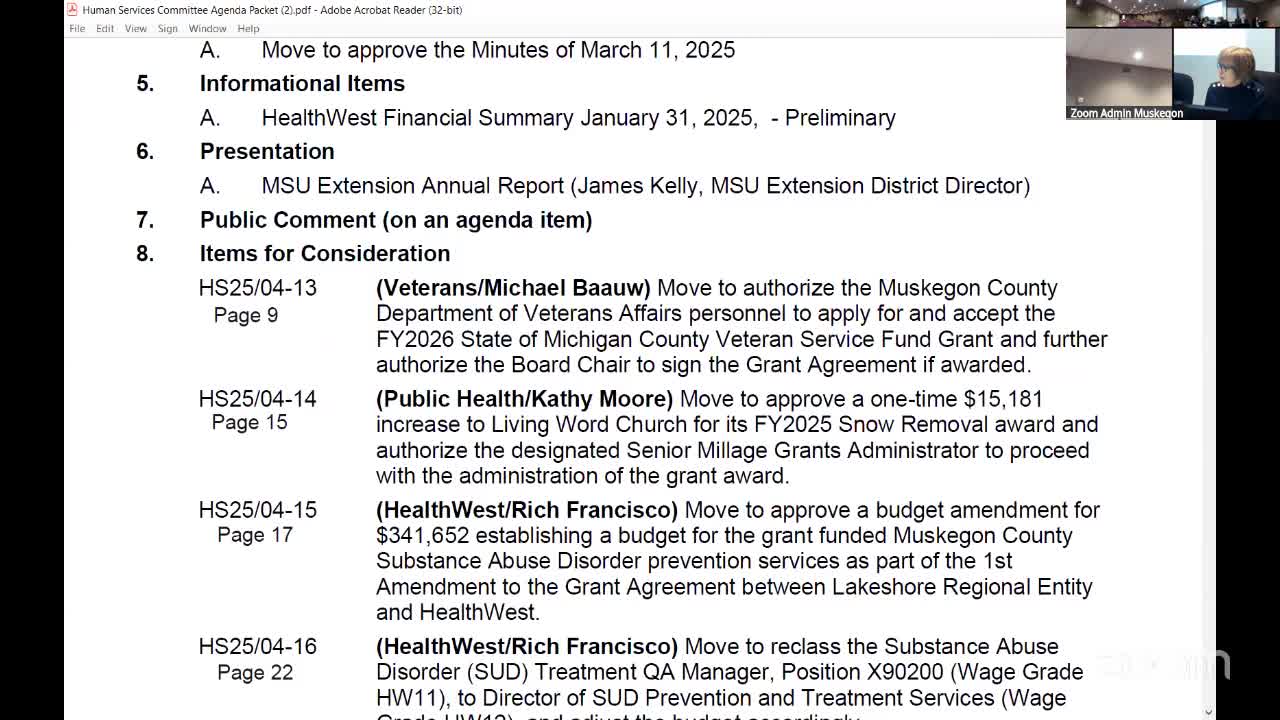
James Kelly, district director for MSU Extension, told the Muskegon County Human Services Committee on an annual report presentation that MSU Extension reached a little over 6,200 county residents through programming, consultations and other contacts in 2024. He said 4,692 people participated in specific extension programs and about 3,800 youth took part in 4-H activities.
Kelly said MSU Extension’s local team represents the university’s four main institutes and that the county receives regular quarterly reports and a monthly partners email to summarize activity. “We are the window into the university,” Kelly said, urging county leaders to bring local problems to Extension so the university can help identify resources.
The presentation highlighted the county’s food, agriculture, research and manufacturing facility (FHAR), a stage‑2 food processing lab on or adjacent to the Muskegon Community College property where entrepreneurs test products and equipment. Kelly said the facility served 27 businesses and provided 542 consulting and research hours in 2024; he said there is a waiting list and that the program is seeking funding to expand capacity.
Kelly described continuing investment in mental‑health training for youth, including an eight‑hour Mental Health First Aid Youth program delivered in schools, and noted a two‑person community nutrition team that delivered food safety (ServeSafe) and nutrition programming to schools, day cares and senior centers. He also described outreach on regenerative agriculture and a county‑level focus on fats, oils and grease (FOG) and its impact on wastewater and waste management.
The report noted 531 distinct programs offered to Muskegon County residents, 31 community coalitions and partnerships, and roughly 63,000 communications contacts across social media and web activity. Kelly also referenced a visit from Michigan State University President Samuel L. Stanley Guskewicz (Guskewicz), who toured local Extension outreach, and recognized staff and community partners involved in the Extension council.
Several commissioners asked about tours of the FHAR facility; Kelly said staff would arrange visits. The presentation concluded with brief commissioner discussion and no formal committee action on the report — it was provided as an informational item.
Kelly’s remarks and the written annual report were the primary sources for the figures and program descriptions presented to the committee.