Get Full Government Meeting Transcripts, Videos, & Alerts Forever!
Get email alerts on the Warners Pond Alternatives topic
No spam. Unsubscribe anytime.
Warner’s Pond task force presents three alternatives — management plan, dredging or dam removal — and gathers public feedback
Summary
The Warner’s Pond Task Force presented three alternatives for the pond’s future — recurring management, expanded dredging with a new disposal site, and full dam removal — outlined costs and uncertainties, and solicited public comment as it prepares a recommendation to the Natural Resources Commission.
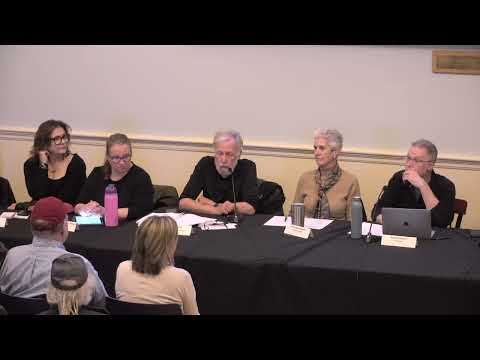
The Warner’s Pond Task Force presented three alternative visions for the pond’s future on Oct. 8, asking residents for feedback before it prepares a recommendation to the Town of Concord’s Natural Resources Commission.
Task force co-chair Christine Denaro, co-chair of the Warner’s Pond Task Force, opened the meeting saying, “Three alternatives will be presented tonight. They do not have to be mutually exclusive. No decisions will be made tonight.” The proposals presented were: a recurring pond management plan, an expanded dredging plan using a newly identified on-site disposal area, and removal of the Commonwealth Avenue dam to restore a free-flowing Nashoba Brook.
The task force said its work responds to long-running eutrophication at Warner’s Pond and to earlier town planning. Toby Berkman, facilitator and a staff member at the consulting nonprofit CBI, summarized the group’s mandate: review prior studies, test alternatives against criteria in the Envision Concord 2030 comprehensive plan, gather public input and produce a recommendation to the Natural Resources Commission.
The recurring management proposal, presented by Mark Howell of the task force’s management subgroup, calls for an operations-and-maintenance program run by town departments (natural resources, recreation and public works) with expanded community stewardship. Howell said the base scenario is intended to slow decline without a major capital project and to buy time for coordination with redevelopment of nearby parcels such as MCI Concord. The task force’s materials list incremental capital items in the base plan including $50,000 for boat-launch improvements and $20,000 for permits and vegetation-treatment analyses; Howell estimated the five-year cost for the base management scenarios A and B combined at roughly $600,000–$700,000, noting some items are already in town budgets. He emphasized that more intensive capital options — fish passage and engineered drawdown systems — were presented for information rather than immediate action.
Paul Baum, presenting the dredging subgroup’s proposal, said the approach revisits earlier dredging work after a 2022 bid returned a $9.2 million price. The dredging group identified a nearby Department of Corrections parcel called the “Northfield” as a potential disposal site for pumped, dewatered dredge material, which the subgroup says could dramatically reduce trucking and disposal costs. Baum described three dredge-area scenarios (the group’s report used a base figure near 35,800 cubic yards from earlier plans and expanded options that could increase open-water area). He said updated cost estimates from two engineering firms reduced the earlier $9.2 million estimate by roughly 30–50 percent but still left dredging as a multi-million-dollar investment.
Jeff Collins, representing the dam-removal subgroup, described removing the Commonwealth Avenue dam and restoring a channelized Nashoba Brook with about four acres of remaining open water and roughly 30 acres of emergent wetland in the former pond footprint. Collins said the subgroup has produced a roughly 30% design and that a full permitting and 100% design process would follow any decision to remove the dam. He listed benefits the subgroup expects if the dam were removed: restored stream connectivity, improved dissolved oxygen and cooler summer temperatures, expanded wetland habitat and reduced long-term dam-maintenance costs. He and other presenters noted a key dependency for some ecological benefits — restoration for diadromous fish — is removal of downstream barriers outside Concord.
The meeting included an extended question-and-answer period in which residents raised recurring concerns: costs and funding sources (including whether Community Preservation Act or previously approved dredging appropriations could be reallocated), effects on recreation (skating, paddling, fishing and scout activities), impacts on wildlife and habitat, the technical feasibility and schedule for drawdown, permitting needs and the reliability of cost estimates. Presenters repeatedly told the audience that the task force’s intention was to use the group’s evaluation criteria (drawn from Envision Concord 2030) and the public input collected at the meeting, on sticky-note boards and through an online portal to refine a recommendation to the Natural Resources Commission.
On specific technical points, presenters described the following clarifications recorded during the meeting: town appropriations previously authorized for dredging were $2,500,000 (approved at town meeting in 2020–2021) plus an additional $550,000 in 2023, while the 2022 bid for the full dredge came back at about $9.2 million; the task force has held 18 meetings since February 2024; the recurring management scenario’s short-term capital items included $50,000 for a boat launch and $20,000 for permits (Mark Howell); the dredging subgroup noted the Northfield disposal field could theoretically accommodate on the order of roughly 49,000 cubic yards of material, based on lidar and conceptual grading (Paul Baum); and the dredging subgroup’s updated cost estimates remain informed but preliminary and could vary by tens of percent.
Presenters and audience members also discussed drawdown as a technique to expose invasive aquatic plants: presenters said effective drawdown in comparable ponds (Bear Hill Pond in Harvard was repeatedly cited) requires 2–3 feet of seasonal lowering, pumping infrastructure in some communities and multiple years of repeated drawdowns to see sustained results. Task force members cautioned that Warner’s Pond’s existing control structures would not likely allow the multi-foot drawdown without infrastructure changes.
No formal decisions or votes were taken at the meeting. The task force stated the next steps: it will meet approximately three more times, synthesize the meeting and open-house feedback, refine the alternatives against the task force’s 24 subcriteria and publish a recommendation — including areas of agreement and disagreement — to the Natural Resources Commission. Members also encouraged residents to add written comments at poster stations at the meeting or submit feedback through the task force website.
The meeting revealed deep differences of opinion among residents; several speakers urged preserving the pond and its recreational uses and warned against irreversible change, while others, including speakers with ecological and fisheries backgrounds, argued that dam removal would restore stream connectivity and long-term ecological function. Presenters and engineers repeatedly described uncertainties in cost, permitting and ecological outcomes and urged further study in a formal design and permitting phase if any capital alternative is chosen.
The task force’s report materials and the full 59-page document referenced during the meeting are available on the Warner’s Pond Task Force web page; the group will include public comments gathered tonight in its deliberations before delivering a recommendation to the Natural Resources Commission.