Get Full Government Meeting Transcripts, Videos, & Alerts Forever!
Get email alerts on the Mci Concord Redevelopment topic
No spam. Unsubscribe anytime.
Consultants present preliminary analysis for MCI Concord redevelopment; wastewater, Route 2 and historic buildings flagged as key constraints
Summary
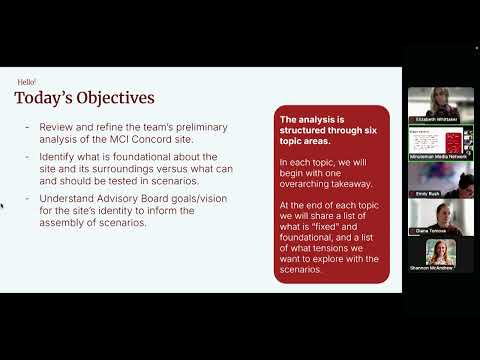
Consultants presented a preliminary analysis and public-engagement plan for redevelopment of the former MCI Concord (reformatory) site at an April 3 advisory-board workshop, urging further study of infrastructure, preservation options and traffic impacts before a preferred scenario is selected.
Consultants presented a preliminary analysis and public-engagement plan for redevelopment of the former MCI Concord (reformatory) site at an April 3 advisory-board workshop, urging further study of infrastructure, preservation options and traffic impacts before a preferred scenario is selected.
The analysis team told the board the site offers significant opportunities for mixed uses, trails and habitat restoration but also carries several fixed constraints and large, uncertain upfront costs. "In order to restore the [wastewater] facility to the 310,000 gallons a day, there is somewhere in the $25,000,000 range," said Alan Cathcart, Concord director of public works, summarizing the consultants' and the town's recent technical assessments. Consultants also noted the plant currently treats roughly 60,000–80,000 gallons per day and will require staged investments to expand capacity.
Why it matters: the wastewater plant, the condition of buried utilities and the state-regulated river buffer around Warner's Pond and the Assabet River strongly shape what can be built on the site and what costs will fall to the town or a developer. Consultants said those constraints will determine whether redevelopment can support substantial housing or must be targeted at lower-cost, mission-driven uses.
Key takeaways and constraints - Fixed elements: consultants said the cemetery on-site will remain and a 200-foot state river buffer limits buildable area near Warner's Pond and the Assabet River. Robin Bankert of Merge Architects said Concord draws about "1,000,000 visitors per year," a regional tourism context that shaped their thinking about open-space and cultural uses. The Bruce Freeman Rail Trail and nearby West Concord train station are also important, fixed regional connections. - Buildings and preservation: the team identified a small set of buildings (warden's house, a white row house and several administrative and large-span structures such as the former gym/school and intake building) as promising candidates for preservation or adaptive reuse, while characterizing many cellblock buildings as technically difficult to repurpose. The consultants recommended testing reuse scenarios in upcoming workshops. - Utilities and environmental issues: consultants described complex underground utilities, inactive sand beds used historically for on‑site wastewater disposal and the steam plant, which "would not be needed in the future" for typical redevelopment, according to the engineering team. Brian Kramer (Niche) noted three service buildings near the river — a wastewater enclosure, a warehouse and an auxiliary building — and said their future use is "to be determined." - Wastewater capacity and cost: town staff and consultants said the plant now operates below permit levels and would need phased capital work to reach the 310,000 gpd figure referenced in permit discussion. Cathcart and the consultant materials placed a full restoration in the roughly $25 million range, but stressed the work could be phased. - Transportation and safety: the team flagged the Route 2 frontage and an adjacent rotary as critical constraints. Consultants recommended coordinating the site's plan with an ongoing MassDOT plan to redesign the rotary and Route 2 approaches; consultants said the rotary experiences higher crash rates than statewide averages and that Commonwealth Avenue carries several times the ideal volume because drivers use it to bypass the rotary. - Economics and feasibility: Landwise Advisors reported that Concord's housing market and fiscal context will shape what the site can support. Consultants said the site's upfront prep costs — utilities, environmental permitting and potential preservation or demolition — will drive the scale of development needed for projects to pencil. They noted demand for housing that is affordable or sized for downsizing seniors but cautioned that the town's high residential tax bills and recent school and capital spending make large public subsidies politically sensitive.
Engagement and schedule Consultants described an outreach plan that includes a public pop-up at an April 19 town event, a first round of public workshops April 30, a scenarios workshop May 28, and a draft-plan review in late June (the slide deck listed a June 23 final meeting). They also showed a draft project website and said the outreach subcommittee would review the site prior to public deployment. The site URL was shown on a slide as "www.mci-conquer.org" (presenters labeled it a draft).
Board reaction and next steps Board members and staff asked detailed follow-ups on wastewater capacity, odors from the plant, what buildings were already identified to remain and the town's deed restrictions for nearby Junction Village. "There are ways to mitigate [odors]," the engineering team said, but added that in hot weather some nuisance odors are likely unless the plant receives more significant upgrades. The consultants emphasized they will continue technical study, coordinate with MassDOT and DCAM, refine cost estimates and assemble three scenarios for the board and public to evaluate.
No land-use votes or formal decisions were taken at the meeting; the session closed with a motion to adjourn, which was moved and accepted by voice.
Ending: consultants said they will take the advisory board's placemat exercise and public feedback into account as they prepare three scenarios for the board and public workshops in May and June.