Get Full Government Meeting Transcripts, Videos, & Alerts Forever!
Get email alerts on the Reserves Policy topic
No spam. Unsubscribe anytime.
Concord Finance Committee to draft reserves policy; recommends 15–25% stabilization target
Summary
The Concord Finance Committee discussed a proposed reserves policy to increase stabilization fund targets, asked staff to draft an outline for the committee, and flagged risks from potential state or federal aid cuts.
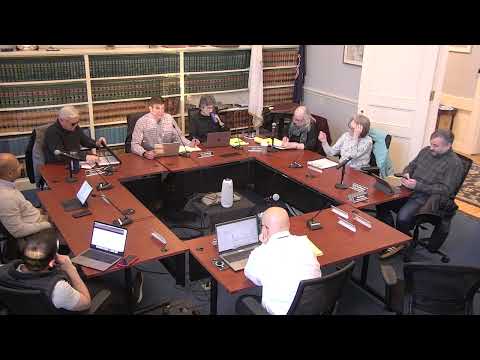
The Concord Finance Committee on March 27 discussed a draft reserves policy and agreed to develop a formal outline for the Select Board that would set targets for free cash and stabilization funds.
Committee members said the discussion was prompted by comparisons with peer towns and by upcoming capital needs. Eric Dahlberg, who led the presentation to the Select Board in advance of this meeting, said Concord’s combined free cash and stabilization funds equal roughly 11 percent of the town’s annual budget, and that $5,000,000 of that balance is already reserved for the middle school stabilization account. He noted that, excluding that set-aside, Concord’s free cash would be closer to 7–7.5 percent.
Dahlberg said the Committee recommended the Select Board consider adopting a reserves target in the range of 15–25 percent of the annual budget, with a working target of about 20 percent modeled after guidance used by other towns. He presented Lexington’s approach as an example: Lexington maintains roughly 7 percent free cash and allocates amounts above that into stabilization funds until its combined target (free cash plus stabilization) reaches 20 percent, with a general stabilization fund sized to cover an example 30 percent shortfall in non-property-tax revenues over a three-year period.
Committee members and staff discussed how stabilization accounts work in practice. Lindsay Liss explained the legal mechanics: establishing some stabilization funds now requires a majority vote to create and deposit funds, while taking money out typically requires a two-thirds vote (a recent change in state law noted in the meeting). Town staff member Anthony (last name not specified in the record) explained that withdrawals from stabilization funds also require town meeting approval and described the timing of free-cash certification (typically in the fall) and how that timing affects transfers at the subsequent town meeting.
Members also discussed the middle school stabilization account, which holds about $5,000,000 to smooth a known near-term spike in debt service as elementary-school borrowing rolls off. Committee members asked whether the warrant article amount for this year (initially reported as $500,000) matched the earlier discussion; town staff and other members clarified the intended transfer is $1,000,000 and that the final dollar amount is still under active review.
Several members urged that a formal reserves policy be written as a range (for example, a floor and ceiling) rather than a fixed percentage to provide flexibility for year-to-year variations. Anthony said the Department of Revenue (DOR) offers workshops and technical assistance on best-practice policies and that the town plans to start a DOR-led policy-refresh process in June.
Committee members also discussed potential external revenue risks that make reserves important: staff noted Concord receives roughly $4,000,000 in education aid and about $6,000,000 in total state aid; the meeting referenced about $680,000 in federal ESSA funding to the Concord Public Schools and roughly $500,000 at the regional level that could be sensitive to federal decisions. The schools’ superintendent told the Committee earlier that loss of those federal funds “would be devastating,” a point committee members cited as an example of why a stronger reserve posture matters.
The Committee asked Eric Dahlberg to prepare a one-page outline of a reserves policy that frames the proposed targets, definitions of free cash and stabilization funds, governance steps (how and when to move funds), and example dollar scenarios using the town’s budget. Dahlberg said he would bring that outline to the Finance Committee’s next meeting for review and then forward a draft to the Select Board for their consideration.
The committee did not adopt a formal policy at the March 27 meeting; members treated the work as preliminary and advisory to the Select Board and as input to the town’s broader policy refresh to be undertaken with DOR assistance.