Get Full Government Meeting Transcripts, Videos, & Alerts Forever!
Get email alerts on the Community Preservation Policy topic
No spam. Unsubscribe anytime.
Concord CPC debates policy to reopen applications if unallocated funds remain after first awards
Summary
The Town of Concord Community Preservation Committee discussed a draft policy on March 11 to allow reopening the application cycle if unallocated Community Preservation funds remain after the first round of awards.
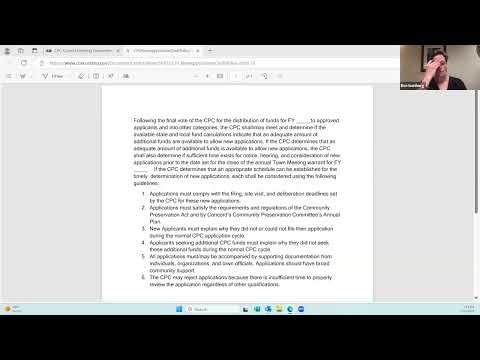
The Town of Concord Community Preservation Committee discussed a draft policy on March 11 to allow reopening the application cycle if unallocated Community Preservation funds remain after the first round of awards. The proposal, authored by John Kratzley and Sue Felsch, would require the committee to determine whether sufficient additional funds and time exist to accept new applications before the close of the annual town meeting warrant or filing deadline.
The matter drew detailed debate over three main questions: whether the committee’s review should be mandatory or discretionary (the draft’s “shall or may” language), whether reopening should accept only new applications or also permit previously-filed applicants to request additional funds, and how the committee should judge whether an amount of leftover funds is “adequate,” “sufficient” or “significant.” John Kratzley, Select Board appointee, explained the central choice: choosing “shall” would obligate an annual review while “may” would make reopening optional.
Committee members discussed operational details the draft attempts to cover. The proposal would require the CPC to confirm (1) that an adequate amount of additional funds exists and (2) that adequate time is available for notice, hearing and consideration of any reopened applications prior to the annual town meeting warrant closing. The draft also listed six guidance points for evaluating reopened applications; members proposed simplifying or combining items (for example, merging a requirement for compliance with the Community Preservation Act and the Concord Community Preservation Annual Plan with an ordinary-application compliance statement).
Several members urged limiting the reopening to new applications rather than allowing existing applicants to increase their original requests. “To keep it clean… I would not extend any existing application into this policy,” said Eve Eisenberg, Select Board appointee. Other members warned reopening could encourage applicants to ask for larger amounts if they expect a second chance; Sue Felsch said she feared future committees might see the policy as an invitation to “ask profligately for more money.”
Committee members also debated the timing reference in the draft — whether to tie the reopening test to the town’s filing deadline or to the statutory close of the town meeting warrant. Anne (staff member) recounted the recent timetable used as an example in discussion: “The filing deadline was February 5. The closing was February 19.” Members proposed phrasing that would let the CPC consider both the filing deadline and the warrant close when judging whether there is sufficient time to review reopened applications.
Members sought to preserve the existing special out-of-cycle process (described in their procedures manual, page 13) for land purchases and true emergencies. Several participants suggested the new language function as an addendum or codicil to the regular cycle — a narrowly tailored mechanism to handle the unusual situation the committee faced this year when unexpectedly large unallocated funds remained after the first round.
The committee discussed outreach and process-improvement steps to reduce the recurrence of the situation: earlier advertising to nonprofits and town committees, soliciting letters of intent before the formal deadline to preview demand, and considering whether the annual application schedule should shift later in the year. Diane Proctor, Select Board appointee, urged against making late applications a routine option and said any reopening should be reserved for “exceptional circumstances.”
No formal motion or vote was taken at the meeting. Members asked John Kratzley and Sue Felsch to revise the draft language to reflect the committee’s input, with Sue agreeing to propose merged wording for certain guidelines and John and staff to identify where the new policy should be placed in the CPC procedures manual. The item will return for further review at the committee’s next meeting in April.
The meeting included minor administrative items (minutes and website navigation) and a brief discussion of outreach; committee members thanked Kratzley and Felsch for preparing the draft and agreed to circulate a revised version before the next meeting.