Get Full Government Meeting Transcripts, Videos, & Alerts Forever!
Get email alerts on the Electronic Voting topic
No spam. Unsubscribe anytime.
Concord study committee debates routine use of electronic clickers at Town Meeting; motion tabled for revision
Summary
The Town Meeting Study Committee on March 10 discussed a Select Board preliminary motion to adopt electronic clickers as the routine vote-counting method at Town Meeting and tabled a committee vote to allow the moderator and Select Board to refine the motion language.
The Town Meeting Study Committee on March 10 discussed a Select Board preliminary motion to adopt a rule that would make electronic “clickers” the routine method for taking votes at Town Meeting, and tabled further action to allow revision and additional review.
The Select Board, the committee was told by Town Moderator Carmen, voted to “make a motion … to establish a rule of the meeting that clickers will be used routinely to take, votes under articles.” Carmen said that if the Select Board’s preliminary motion is presented at Town Meeting it would be discussed on the floor and require a majority vote to adopt for that session.
Why it matters: Committee members said electronic voting would make counted votes faster, create clearer vote records and improve accessibility, while others warned against removing too much discretion from the moderator and urged clear limits so the technology is not used for routine, uncontested items.
Committee discussion and next steps
Phil Swain, a committee member, offered revised language intended to narrow use of clickers: “to be used clickers on all but all but routine and noncontroversial matters where it would appear there is no substantial doubt as to the outcome.” That wording sought to reduce ambiguity about when electronic voting would be used and to ensure clickers would apply more broadly than only final article votes.
Moderator Carmen read a draft FAQ she had prepared explaining how the proposed rule would work. In part she said: “If the motion is approved, votes on main motions and amendments out under articles generally will be taken using clickers unless the absence of discussion by the meeting makes clear that voters are broadly in support of the motion so that a faster vote by show of paper placards is appropriate.” Carmen also noted the committee should perform a few test votes before town meeting so voters understand how the devices work.
Committee members debated two tensions: whether to leave routine decisions to moderator judgment (and thus preserve flexibility) and whether to remove that discretion by prescribing use in a written rule. Parashar Patel and others urged clear, narrow language; other members, including Carter and Eric Moore, said they supported routine use but wanted the motion text clarified and circulated before a vote.
Outcome and assigned follow-up
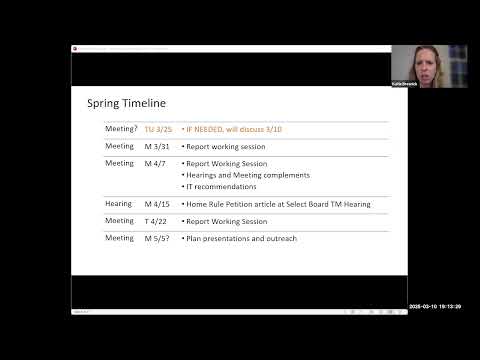
Rather than vote on Swain’s amendment, the committee voted to table the motion and asked Carmen to circulate a cleaned-up, single-text motion for the committee packet. Carmen agreed to provide the draft language for the next meeting so the committee can vote on an up-or-down motion. The Select Board’s preliminary motion is already in the Select Board packet and is scheduled for public hearings leading up to Town Meeting; the committee discussed coordinating a dry run of the committee’s presentation at the Select Board hearing on April 15.
Context and technical considerations
Members raised practical items the town must resolve before wider use of clickers: budgeting to purchase or rent equipment, Wi‑Fi and AV reliability at the high school venue, distribution and test votes before the meeting, and the need for short public-facing guidance on how electronic voting will be used. Committee members noted that a prior town survey showed broad public support for clickers (committee members cited an internal figure of 83% in favor of clickers in a survey), and that the Select Board had already voted to place a preliminary motion on its warrant.
What the committee did not decide
The committee did not adopt a bylaw or finalize any binding rule. Members agreed not to attempt to bind a future moderator by bylaw at this time; instead the group asked for a precise motion text so members can take an explicit up-or-down vote at a future meeting.
Looking ahead
The committee asked Carmen to circulate the proposed motion text and agreed to revisit the item at the next scheduled meeting. Members also discussed running test votes at Town Meeting so voters can see how clickers display results, and flagged that Select Board public hearings (April 15) and Select Board meetings (April 3) will be opportunities for public review of the motion.