Get Full Government Meeting Transcripts, Videos, & Alerts Forever!
Get email alerts on the Land Use Mci 2229 topic
No spam. Unsubscribe anytime.
Candidates at Concord forum split on strategy for MCI land, stress net-revenue, housing and state role
Summary
At a Concord Business Partnership forum, selectboard candidates debated redevelopment of the state-owned MCI campus and nearby 2229 Main Street, stressing the need for the town to secure net-positive revenue, pursue workforce housing, resolve wastewater and ownership issues, and coordinate multiple advisory committees and state agencies.
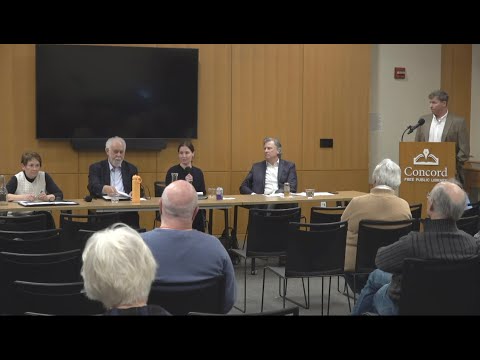
At a Concord Business Partnership forum on candidate races for the Town of Concord select board, candidates described the state-owned MCI campus as a “once-in-a-generation” land-use opportunity and offered different approaches for securing revenue, housing and town control.
The forum’s moderator, Tyler Spring, asked how candidates would follow recommendations from the MCI advisory committee and other town panels to achieve “the optimal outcome” for the MCI parcel and related town-owned properties. Mary Hartman, chair of the Concord Select Board and the forum’s incumbent candidate, said she is awaiting the advisory committee’s final recommendations and emphasized the town’s need to ensure any redevelopment is “net revenue positive.”
“The overarching goal of the MCIA parcel is to be net revenue positive,” Hartman said, adding that wastewater and the transfer of the existing MCI wastewater treatment plant from the state are central pieces of any deal. She said the town needs both community input and consultant analysis before a formal path forward.
Elizabeth Akers Moore, a business owner and member of the MCI advisory committee’s legal-and-governance subcommittee, urged the town to press the state more forcefully and to examine a legislative option that could let the state enter a sales partnership with Concord. She said Concord does not control the land and that constraint should shape strategy: “We don’t control the land, and it’s great to hear what everyone wants to do, but we need to be more forceful and advocate for the town more strongly.”
Paul Baum, who said he has been involved with 2229 Main Street oversight, argued the select board must maintain a high-level view across all large town properties, coordinate advisory committees, and remove ‘‘blockages’’—zoning, bylaws and practices—that impede mixed-use development. He called for consideration of municipal–private partnerships and land-lease models if the town acquires property.
Joel (Joe) Lauren said Concord should pursue multiple expert analyses and RFPs, compare alternatives, and phase redevelopment so each step is financially defensible. Candidates repeatedly raised housing mix as a priority: Hartman favored workforce housing for people who work in Concord; others noted state guidance that the MCI reuse should include affordable housing and sustainability measures.
Candidates also flagged practical constraints: the land is state-owned and overseen by the Division of Capital Asset Management (DCAM); MassDOT work at the rotary could affect access and traffic; and environmental liabilities and liens complicate any transfer. Several candidates said timelines for large projects are measured in years and stressed the need to coordinate with state agencies and advocacy at higher levels.
The discussion referenced other town projects and committees—2229 Main Street, the Community Preservation Committee, the finance committee and the Economic Vitality Committee—as part of a broader fiscal and planning strategy. Candidates repeatedly cautioned that commercial development alone will not immediately erase fixed costs such as school-related debt service.
The forum ended the land-use exchange with a mix of priorities—revenue, housing mix, environmental and legal risk management, infrastructure (especially wastewater), and active selectboard leadership over interrelated committees and development projects.