Get Full Government Meeting Transcripts, Videos, & Alerts Forever!
Get email alerts on the Mental Health Response topic
No spam. Unsubscribe anytime.
Champaign council directs staff to launch 24/7 mental‑health emergency response unit
Summary
The Champaign City Council gave staff direction to implement a city-run, 24/7 mental‑health emergency response division after a detailed presentation on local call volumes, models and costs; the plan would add a licensed clinical social worker, four advocates and one‑time equipment and supportive-service funding totaling about $915,000.
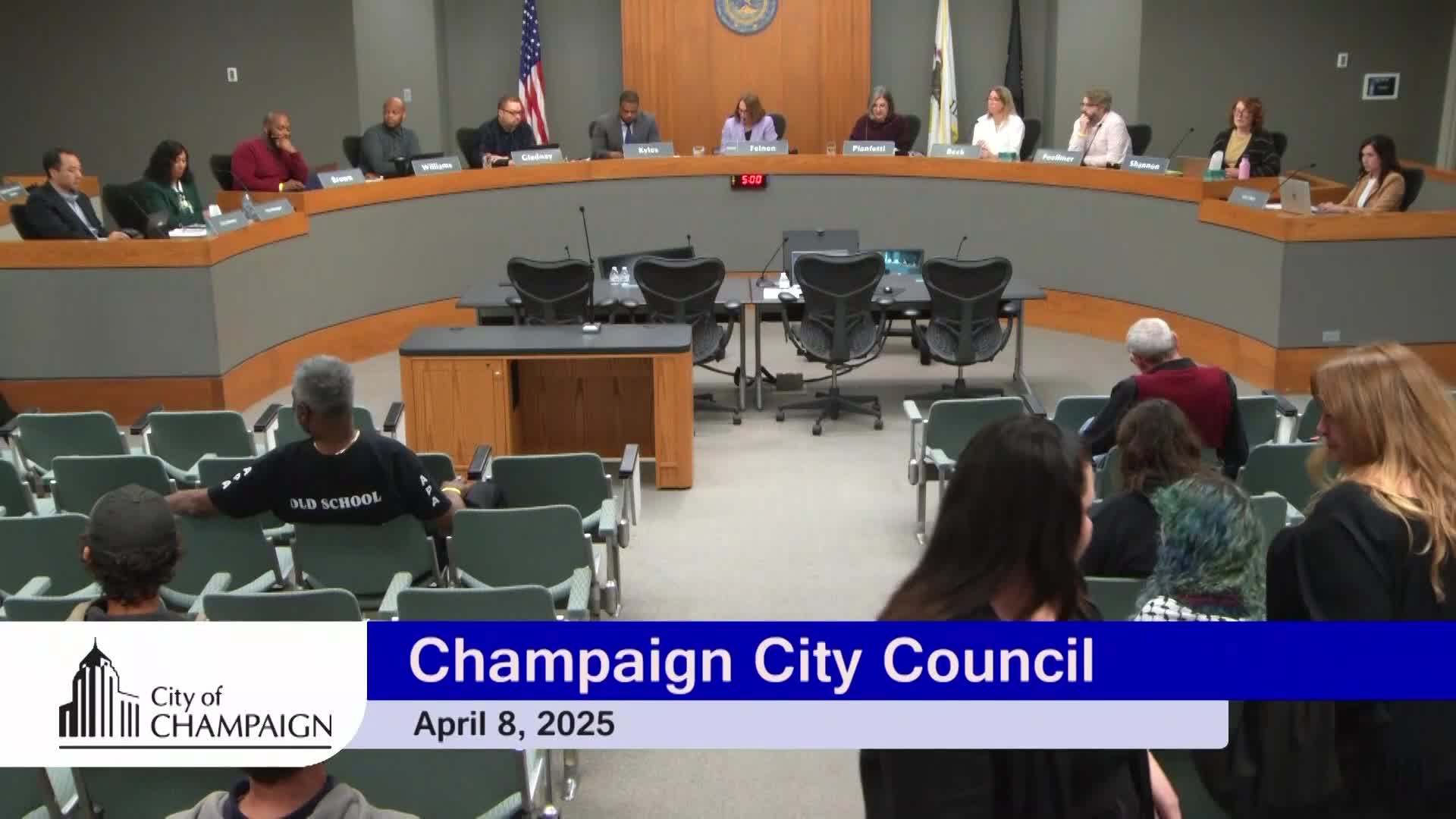
The Champaign City Council on April 8 directed staff to implement a city-run mental‑health emergency response model that would pair licensed clinicians and advocates with first responders to respond to mental and behavioral health crises.
The measure grew out of a presentation from Rachel Joy, director of the Equity and Engagement Department, who told the council the goal is a racially equitable, trauma‑informed and language‑accessible co‑responder program operating 24 hours a day. Joy said the proposal would establish a new division housed in her department with one licensed clinical social worker (LCSW) to manage the unit and four advocates to respond in the field and provide case coordination and follow‑up.
The plan matters, Joy and public safety officials told the council, because mental and behavioral health incidents make up a large and growing share of emergency calls. “From 01/01/2020 to 03/11/2025, the Champaign Police Department responded to 80,251 calls for service with mental and behavior health crisis being a significant part of our workload,” Police Department staff said during the presentation, citing department call records. City staff described frequent calls to several care facilities — including Strides, The Pavilion and Eden supportive living — that together have pushed local police resources.
City staff proposed a staffing, training and equipment package with recurring and one‑time costs. The total estimated first‑year cost is approximately $915,000, including recurring personnel and training expenses and one‑time purchases such as vehicles and a $150,000 supportive‑services fund for needs advocates identify on scene. The timeline presented calls for hiring and recruitment work to begin immediately, job descriptions finalized by late August 2025, and the division fully staffed and responding by late September 2025; staff also said an earlier implementation milestone — hiring and initial launch work — could begin as soon as late May 2025 if the council approved the direction.
Ralph Caldwell, director of Metcad (the regional 911 dispatch center), briefed the council on state law and funding dynamics. Caldwell summarized recent Illinois public acts related to mobile crisis and co‑responder models, saying the Community Emergency Services Act (Public Act 102‑0580) and a later measure (Public Act 103‑0645) tasked the state with creating mobile crisis capacity and training standards but that statewide implementation has lagged and the July 1, 2025 timeline is unlikely. Caldwell recommended local action rather than waiting for full state rollout and noted pending bills and grant programs the city will seek to track for potential funding.
Elected officials pressed staff on safety, staffing and operational details. Council member Gladney asked how safety would be assured for advocates and the LCSW; Joy said advocates would follow protocols and, when responding alongside police or fire personnel, those responders would “clear the scene for safety.” Council member Williams asked how dispatch would decide when to send the co‑responder unit; Metcad staff and Joy said units could be paged automatically for certain CAD call types and that the program will use quality assurance reviews to calibrate dispatch criteria over time.
Several council members and the mayor voiced support for the model while raising caveats about staffing levels and mission creep. Council member Beck urged the city to conserve the division’s focus on community crisis response and warned to “beware of mission creep.” Multiple council members recommended early evaluation checkpoints to assess whether the number of advocates and clinicians is sufficient for overnight and holiday peaks; city data presented by staff showed crisis calls spike evenings into the overnight hours and on weekends.
Public commenters at the meeting strongly backed the proposal. Community member Martel Miller, who works with people experiencing homelessness, said local responders need alternatives to arrest or hospitalization and urged quick implementation. Student and social‑work trainee Maya Novick asked what supports advocates would have for their own mental health while serving in stressful roles.
Next steps described by staff include finalizing job descriptions and recruitment, negotiating service agreements with local providers (including Rosecrans, which is planning a crisis triage center), meeting with care facilities that generate high call volumes, and creating a community advisory group. Staff also said they would pursue state or federal grants — including an emergency co‑response grant program under consideration in the Illinois legislature — and would coordinate with Rosecrans’ planned triage center, which staff expect may open in fall 2025.
The council’s direction was phrased as staff implementation (not a finalized ordinance). Following discussion, council members voted in favor of directing staff to implement the proposed mental‑health emergency response model.
Votes at a glance: the meeting record also shows routine approvals earlier in the session. Electors at the annual township meeting elected Kyle Patterson as moderator by voice vote; the assembly approved the 2024 annual town meeting minutes and placed the supervisor’s annual financial report on file by voice vote. The Town Board approved regular meeting minutes from March 4, 2025, and put the February 2025 summary of expenditures on file. A flooring contract for the Strides shelter was discussed and deferred for a special meeting to resolve outstanding questions about asbestos and local/union labor preferences.
What’s next: staff will begin hiring and meetings with providers if directed, with a staffing goal of posting and filling positions in late summer 2025 and an aim to have trained advocates and the LCSW in place and responding citywide by late September 2025. The council asked that staff return with early evaluation metrics and be prepared to adjust staffing if demand outpaces capacity.
(Reporting based on public presentation, staff slides and council Q&A at the April 8, 2025 City of Champaign study session.)