Get Full Government Meeting Transcripts, Videos, & Alerts Forever!
Get email alerts on the Meeting Procedure topic
No spam. Unsubscribe anytime.
Concord committee approves minutes, backs broader use of consent calendar and weighs grouping high‑interest articles
Summary
The Town Meeting Study Committee approved minutes, voted to recommend maximizing use of the consent calendar and debated, then recommended where practical, grouping high‑interest articles on the same night to make attendance easier for voters.
The Town Meeting Study Committee on Feb. 11 approved minutes from its Jan. 28 meeting, voted to recommend that the moderator and Select Board maximize use of the consent calendar, and recommended — where practical — that high‑interest articles be scheduled together so voters can attend just the portions of Town Meeting that matter most to them.
Why it matters: The committee’s recommendations aim to make Town Meeting more efficient and to reduce the time burden on voters while preserving deliberation. The consent calendar is a routine tool that lets the meeting approve multiple noncontroversial articles en bloc; expanding its use could shorten meeting time. Grouping high‑interest articles is meant to make it feasible for citizens with limited time to participate meaningfully in the issues that most affect them.
Minutes approved
The committee voted to approve minutes from the Jan. 28 meeting. During a roll‑call segment the committee recorded affirmative votes from Keith Bergman, Kristen Haggerty, Alice Kaufman, Eric Moore, Parashar Patel, Phil Swayne and Chase Thompson; two members (Katie Bresnick and Eric Benoit) were recorded as absent. The motion carried.
Consent calendar motion
After discussion of how the consent calendar is prepared (the moderator prepares a proposed consent calendar for the Select Board to move at Town Meeting), a committee member moved that the committee recommend continuing to maximize the use of the consent calendar. The motion was seconded and passed by the committee; committee members discussed that the moderator and Select Board would still leave controversial items available to be taken off the calendar by voters if requested.
High‑interest articles: pros, cons and a recommendation
The meeting held an extended debate about whether the committee should recommend scheduling high‑interest articles on a single night so residents could choose to attend a single session and still weigh in on matters important to them. Supporters said consolidating high‑interest items would help parents and other residents who cannot attend multiple nights. Opponents said such a rule could conflict with staff availability, put pressure on the moderator to compress deliberation, and risk sidelining important budgetary or technical matters that do not appear controversial in advance.
After deliberation the committee voted to recommend that, where practical, the moderator should attempt to schedule high‑interest articles in the same session to make it easier for voters to participate selectively. Members emphasized the recommendation includes the qualifier "where practical" to preserve moderator discretion and to account for staff and departmental scheduling constraints.
Report timeline and audience
Committee members agreed on a production timeline for the committee’s final report: a rough cut of the full report in early April, an edited draft later in April, and print‑ready materials in late April/early May to meet the Town Meeting briefing‑book deadline (May 6). The group discussed producing an executive summary suitable for the briefing book and a longer appendix online. Committee members divvied up sections — accessibility, meeting culture, communications, and voting procedures — and will submit drafts for compilation.
Public comment and closing
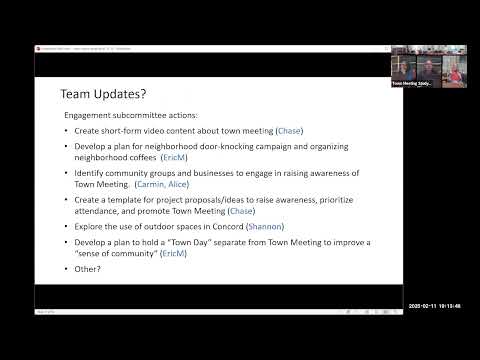
A member of the public, David Allen, urged the committee to prioritize “quality of attendance” and representativeness rather than simply increasing headcount at Town Meeting. The meeting closed with assignments and the expectation that committee members will circulate drafts ahead of the March and April meetings.