Get Full Government Meeting Transcripts, Videos, & Alerts Forever!
Get email alerts on the Electronic Voting topic
No spam. Unsubscribe anytime.
Concord committee recommends routine use of electronic clickers; vote passes 6-3
Summary
The Town Meeting Study Committee voted 6-3 to recommend routine use of electronic voting clickers for votes on warrant articles, citing privacy and vote accuracy while members raised concerns about cost, moderator discretion and effects on deliberation.
The Town Meeting Study Committee voted 6–3 on Jan. 28, 2025, to recommend that electronic voting clickers be used routinely for votes and motions to approve articles on the warrant.
Committee members led a long discussion over whether clickers should be used for all substantive warrant-article votes, only for secret ballots, or at the moderator’s discretion. Supporters said clickers protect voter privacy and improve vote accuracy; opponents raised questions about cost, potential effects on deliberation and the need to preserve moderator control over meeting procedure.
The vote followed extended discussion about how to evaluate the devices after their first use in 2024. Several members urged a short survey and a moderator-led debrief after town meeting 2025 to measure impacts such as perceived privacy, time savings and effect on the meeting experience. At the Committee’s meeting, staff reported an initial vendor estimate of roughly $18,000 to lease 1,300 clickers; the group was also told the town manager had identified $33,000 in American Rescue Plan Act (ARPA) funds that could be applied to clicker costs.
During debate, members described three practical options: (a) leave usage to the moderator’s discretion; (b) recommend routine use for votes on articles; or (c) require clickers for most votes. The motion that carried asked the committee to recommend routine use for votes and motions to approve warrant articles, with understanding that the moderator retains procedural authority at town meeting.
Opponents warned that using clickers for every vote could slow some noncontroversial procedural items (for example, minutes or minor motions) and that a one‑year pilot and post‑meeting evaluation were more appropriate. Proponents replied that much of the vendor cost is a one‑time setup and that partial use (for a single night) would not materially reduce vendor setup costs.
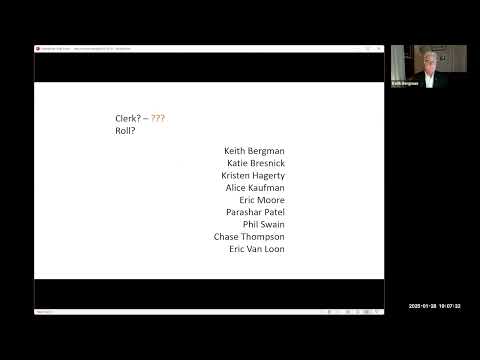
At roll call the committee recorded the following votes: Keith Bergman (yes), Katie Bresnick (yes), Kristen Haggerty (no), Alice Kaufman (no), Eric Moore (yes), Parashar Patel (yes), Phil Swain (no; said he supported clickers but would vote no on the motion), Eric Van Loon (yes). The committee reported the final tally as 6 yes, 3 no.
The committee asked staff to notify the town manager and the moderator of the recommendation and to proceed with procurement timing so that devices would be available for the 2025 town meeting if the town chooses to lease them. Committee members requested that the committee’s final report include both the majority recommendation and brief dissenting statements explaining the no votes.
The committee also discussed evaluation criteria for post‑meeting review: whether voters preferred clickers, whether privacy concerns were reduced, whether time per vote changed, and explicit cost‑benefit questions to include on a post‑meeting survey. Several members suggested the moderator ask a show‑of‑hands question at the meeting’s end in addition to a written survey to gather immediate feedback on the clicker experience.
Implementation details — including the number of units to lease, lease vs. purchase options, and scheduling for vendor setup and takedown — were left to the town manager and staff. The committee emphasized the recommendation was advisory; the moderator and Select Board retain authority over the final operational and budget decisions.
Ending: The committee’s recommendation and the recorded dissenting views will be reflected in its forthcoming report. Staff will follow up with procurement and scheduling details and will design a short post‑meeting survey tied to the evaluation criteria the committee discussed.