Get Full Government Meeting Transcripts, Videos, & Alerts Forever!
Get email alerts on the Dam Removal topic
No spam. Unsubscribe anytime.
Warner's Pond dam-removal proposal draws detailed scrutiny; task force forms small reconciling group
Summary
At a Jan. 16 Warner's Pond Task Force meeting, members spent the bulk of the session reviewing the dam‑removal proposal, debating ecological, recreational and cost uncertainties. The group voted to form a small reconciling subgroup to draft compromise language and resolve outstanding technical questions before the public forum.
The Warner's Pond Task Force on Jan. 16 devoted most of its meeting to detailed review of the dam‑removal alternative, airing scientific, recreational and cost concerns and voting to create a small subgroup to reconcile disputed language.
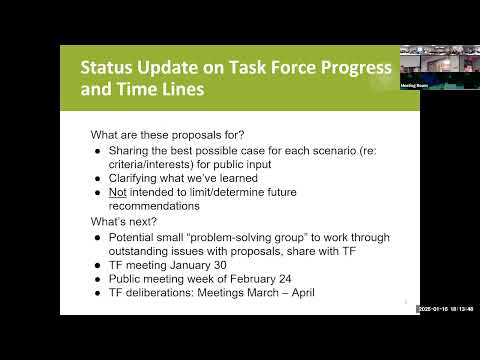
The task force — chaired by Chris Denaro, who opened the meeting — examined language in a draft proposal prepared by consultants and discussed where the text should be clarified or hedged to reflect acknowledged uncertainties. Rachel Fried of consulting firm CBI told the group that the proposals were intended as “best‑case scenarios” and that “the proposals are not the recommendation. The proposals do not represent your deliberations,” language she urged members to treat as explanatory for the public materials.
Members pressed consultant text on several specific points. Speakers asked that claims about greenhouse‑gas benefits be softened as “marginal” and qualified; that statements about biodiversity be framed with caveats where evidence is mixed; and that descriptions of fish passage and cold‑water species be tied explicitly to the evidence and to upstream connectivity. Multiple members urged clearer, consistent cost reporting across all alternatives and a single annualized dollar figure in today’s dollars for comparability. Rachel Fried said consultant teams would attempt to harmonize the cost lines and supporting citations.
The task force also debated future channel geometry and access to Scout Island. Engineering graphics supplied by the consultants show a likely post‑removal channel path and a cross section indicating shallow majority depths (1–3 feet) immediately after dam removal, with potential local incision over time. Members noted the illustrations were hard for lay readers to interpret and asked for clearer captions, a legend tying transects to the map, and a short “what to expect now vs. after initial floods vs. long term” narrative.
After discussing whether a smaller group could resolve remaining language disputes efficiently, member Bill Tremeza moved to form a reconciling subgroup; Paul (task force member) seconded the motion. The task force agreed by voice vote to create the subgroup and identified several preliminary members, with chairs and staff to confirm final membership.
The small group will be asked to draft compromise text on ecological impacts (plants and wildlife), fisheries/fish passage assertions, recreation and access (including Scout Island landings), and cost estimates and sources. Consultants will provide flagged slides showing unresolved language and suggested alternate wording. Members emphasized that the subgroup should return recommended language to the full task force for review and that any unresolved item be flagged, not suppressed, in the public materials.
The task force scheduled follow‑up work and asked members to send written comments to the consultant team ahead of the next task force meeting so staff could incorporate edits into the public draft.
Ending: The task force left the proposal in place for more editing rather than adoption; the subgroup will attempt to resolve core disagreements and report back before the public workshop later that month.