Get Full Government Meeting Transcripts, Videos, & Alerts Forever!
Get email alerts on the Electronic Voting topic
No spam. Unsubscribe anytime.
Town meeting subcommittee backs ARPA-funded pilot to lease electronic voting clickers
Summary
The Town Meeting Study Committee discussed a plan to lease electronic voting "clickers" with ARPA funds for a pilot at the June 1, 2025 town meeting, outlining evaluation goals and budget questions before the Select Board consideration on Jan. 27.
The Town Meeting Study Committee on Jan. 13 discussed a plan to lease electronic voting “clickers” for the June 1, 2025 town meeting using American Rescue Plan Act funds, and outlined how the committee and staff expect to evaluate a pilot.
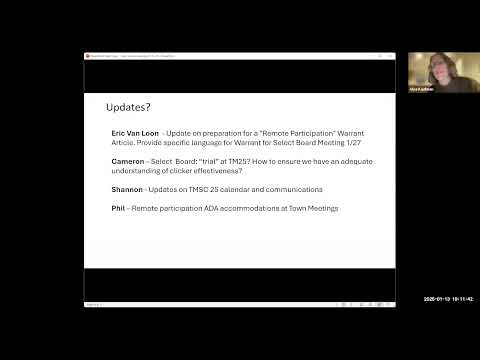
Committee members said the town manager’s weekly operations report identified ARPA money for a lease. "ARPA funds have been identified to conduct a pilot program to lease clickers for Town Meeting on 06/01/2025," Cameron said during the meeting. The Select Board is scheduled to consider related items on Jan. 27, committee members said.
Why it matters: Electronic voting could speed secret ballots and change how votes are taken at Town Meeting, but committee members stressed the pilot should measure user experience, possible impacts on meeting pace and the longer-term budget implications.
Committee discussion focused on evaluation and costs. Kristen Haggerty said the pilot’s success should be judged by user experience and participation, and asked that the Select Board consider tradeoffs if the town is asked to continue electronic voting after the pilot. "Well, it's gonna cost us $50,000," Haggerty said when raising long-term budget concerns. The committee also discussed shorter-term leasing costs; one committee member said they had heard a figure of about $14,000 for leasing this year. The transcript records both figures as statements raised in discussion; the committee did not approve a final budget in the meeting.
Members noted an earlier, non‑unanimous committee vote to recommend use of clickers: "we did have a vote ... to recommend use of clickers; it's not an unanimous vote," Eric Moore said. Several members urged the Select Board and town staff to publish how the pilot will be evaluated and what metrics will be collected, including a post‑meeting user survey and measures of whether the technology affects the pace of votes or participant satisfaction.
Carmen, the town moderator, said the decision to use electronic voting at a given meeting often rests with the moderator but can be changed on the floor: "if the moderator prescribes a particular means of taking a vote, it will remain open to anyone on the floor of the meeting to make a motion to take the vote in a different manner," she said.
The committee did not take a formal vote on ARPA funding or lease terms at the Jan. 13 meeting. Members said the Select Board and town staff will need to clarify costs, leasing versus purchase options, and whether the pilot will include guidelines about how frequently clickers should be used. The town manager’s report and the Select Board agenda on Jan. 27 were identified as the next steps for formal action.
Ending: Committee members asked staff to prepare clearer cost information and an evaluation plan for the Select Board and signaled they will return to define recommended guidance for use of clickers after the pilot and after seeing the Select Board’s decision.