
Bozeman police outline staffing shortfall and options after mill-levy defeat
Get AI-powered insights, summaries, and transcripts
Subscribe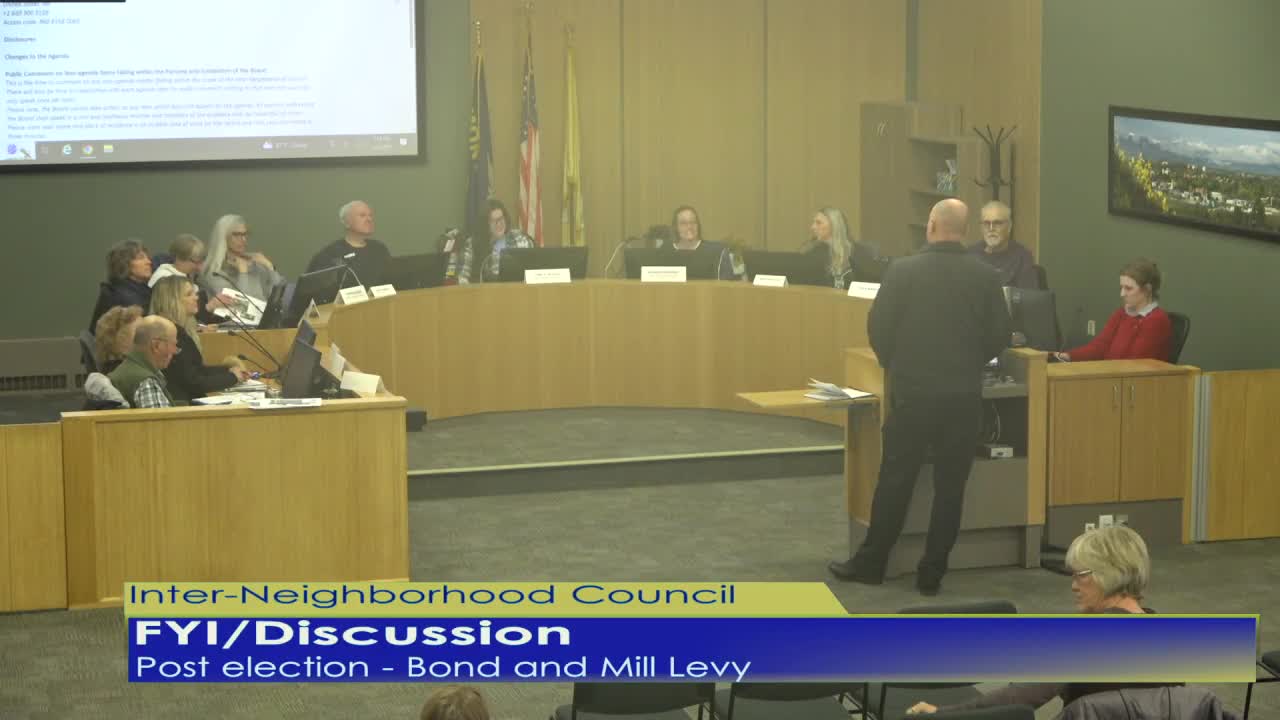
Summary
Police Chief Jim Veltkamp told the Bozeman Inter Neighborhood Council that the department remains understaffed after a failed mill levy and that city leaders approved an operational and staffing study to identify efficiencies and options including technology, reprioritizing responses and exploring funding tools such as impact fees or bonds.
Bozeman Police Chief Jim Veltkamp said the department remains behind its recommended staffing levels and reiterated that the failed mill levy does not end the city’s need to expand public-safety capacity.
“One of our primary goals and for any police department is sustainable funding. So we’ve gotta have the funding,” Chief Jim Veltkamp said, describing the mill levy as one funding option among others.
Veltkamp told the Bozeman Inter Neighborhood Council the police had proposed adding six officers per year for five years; that plan was intended to phase in staffing rather than hire 30 officers at once. He said the department’s most recent staffing plan had called for about 79 officers by 2021; the department is authorized for 76 and remains short a few officers. Veltkamp said hiring and training take many months — more than six months before a new officer can work independently — and that filling vacancies has become more difficult in recent years.
To address gaps, Veltkamp listed several strategies the department is pursuing: an externally conducted operational and staffing study (a contract the city commission approved the previous week), reprioritizing lower-priority responses, using civilian staff or online reporting where appropriate, exploring targeted technology such as AI-assisted report drafting, and testing beat changes and other efficiency measures.
“We’re just starting up an operational and staffing study with an external company. The city commission just approved that contract this past week,” Veltkamp said, describing the study as a holistic review of calls, organization, shifts and beats. He said the study could identify places where the department could reallocate resources or improve efficiency.
Veltkamp and deputy mayor Joey Morrison also discussed funding constraints. Morrison said the city has looked at impact fees and other targeted mechanisms but that impact-fee revenue is typically limited and tightly regulated; it must be tied to capacity-related infrastructure and cannot be used to offset existing costs. Veltkamp added that impact fees generally cannot pay for ongoing staffing costs.
Veltkamp described other funding and staffing realities: the fire department had received a SAFER grant that helps with firefighter hires for a limited period; there is a small police office at Fire Station 2 on Kegi to provide coverage in the growing southwest area of town; and some options — including bonds, smaller local facilities, or special districts — would require further city-level decisions.
On community safety and response models, Veltkamp outlined existing crisis partnerships and training. He said Gallatin Mobile Crisis staff are co-located in the police building and monitor radio traffic from 10 a.m. to 10 p.m.; officers receive weeklong crisis intervention training; and the department has crisis negotiators attached to its special response team. He acknowledged limits when a scene presents an immediate threat and described efforts to route lower-priority reports to civilian staff or alternative responders.
On hiring challenges, Veltkamp said Bozeman continues to attract applicants but the pool has shrunk: earlier hiring cycles drew roughly 120 applicants; the most recent process attracted about 75. He said some neighboring agencies of similar size have seen as few as 16 applicants. The department uses a mix of lateral hires and entry-level recruits and reserves a small number of state academy slots for its hires.
Neighborhood representatives asked detailed questions about daily patrol staffing, how officers are distributed across shifts, and whether development fees or special assessments ever pay for police staffing. Veltkamp said patrol teams typically have roughly seven officers per team, with overlapping coverage on busy nights; he reiterated that impact fees generally go to infrastructure rather than ongoing personnel costs.
The presentation closed with a call from Veltkamp and city staff for continued community conversation about funding priorities and trade-offs, and with an invitation for the Inter Neighborhood Council to continue scheduled check-ins with police leadership.