Get Full Government Meeting Transcripts, Videos, & Alerts Forever!
Get email alerts on the Parks And Trails topic
No spam. Unsubscribe anytime.
Volunteers, Evergy and IMBA pitch Cameron’s Bluff trail; landowner, neighbors raise ecology and access concerns
Summary
An advisory‑board presentation and public comment session laid out plans and concerns for potential mountain‑bike and multiuse trails at Cameron’s Bluff along the Kansas River, with supporters citing an IMBA assessment and an apparent recreational easement and landowner and neighbors warning of ecological and access risks.
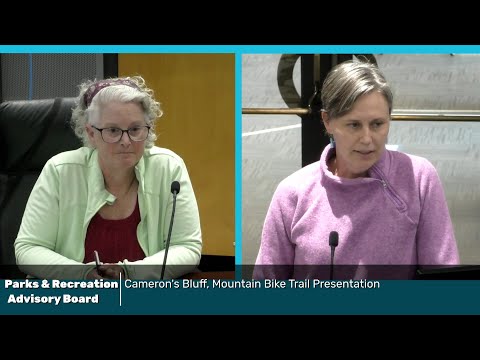
An advisory-board presentation on a proposal to develop mountain‑bike and multiuse trails at an area known as Cameron’s Bluff drew broad interest and several concerns at a meeting of the Lawrence Parks & Recreation Advisory Board.
An unidentified presenter, introduced as chair of Friends of Lawrence Area Trails, said the International Mountain Bicycling Association (IMBA) assessed the site and recommended further planning and community engagement. “We’re really excited about the possibility of another set of mountain bike trails,” the presenter said, noting the IMBA report and that the site lies along the Kansas River north of I‑70.
Sarah Hill Nelson, representing Friends of the Kaw, described years of outreach and fundraising to win an IMBA trails‑accelerator grant and said the primary current obstacle is access. “Part of the challenge is because this area lies north of I‑70, there is a little bit of an issue of how do you gain access,” she said, describing possible connections from Burcham Park and partnerships with the Kansas Turnpike Authority (KTA) and Evergy to complete a loop. She said a professional trail design would cost on the order of $18,000–$20,000 and that Evergy has committed staff and equipment for construction if partners can align on access.
Presenters said recent legal review by city counsel indicates a recreational easement mapped along the west bank of the Kansas River could be used to reach the site. “We fairly recently received a communication from legal counsel that believes this is a valid recreational easement that could be potentially utilized to develop a trail,” the unidentified presenter said.
Public commenters included Diane Menzies of the North Lawrence Improvement Association, who urged the city to help pursue a linked pedestrian bridge and other crossings to improve safety and connectivity. “If you could do that northern access point, that’d be amazing because people could leave Downtown Lawrence, bike up and get out on the Farmer’s Turnpike,” she said.
Property owner Jeff Allen said he has long resisted a trail on portions of his land and warned of ecological harm and privacy impacts. “Running a scar through the property down there would create a barrier for a lot of animals who live near or on the river,” Allen said, adding that he had previously proposed a license fee and at one point discussed selling the parcel but later decided not to sell. Allen also said an encampment currently on or near the easement has raised safety and sanitation concerns.
Supporters and presenters countered that recent ecological surveys paid for by Evergy and performed with KU and local experts recommended the site is appropriate for restoration and that native restoration would improve water retention and wildlife habitat. A staff speaker summarized the ecological review: “There is a potential to restore native vegetation throughout the site through management of aggressive non‑native species … restoring a landscape of this size would provide invaluable resources to wildlife, residents of Douglas County, and visitors to the area.”
Speakers discussed specific engineering hurdles: frequent train stoppages at the Burcham Park rail crossing, floodplain constraints, and options to cross the railroad, including a box culvert or a structure that would avoid stranding park users. Staff and presenters cited earlier and existing grants from KDOT and said KTA indicated it would not object to some land use, but noted parcel aggregation and unclear ownership in places would require legal steps (including possible Secretary of State processes) to clear titles.
No formal motion, vote or commitment of city funds was recorded at the meeting. Presenters asked Parks & Recreation and the advisory board to help convene partners and to host public engagement required by the IMBA grant; Parks staff said they would participate in future planning as needed. City staff described the next practical steps as reconvening Evergy, county and city staff, and community partners to produce a shared work plan and public meeting schedule.
Supporters emphasized equitable access and the opportunity to connect neighborhoods and finish sections of the Lawrence Loop; critics emphasized protecting private property, wildlife and the river corridor. The presenters and several board members said they would pursue a public meeting and more detailed design and legal work before any formal city action.
What’s next: Presenters said they will work with Parks & Recreation to plan community engagement required by the IMBA grant and to develop a professional trail design scope; no timeline or funding commitment by the city was established at the meeting.