Get Full Government Meeting Transcripts, Videos, & Alerts Forever!
Get email alerts on the Flood Mitigation topic
No spam. Unsubscribe anytime.
BET OKs FEMA home‑elevation grants for two Greenwich residences, with quarterly reporting requirement
Summary
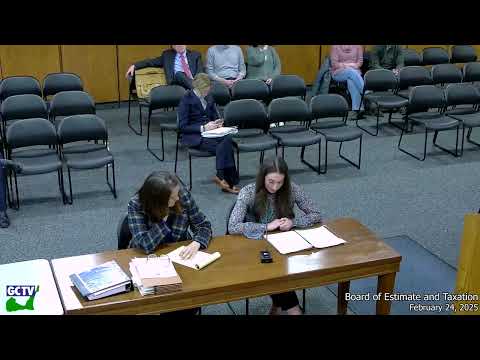
The Board of Estimate and Taxation voted unanimously to accept two FEMA Hazard Mitigation Grant Program awards for home elevations in Greenwich after adding a condition that conservation staff provide progress reports to the BET each quarter.
The Board of Estimate and Taxation unanimously voted Monday to accept $1,053,500 in FEMA Hazard Mitigation Grant Program awards for two single‑family home elevation projects in Greenwich, approving the grants after adding a requirement that the Conservation Commission report progress to the BET quarterly.
The grants, awarded in December 2024, total $563,000 for a property on Apple Tree Lane in Riverside and $490,500 for a house on Northway in Old Greenwich. Sarah Caccaro, assistant director of environmental affairs, told the BET the awards are administered through the State (DEMHS) and that the town serves as sub‑grantee; homeowners hire contractors, pay up front and are reimbursed after FEMA and the State approve requests. “I just want to repeat that the town does not pay for any of the home elevation projects at these residences,” Caccaro said.
Why it matters: the FEMA Hazard Mitigation Grant Program (HMGP) pays for mitigation projects after a presidentially declared disaster; historically the federal share was 75% but recent HMGP cost‑share rules can be higher. The two Greenwich awards arise from projects developed in 2022–2023 after the federal declaration related to Hurricane Ida; the award periods run through February and April 2026, and the town may request extensions.
Discussion and safeguards
Members of the BET and its law and budget committees pressed staff about prior problems on an earlier project that resulted in a FEMA clawback. Karen Fasiliotis, speaking for the law committee, said the committee had “discussed the indemnification provisions at length” and worried that project work not matching FEMA‑approved scope could expose the town. The budget committee, which initially voted 3–1–0 to approve the grants, recommended that reimbursement funds be withheld until the Conservation Commission confirmed each project was completed and officially closed out with FEMA and DEMHS.
Assistant Town Attorney Laura McGeachie said the town’s legal team had examined options such as performance bonds and placing liens on title but found no straightforward statutory mechanism that would allow a routine lien to be imposed in this grant context; a judgment lien would require court action. Megan D’Amato, director of risk management, provided a memo summarizing efforts by the town’s broker, Gallagher & Company, to locate indemnity insurance; staff reported insurers declined to underwrite a small policy to cover the potential exposure in this residential program, or offered coverage with a large retention that staff judged disproportionate to the projects’ sizes.
First Selectman Fred Camillo, who addressed the BET in support of the grants, described the homeowners as long‑standing neighborhood residents and warned that conditioning the grants with a 100% holdback would create a “chilling effect” because many eligible homeowners could not front the entire cost of elevation and then wait for federal closeout. “Not everybody lives in a $5,000,000 home and has money to spare,” Camillo said, urging the town to enable participation while strengthening oversight.
BET response and motion
BET members pressed staff for written procedures, staged inspections and Municity (the town’s permitting database) entries to document milestones and permit approvals. Caccaro and McGeachie said FEMA‑required quarterly reports and the town’s permitting inspections would provide overlapping checks, and they committed to formalizing procedures and to conditioning inland wetlands and CAM approvals where those authorities apply.
To balance homeowner access and town protection, the BET amended the motion: instead of a full holdback, the board required that conservation staff appear before the BET with progress reports at least quarterly until projects are complete. The board then voted to accept the grants as amended, 12–0–0. The motion (CC1) to accept FEMA HMGP funds for the two properties was moved by Ms. Tarkington and seconded by Ms. Moriarty.
What the decision does and does not do
The town will act as sub‑grantee and submit reimbursement requests on homeowners’ behalf; the town will not pay project costs up front. The BET did not require a 100% holdback of FEMA funds and did not direct a specific insurance arrangement. The budget committee’s earlier condition—holding reimbursements until official FEMA/DEMHS closeout—was replaced by the BET’s quarterly‑reporting requirement. The law committee will follow up on potential legal mechanisms to secure town recovery if a reimbursement is clawed back.
Next steps
Conservation staff will administer the grants, coordinate required permits and inspections, and return to the BET with quarterly progress updates until each project is completed and closed out with FEMA and DEMHS. The award periods end in early 2026 with the option to seek up to two 12‑month extensions.