Get Full Government Meeting Transcripts, Videos, & Alerts Forever!
Get email alerts on the Right Of Way Vacation topic
No spam. Unsubscribe anytime.
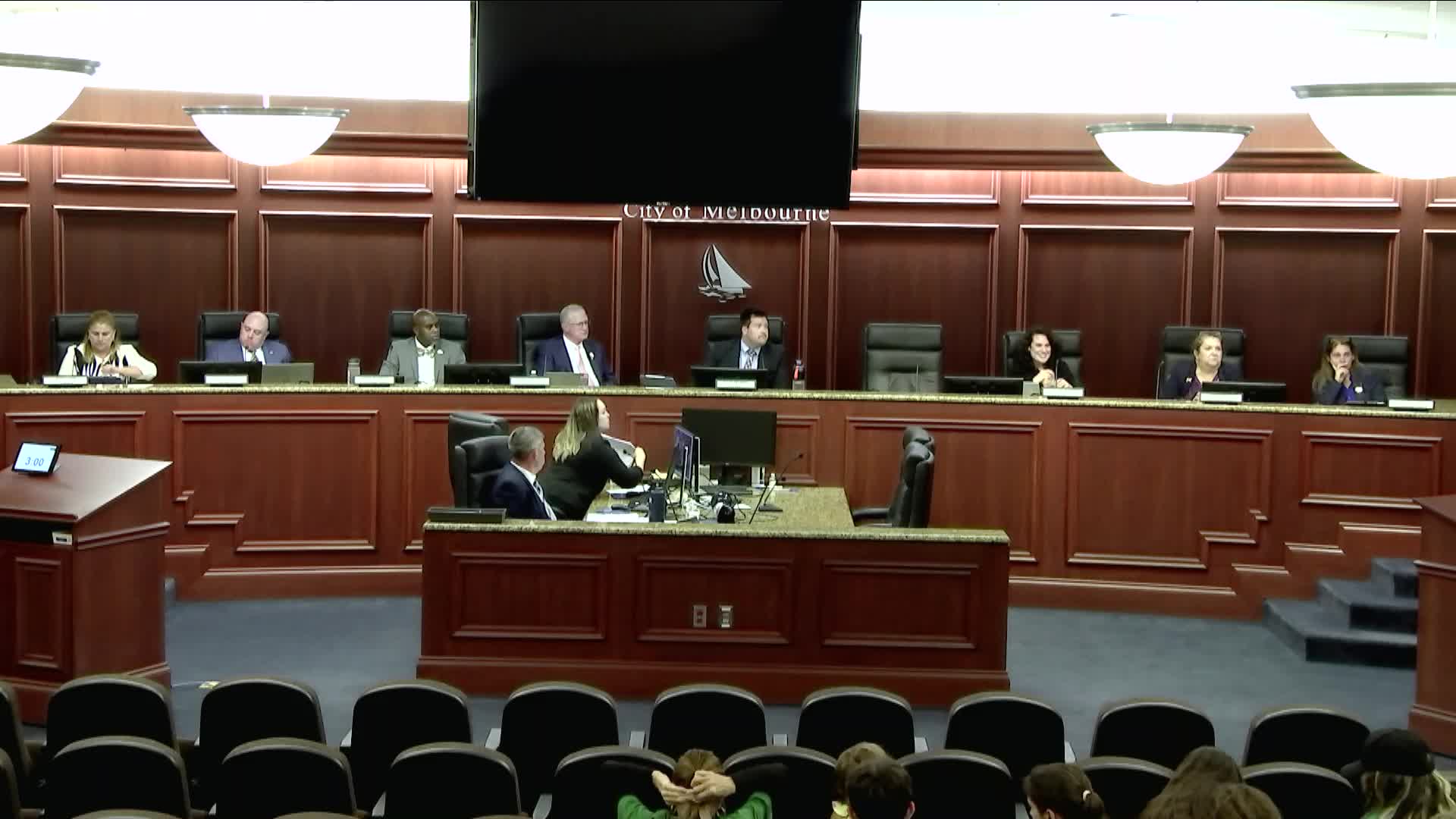
Melbourne council hears request to vacate Potter Avenue right-of-way; directs staff to inspect and clear encampments
Summary
An attorney for a Melbourne waterfront homeowner asked the City Council on April 8 to vacate a narrow right-of-way off Potter Avenue that abuts the Indian River Lagoon, saying the strip is inaccessible and has become a site for homeless encampments; council members directed staff to inspect and pursue cleanup but declined to waive code protections without a formal application.
An attorney for a Melbourne property owner asked the City Council on April 8 to vacate a narrow right-of-way next to the Indian River Lagoon, saying the strip is not actually usable for water access and has become a safety nuisance.
Nathan Malone, an attorney with Weidern & Malek, said his client, Eric Hughes, owns 1607 Riverview and requested the city vacate Potter Avenue’s right-of-way behind the property. Malone said the right-of-way has a steep drop-off to the lagoon, is effectively inaccessible, and is being used by people experiencing homelessness who leave trash, have broken into vehicles and once overdosed near the home.
The request confronted a clear limitation in Melbourne’s code. City Manager Jenny (name provided in the meeting) and City Attorney Adam told council that Section 52-99, subsection 3 of the city code prohibits vacating any right-of-way or public easement that gives access to publicly accessible waters unless equivalent access is preserved. Adam said those legal findings typically must be made through a quasi‑judicial process after an application is filed and public notice is given.
Following discussion, council did not vote to change the code or to waive the subsections cited. Instead councilmembers asked staff to inspect the Potter Avenue site, review the city code more broadly for similar platted rights-of-way along the lagoon, and report back. Councilmember Kennedy had sought a continuance on a related rezoning so staff could draft potential text amendments; members indicated support for staff exploring a code amendment process only after broader review rather than approving a one-off waiver.
Vice Mayor Newman and several councilmembers voiced particular concern about the safety issues Malone described. Council reached consensus to direct staff to examine the property and pursue cleanup or maintenance options where the right-of-way is city-owned — including removal of debris and addressing underbrush where legally permitted — and to return with options rather than immediately changing the code.
City staff said the matter of whether the code’s access protection applies is more appropriately resolved through the formal, quasi‑judicial vacate/abandonment application process once an applicant files. Adam advised council that making legal findings to override the code without public notice could be inappropriate.
The council’s direction was procedural: staff will inspect the Potter Avenue right-of-way, evaluate cleanup/maintenance and potential code changes as a citywide review item, and report back to council. No formal vacation or code amendment was approved at the April 8 meeting.
Community members who spoke during public comment raised lagoon water-quality concerns more broadly; several councilmembers said they would coordinate follow-up on public-safety and maintenance actions for city-owned rights-of-way.