Get Full Government Meeting Transcripts, Videos, & Alerts Forever!
Get email alerts on the Property Improvement Grant 1818 Madison topic
No spam. Unsubscribe anytime.
CRA denies $75,000 property improvement grant for proposed dog daycare at 1818 Madison Street
Summary
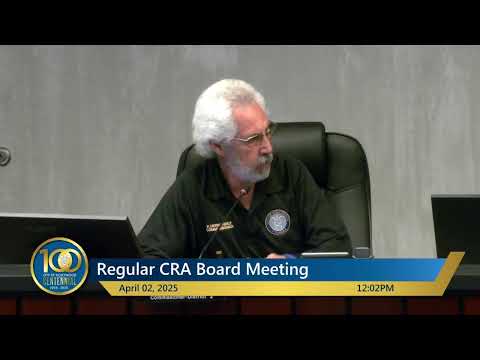
The Hollywood Community Redevelopment Agency voted unanimously to deny a proposed Property Improvement Program (PIP) grant for exterior improvements at 1818 Madison Street, a conversion from a duplex to a dog daycare, after lengthy public discussion on parking, noise, neighborhood fit and use of public funds.
The Hollywood Community Redevelopment Agency on April 2 denied a request for up to $75,000 in property improvement grant funding for improvements at 1818 Madison Street, a proposed conversion of an existing duplex into a dog daycare called Barkology.
Supporters of the application, including the property owner Alex Goinman and operator Nico (Nico) Safrani, described plans for exterior improvements — impact windows and doors, paint, stucco, fencing and pavers — tied to $173,000 in total private investment. Agency staff presented the PIP application and recommended approval of a $75,000 grant covering roughly 43 percent of the exterior scope.
The board’s discussion focused less on whether the dog daycare was allowed — Andrea Winget, the city’s Director of Development Services, said the Federal Highway 2 (FH2) zoning district permits mixed uses — and more on whether CRA dollars were appropriate for funding the change of use and whether the proposed site could meet operational requirements. Concerns raised included the size and configuration of the rear parking area, alley access for drop‑offs, potential noise and waste management impacts on nearby residences, and whether the exterior improvements funded by the CRA would be used to support what several board members described as a commercially driven change of use rather than rehabilitation of an existing commercial operation.
“I'm not opposed to the use, but I don't think it should be done at the public dollar's expense,” Board member Warner Hernandez said during debate, motioning to deny the grant application. Board members also flagged the application as “half‑baked” because the submitted renderings, landscaping and details about kennel capacity, parking layout and operational controls (noise attenuation, waste removal and staffing ratios) were incomplete or not yet resolved.
Board members repeatedly distinguished the board’s authority to fund exterior improvements from zoning and permitting decisions. Board member Gruber noted: “What you're technically voting on today is just the exterior improvements to the property, not the change of use.” Andrea Winget and CRA staff explained the applicant still must satisfy building‑permit and licensing requirements — including parking configuration and city kennel/license requirements — through the permitting process before grant funds would be disbursed.
Public and board questioning focused on operational details offered by the operator, who said she planned to limit groupings, keep dogs mostly inside with acoustical ceilings and take dogs for supervised walks to a nearby park. The property owner said an earlier plan for a 15‑unit new construction project was found infeasible pre‑pandemic and that the current plan uses an existing structure to attract neighborhood customers.
After extended discussion the board first moved to continue the item to the June CRA meeting to allow the applicant time to work with staff on outstanding planning, parking and kennel licensing details; that motion passed. The board later reconsidered and, following additional debate, approved a motion to deny the PIP grant. The denial passed unanimously. CRA staff noted the applicant may reapply; the board and staff encouraged the owner and operator to resolve the outstanding building‑permit and licensing conditions, work with neighbors, and return with clearer plans and documentation.
The CRA staff also clarified that PIP grant awards include a standard grant agreement with a five‑year retention/clawback clause: if the property is sold or the funded use is discontinued within five years, the CRA would retain a prorated portion of the grant via contract remedies.
The denial leaves the zoning decision intact — the FH2 district allows the proposed daycare as an as‑of‑right use — but removes public exterior improvement funding for this application. Staff advised the applicant that building‑permit, parking and licensing approvals remain the applicant’s responsibility if they wish to proceed without CRA funding.
Notes: the board discussed TIF impacts and the return on CRA investment from the $75,000 award; staff estimated the private investment at $173,000 and the grant at $75,000. The board recommended the applicant address parking layout, sound attenuation, landscaping, waste removal plans and evidence of neighborhood outreach before returning.