Get Full Government Meeting Transcripts, Videos, & Alerts Forever!
Get email alerts on the Bay Park Infrastructure topic
No spam. Unsubscribe anytime.
Commission approves Bay Park Phase 2 seawall repairs and floating day dock, citing water-quality and access goals
Summary
The commission unanimously approved site-plan, major conditional-use, and G-zone waiver requests to rebuild a battered seawall and add a floating day dock at Bay Park as part of Phase 2; commissioners and engineers said the design aims for resilience and improved water quality.
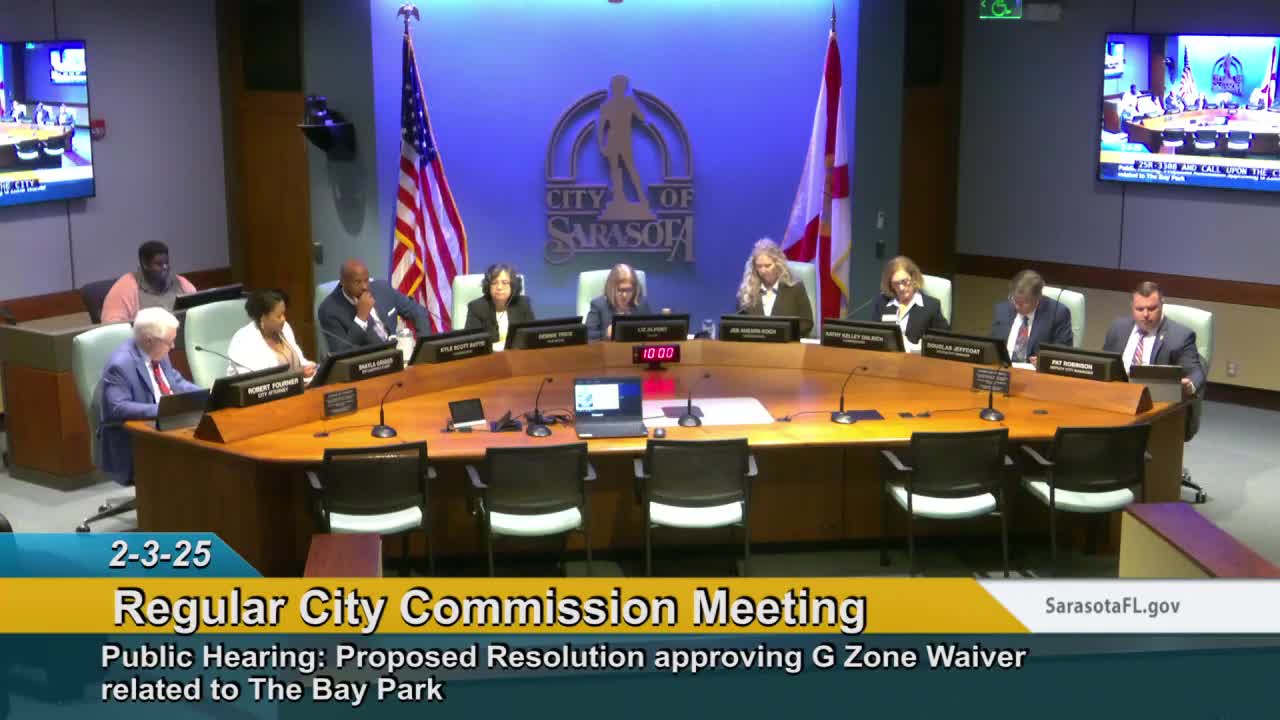
The Sarasota City Commission on Feb. 3 approved the Bay Park Phase 2 site plan and related G-zone waivers to reconstruct the south seawall around the park’s canal and to build a floating day dock, actions intended to improve public waterfront access and water quality.
The Bay Park Conservancy and consultant team presented the project. The Phase 2 work includes finalizing a resilient seawall rebuild, dredging that has already been completed in the boat basin, and the installation of a floating day dock that runs along the southern seawall. Applicants said the existing seawall shows signs of long-term deterioration and cavities where debris collects; correcting those conditions was presented as a water-quality benefit.
Kimley-Horn planner Philip Di Maria and Bay CEO AG Lafley said Phase 1 delivered a restored bayou and accessible paddling launch; Phase 2 focuses on the boat basin and canal district to extend boater access. City staff and marine engineers described numerical modeling and a performance-based design for the floating dock. Marine engineer Michael Herman said the dock will float to accommodate storm surge and will be anchored to piles designed to resist lateral wave and wind forces; he acknowledged some damage is still possible in severe storms but said the design criteria reflect the 100-year design condition and include freeboard and installation specifications to limit breakaway risk.
The application required a “major conditional use” because the proposed floating day dock exceeds thresholds in the zoning code (which are written for standard single-family docks), and two G-zone waivers: one to allow dock pilings up to 14.5 feet above mean high water (code limit 10.5 feet) to provide vertical clearance for surge and floatation, and one to permit a seawall height of 6.1 feet above mean low water (code limit 5 feet) to increase resilience. Staff reported that the DRC provided sign-off in November 2024 and that the Planning Board unanimously recommended approval on Jan. 8, 2025.
Development Review Chief Planner Noah Fossek and staff recommended approval; planners said the project meets applicable development standards and that no trees are proposed for removal. Commissioners questioned durability, liability for repairs after storm damage, and how this location differs from earlier, more exposed floating-dock failures elsewhere in the city. Engineers and the applicant’s team said the canal geometry and orientation give this site greater protection than open-shore installations and that FEMA reimbursement processes may apply to post-storm repairs when eligible.
Commissioner Batty moved approval of the site-plan and major-conditional-use application (Case SP-25-0525 CU-02); Commissioner Ulrich seconded. The motion passed unanimously. The commission then adopted Resolution No. 25R-3308 to permit the G-zone waivers to allow the piling height and seawall elevation requested; Commissioner Batty moved adoption, Vice Mayor Trice seconded, and the resolution passed unanimously.
Project team members present included planners from Kimley-Horn, marine engineers Moffatt & Nichol (participating remotely), environmental scientist Penny Cutt, and Bay Park staff. Staff and applicants said the rebuild and dock are part of the park master plan previously approved by the commission and will be implemented through the Bay Park capital program and construction contracts.