Get Full Government Meeting Transcripts, Videos, & Alerts Forever!
Get email alerts on the Public Art topic
No spam. Unsubscribe anytime.
City Commission approves zoning changes to expand public art options and funding uses
Summary
The Sarasota City Commission approved a zoning text amendment that clarifies developer obligations for public art, preserves exemptions for attainable-housing portions of buildings, and allows larger contributions to be spent on public sites when they exceed $500,000.
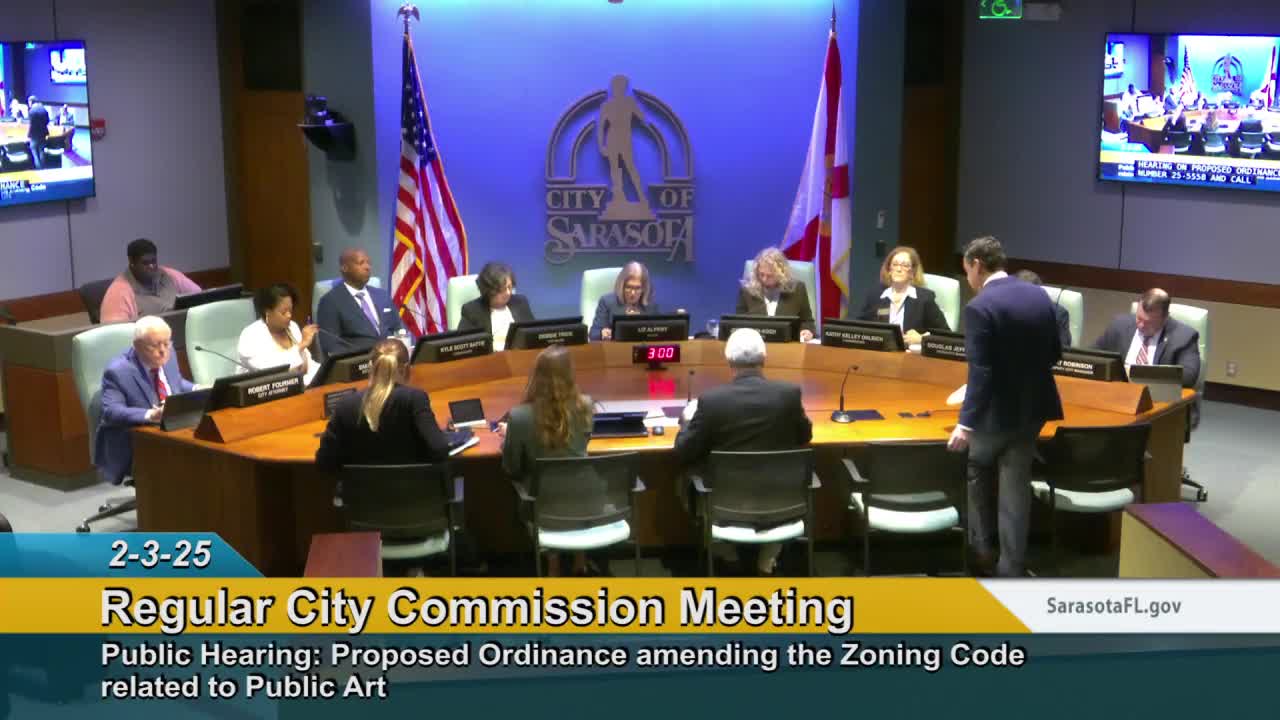
The Sarasota City Commission on Feb. 3 adopted Ordinance No. 25-55-58, a zoning text amendment that updates rules for the citywide public art program and clarifies how developer payments and privately provided works will be reviewed and maintained.
The amendment requires any property owner or developer applying for a building permit with construction value of $1,000,000 or more for a multi-dwelling, mixed-use or commercial development to either pay into the public art fund or provide public art on the development. Developers may pay an amount equal to one-half of 1 percent of construction cost, provide on-site public art equal to one-half of 1 percent, or provide public art on public land or rights-of-way equal to one-half of 1 percent when payments exceed $500,000. The amendment also clarifies maintenance and insurance responsibilities and that works on private property remain the private owner’s property while being considered part of the city collection.
City planning staff said the update implements the 2023 Public Art Plan and aligns the zoning code with current program practices, including the review role of the Public Art Committee and when the City Commission must review a proposal (projects valued over $250,000). Planning Director Steve Coover and Chief Planner Brianna Dobbs explained the amendment at a public hearing and said the change was intended to broaden options for how large contributions are used, allowing dispersed installations in public rights-of-way rather than a single very large piece.
Public Art Administrator Sierra Coleman told the commission the amendment also preserves an exemption for the square footage of attainable-housing units. She said the city has created a small budget program this year to place art on attainable-housing projects and that staff will coordinate with the Sarasota Housing Authority and pursue grants and partnerships to expand that work; she said the current dedicated fund for that program is approximately $15,000.
Commissioners asked for more codified guidance on how the public art fund will be spent across neighborhoods that do not generate developer fees and for clearer methods to determine the budget breakdown for commissioned pieces (artist fee, materials, installation). Staff said work plans presented through the annual budget cycle and periodic public reports will provide program-level detail and that a selection protocol for commissioning would be developed in collaboration with the Public Art Committee.
Vice Mayor Trice offered an amendment to remove an individual staff member’s name from the draft ordinance; the commission debated that amendment and ultimately left the ordinance language as drafted. Commissioner Ahern Koch moved adoption of the ordinance; Commissioner Batty seconded. In roll call the ordinance passed (Ayes: Commissioner Albert, Commissioner Batty, Commissioner Ulrich, Commissioner Ahern Koch; Noes: Vice Mayor Trice). The ordinance will be scheduled for a second reading in March.
The commission’s discussion also noted state-level preemption (Senate Bill 250) that prevents municipalities from increasing certain developer fees until Oct. 1, 2026, and several commissioners urged outreach to state legislators to seek relief or carve-outs for local public art programs.
The ordinance text, the Public Art Plan, and staff presentations are on file with the city planning department.