Get Full Government Meeting Transcripts, Videos, & Alerts Forever!
Get email alerts on the Brownfields topic
No spam. Unsubscribe anytime.
Commission approves brownfield plan amendment for Court Tower redevelopment at 221 West Webster
Summary
The City Commission voted unanimously to approve a brownfield plan amendment for the six‑story Court Tower/Core Plaza at 221 West Webster and adjacent Second Street property, allowing the city and Brownfield Redevelopment Authority to collect tax increment for five years to recover remediation costs for work already completed.
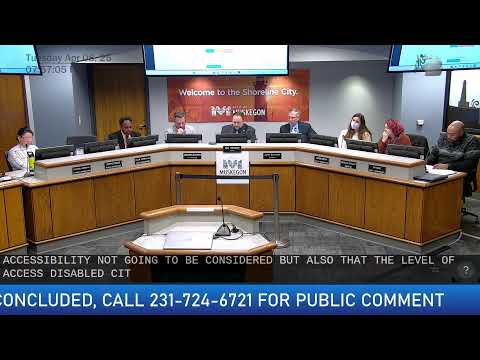
The City of Muskegon City Commission on April 8 approved a brownfield plan amendment for 221 West Webster (known as Court Tower) and associated property at 1040 Second Street, authorizing the mayor and city clerk to sign the documents that implement the amendment.
The amendment was presented by the city manager and by brownfield specialists representing the applicant. The manager told commissioners that "the brownfield law does allow for a look back period" and that the present request covers remediation work already completed during the building renovation. Kirk Pershbacher of Fishbeck, the brownfield specialist, said the renovation uncovered additional asbestos and other remediation needs as the interior work progressed and the developer chose to complete the full remediation before seeking the tax increment capture. Pershbacher said the amendment "allows the city and the BRA to capture approximately $300,000 for their LBR." Troy Wasserman of Core Realty and Brian Bench of Core Development described the project as a mixed reuse conversion with professional offices on upper floors, a co‑work space, retail and food hall uses at street level, and residential space on part of the third floor.
Commissioners asked about timing and whether this was a special concession. The manager said the statutory look‑back provision permits requests after work is done, and that the base year for the tax increment would be set one year back (2024 in this case), which can increase the value used to calculate captured increment compared with setting the base year prior to the project. The manager also noted the Brownfield Redevelopment Authority had unanimously approved the amendment earlier the same day; the manager disclosed he serves on the BRA and voted.
Following the public hearing—with no members of the public in the room or on the phone offering comment—Commissioner Dermott moved and Commissioner Kochan supported approval. The commission voted affirmatively on the roll call; the motion passed.
The amendment will create a five‑year collection period for the city and the BRA to recover eligible remediation and eligible brownfield expenses under the plan. Commissioners and staff described the measure as consistent with earlier brownfield practice for the city and as intended to recover remediation costs rather than to provide an up‑front subsidy.
The developer team said the building is now actively occupied by a mix of businesses and retail tenants and that they have addressed remediation as discovered during interior demolition. No change to zoning or land use was made as part of this amendment; the action applies to tax increment capture under brownfield procedures.
Votes at a glance: the city commission approved the brownfield plan amendment by roll call vote (unanimous affirmative votes recorded; motion recorded as passed).