
Commission questions redevelopment concept at Davenport/Steamboat: legal limits on moving and expanding dimensional nonconformities remain unresolved
Get AI-powered insights, summaries, and transcripts
Subscribe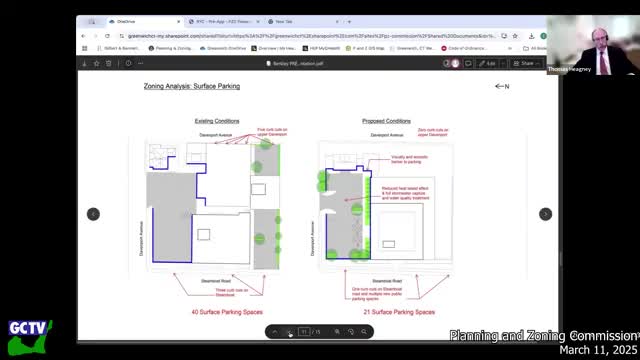
Summary
Berkeley Insurance Company presented a reworked plan for properties along Davenport Avenue and Steamboat Road; commissioners praised design changes but directed the applicant to justify legally how protected nonconforming volume would be reallocated across parcels.
Berkeley Insurance Company returned to the commission on March 11 with a substantially reworked proposal for properties along Davenport Avenue and Steamboat Road. The new design reduces building heights, increases setbacks along residential edges, consolidates curb cuts and increases landscaped buffer area, but legal and neighborhood concerns kept the discussion unresolved.
What commissioners heard. Attorney Tom Hegney described a redesign that narrows the buildings’ profiles toward the Davenport residential side, reduces total cubic footage compared with an earlier submission and consolidates driveways to two curb cuts. Hegney said the revised plan reduces several dimensional nonconformities (height, site coverage and building coverage) on individual parcels and increases landscaped areas.
Central legal issue: shifting nonconformity. Commissioners including Mary Jenkins and Commissioner Peter Lowe repeatedly questioned whether the applicant’s approach legally transfers protected nonconforming volume or square footage between parcels. Jenkins said the law protects what currently exists on each parcel and that the commission should not allow creation of new nonconforming buildings on separate parcels simply by reallocating protected dimensions. “What you’re doing is you are moving volume, which is protected as nonconforming where it currently exists, and moving it around,” Jenkins said. “Each of the parcels has a different new nonconformity that solves some of your existing protected nonconformity.”
Hegney said the revisions make each parcel more conforming in key dimensional respects (setbacks, height or coverage) and pointed to reduced total cubic footage across the project; he argued the plan improves neighborhood relationships and reduces the most visible impacts. Commissioners said they appreciated the design improvements but asked Hegney for legal briefing and case law showing the town may accept the applicant’s dimensional reallocations without expanding the existing nonconforming office use.
Neighbors raise noise and maintenance concerns. Multiple neighbors raised long‑standing complaints about rooftop mechanical noise from the existing W.R. Berkeley building; residents asked when previous mitigation commitments would be implemented and said earlier promises to address noise and rooftop equipment had not been completed. One neighbor asked the town to revisit the local noise ordinance because measurement at 4 feet above grade (the town’s enforcement point) can miss rooftop sound that affects nearby dwellings; the commission and staff invited citizens to submit suggested ordinance language for review and noted noise enforcement falls under the first‑selectman’s office.
Parking, phasing and site maintenance. Commissioners asked for a consolidated parking table (existing v. proposed) and for a traffic/parking study that compares the site to a similar nearby development to test proportional parking demand. Staff and neighbors also asked for a maintenance commitment for landscaping shown in the plans and asked for clearer answers about when previously‑approved mitigation required on a separate Berkeley site would be implemented.
Next steps. The commission asked the applicant to provide a legal brief explaining how the plan complies with nonconformity rules and to submit a parking calculation table and a parking demand/traffic study. Commissioners also asked the applicant to follow up on prior mitigation obligations tied to earlier approvals and to clarify landscaping maintenance commitments.
End: The commission left the discussion open and requested written legal analysis and updated technical tables before scheduling the project for a subsequent hearing.