Get Full Government Meeting Transcripts, Videos, & Alerts Forever!
Get email alerts on the Molst Training topic
No spam. Unsubscribe anytime.
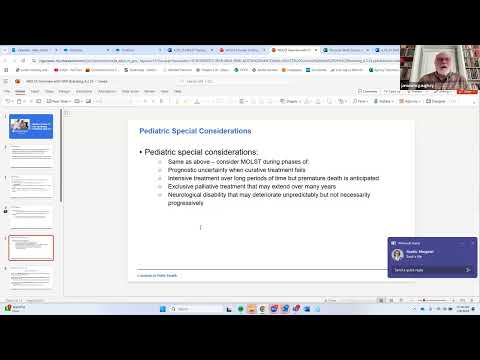
DPH subcommittee moves pediatric MOLST guidance to provider training; orders slide and form revisions
Summary
A Department of Public Health subcommittee agreed to move pediatric "special considerations" from the public overview into the provider slide deck, to present the MOLST form visually and to highlight signature/voluntary language; staff were assigned to produce revised slides and a follow-up meeting was scheduled.
A Department of Public Health subcommittee working on MOLST (Medical Orders for Life-Sustaining Treatment) education agreed during a meeting to shift pediatric “special considerations” out of the public overview slides and into the provider training deck, and to overhaul several slides to show images of the actual MOLST form sections.
The change aims to avoid implying that children have different eligibility criteria for MOLST. Committee members agreed to phrase eligibility as applying to “all patients” and to add brief notes directing providers to use discretion with special populations. Staff were assigned to break the form into separate, readable slides, insert visuals of each form section, and add resource links for conducting the MOLST conversation.
Why it matters: the subcommittee’s edits affect how clinicians, EMTs and other professionals learn to use the MOLST form and how the public sees the program. Presenting the form visually and clarifying signature and voluntary language are intended to reduce confusion among providers about what to enter on the form and how to conduct the conversation.
Discussion and decisions - Pediatric slide placement: Members said pediatrics should not appear to have distinct eligibility rules; instead the team will use wording such as “all patients” in the public overview and keep more detailed pediatric guidance in the provider deck. Several participants recommended a placeholder or brief parenthetical in the overview that emphasizes clinicians’ discretion for special populations rather than a standalone, public-facing pediatrics slide.
- Form presentation: The group agreed to split the MOLST form into multiple provider slides so each section of the form is displayed as an image of that section (for example, section a, b, c, etc.), rather than retyping the form text. Several members said a screenshot or scanned image will make it clearer how to complete the form.
- Signature and voluntary language: The subcommittee discussed highlighting that the witness signature is not required and that completing the form is voluntary. Members directed staff to set off that note (for example, in italics) on the signature slide and to call attention to “voluntary” in the narration.
- Wording, formatting and editorial review: The committee asked staff to standardize capitalization and bolding across slides, shorten long text blocks, add a brief visual example of an amended form, and run the final deck through DPH legal and editorial review before publication.
Assignments and timeline - Melia (Melia Allan) and Barbara Cass (DPH staff) were named as the recipients for resource suggestions and slide materials; staff will compile resources (conversation guides, external trainings) and incorporate them into the provider deck. - The slide author will break large text blocks into smaller slides, insert photos/screenshots of each MOLST form section, and prepare a visual example of filling in a portion of the form for provider training. - The group scheduled a follow-up meeting for Tuesday the 22nd at 3:00 p.m. to review updated slides and remaining items.
Context and constraints - Committee members repeatedly noted that the statutory scheme treats eligibility as applying to all individuals; several participants urged care in language so the public overview does not suggest separate eligibility for children. - Participants emphasized that the provider deck and the public overview serve different audiences: the public overview should be concise and high-level; the provider deck should include special considerations, images of the form, and links to resources for clinicians uncomfortable with or unfamiliar with these conversations.
Next steps DPH staff will circulate revised slides, include a placeholder slide of “MOLST conversation resources” until external links are added, and incorporate an explicit notation on the signature page that completion is voluntary and witness signatures are not required. The subcommittee will reconvene at the scheduled follow-up to finalize the deck ahead of editorial and legal review at DPH.