Get Full Government Meeting Transcripts, Videos, & Alerts Forever!
Get email alerts on the Nursing Homes topic
No spam. Unsubscribe anytime.
Nursing-home occupancy rises to 88.2% as regulators report three closures and eight immediate‑jeopardy findings
Summary
State Department of Social Services staff reported an average nursing‑home occupancy of 88.2% for the quarter ended March 31, 2025, and detailed three facility closures, several ownership changes and eight immediate‑jeopardy findings during a committee meeting.
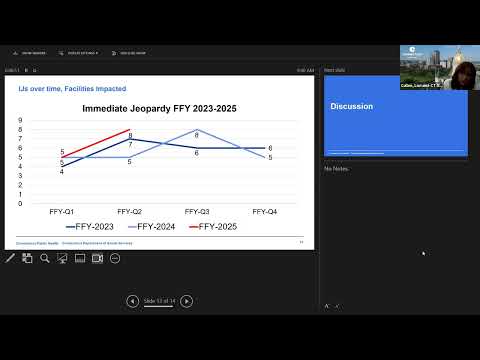
The Department of Social Services reported an average nursing‑home occupancy of 88.2% for the quarter ended March 31, 2025, and said the quarter included three facility closures and eight immediate‑jeopardy findings, officials said at a quarterly oversight meeting.
Nick Mazzato, a staff member who presented the data, said, "The average occupancy for the quarter came out to 88.2%, which represents a 1.1% increase over the prior quarter." He told the committee that the number of occupied beds per quarter has been stable over the past 2½ years, averaging roughly between 19,146 and 19,393 occupied beds.
Mazzato said 44 beds were removed from the licensed total during the quarter, one because a license converted from an RHNS to an RCH and the remainder through de‑licensures. The agency listed three facility closures during the reporting period: Avid Terrace, Countryside Manor and Wilkins View Manor. The presentation also noted recent change‑of‑ownership transactions at Village Green in Bristol, Chest Elm in Mudis and Beechwood in New London; the presenter said those were for‑profit ownership changes.
Mazzato outlined the top five federal survey tags cited in the quarter and gave examples of deficiencies: failures in quality of care (including inadequate pressure‑ulcer prevention and skin checks), failures to prevent accidents or to supervise residents that led to missing‑resident incidents, failures to notify a physician when a resident did not receive medication, incomplete or missing nursing‑assistant documentation in resident records, and at least one instance of verbal mistreatment noted under the free‑from‑abuse and neglect tag.
The presenter said investigators recorded eight immediate‑jeopardy findings across eight facilities in the quarter, including three categorized as accidents and hazards, one for significant medication errors, one for abuse/neglect concerns, one involving dialysis, one related to alleged violations that required investigation/correction, and one involving mental/psychosocial treatment services.
During questions, Member Matt Barrett asked whether the agency had an anticipated decision date on petitions to close two Bristol facilities. Nicole Godburn, director of reimbursement and certificate of need for the Department of Social Services, said the decision to close Countryside Manor has been issued and that the building is officially closed. She said Sheridan Woods remains under review and that the certificate of need (CON) is on file but no determination has been made.
Committee members asked whether the rising census could be contributing to the spread of immediate‑jeopardy incidents. Mazzato said the agency has not observed a clear correlation so far: "We haven't seen a correlation with immediate jeopardies at this point," and staff are monitoring for repeats at the same facilities and other trends.
Godburn also warned that the department's online census data feed has not been updated because of an information‑technology issue; she said staff expect to restore the most recent census figures to the DSS website within about a week.
In other business, the committee approved minutes from its Jan. 8 meeting. Member Matt Barrett made the motion and Member Barbara Cass seconded; Godburn and Member Michael Morris recorded abstentions.
The committee closed after a brief discussion and no additional formal actions related to the quarter's nursing‑home statistics.