Get Full Government Meeting Transcripts, Videos, & Alerts Forever!
Get email alerts on the Council Actions topic
No spam. Unsubscribe anytime.
Kearney council introduces two ordinances, adopts handicap-parking ordinance and approves consent agenda including multiple contracts
Summary
The mayor and council introduced two new ordinances, held a public hearing and adopted an ordinance establishing a handicapped parking space, and approved a consent agenda that included several construction contracts, overtime authorizations and personnel items.
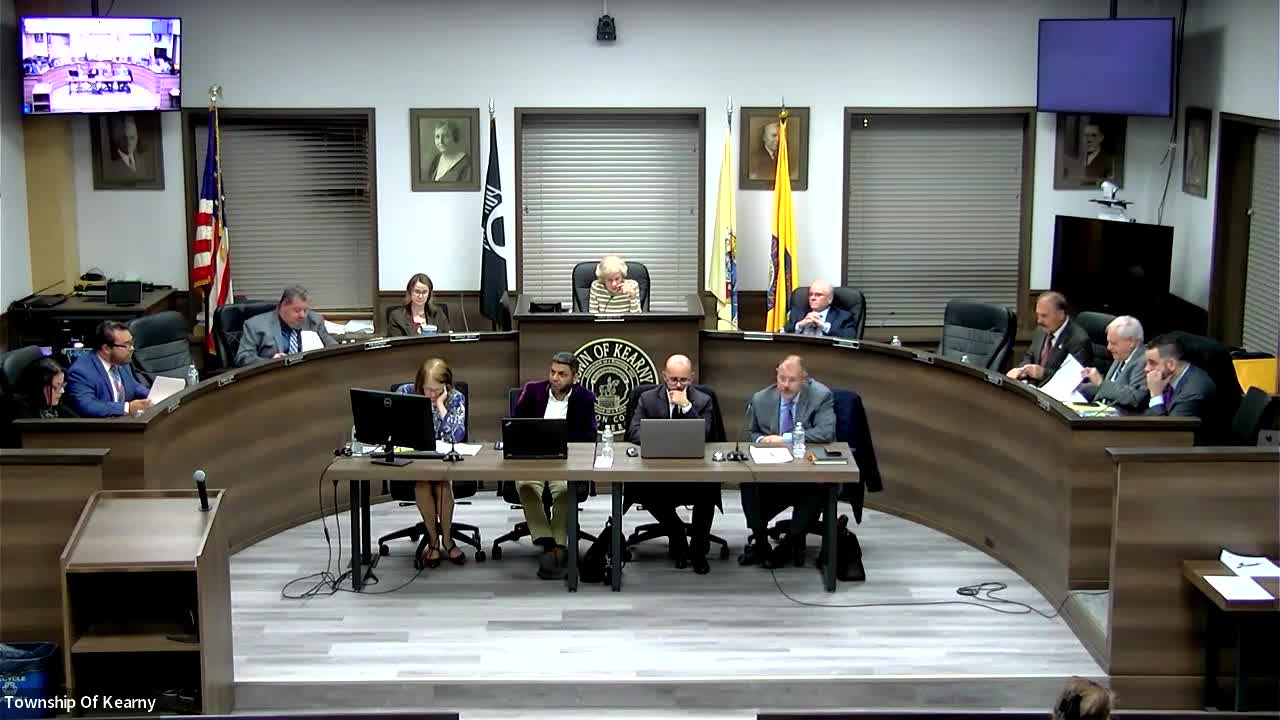
At a regular meeting of the mayor and town council of the Town of Kearney, council members introduced two ordinances for first reading, held a public hearing and adopted an ordinance creating a handicapped parking space, and approved a consent agenda that included contract awards, change orders and personnel actions.
The council voted to adopt ordinance 25‑o‑13 after a public hearing. The ordinance establishes a handicapped parking space at 168 Windsor Street; the public hearing drew no speakers and the council adopted the ordinance unanimously by voice vote.
Council members introduced two additional ordinances for first reading: 25‑o‑14, establishing a handicapped parking space at 4440 Fourth Street (introduction moved and seconded), and 25‑o‑15, an amendment to section 7‑15 of the town code regarding parking of commercial vehicles, including moving vans. The council conducted a roll call for 25‑o‑15’s introduction; formal second-reading/public‑hearing dates were set per the council’s procedures.
The meeting’s consent agenda covered a lengthy set of routine items the council approved in a single motion. On the consent agenda the council authorized multiple public-construction and management contracts, grant-funded projects closeouts, equipment or site-access agreements, overtime and personnel items. Key contract and finance items announced during the meeting included:
• Resolution 2‑44: award of a construction contract to Smithsondi Asphalt Construction Company, Inc., for Chestnut Street and Garfield Avenue lead service replacement and roadway improvements funded by CDBG, in the amount of $523,849.03.
• Resolution 2‑45: contract to Negley Engineering Associates for construction management for the Chestnut Street and Garfield Avenue project, time-and-materials not to exceed $51,765.
• Resolution 2‑46: award of contract to Smith Sondi (transcript spelling) Asphalt Construction Company, Inc., for Elm Street lead service replacement and roadway improvements (NJDOT funded) in the amount of $815,379.54; a companion construction-management contract (Resolution 2‑47) to Negley/Nagle Engineering was authorized at approximately $81,405.
• Resolution 2‑48 and 2‑49: change order number 2 (final) and contract closeout for the Riverbank Park bike trail project (NJDOT funded) with Revax Contracting Corp.; the change order decreased the contract by $3,396.88 and the closeout was authorized.
• Resolution 2‑50: authorization for Ashland Inc. to access town stormwater manholes and inlets for inspection and potential cleanout connected to environmental remediation at 1106 Harrison Avenue (Block 282).
• Resolution 2‑52: acceptance of the retirement application of William Conley, senior cashier in Finance, with an estimated payout for unused leave and longevity totaling $51,389.91 (subject to public employees’ retirement-system approval and any salary adjustments).
Other consent-agenda items included multiple permits and road‑opening approvals, small overtime authorizations for town staff to cover clinics and meetings, and housekeeping resolutions (spelling correction for a street name, a memorandum of agreement approval and temporary hour increases for a part‑time public information officer). The mayor moved the consent agenda with the listed exceptions; the council seconded and approved the omnibus motion by voice vote.
Several council members and members of the public used the meeting’s general and business reports to raise separate community items: senior‑services and public‑health notices, youth recreation schedules, and acknowledgments of recent ribbon cuttings and cultural proclamations.
Formal roll-call vote tallies were not published in the meeting transcript for most consent items; those items were approved under the council’s consent-agenda procedure. Where roll-call votes were recorded (introduction of one ordinance), the clerk called members for their votes in sequence.