Get Full Government Meeting Transcripts, Videos, & Alerts Forever!
Get email alerts on the Parking Permit Pilot topic
No spam. Unsubscribe anytime.
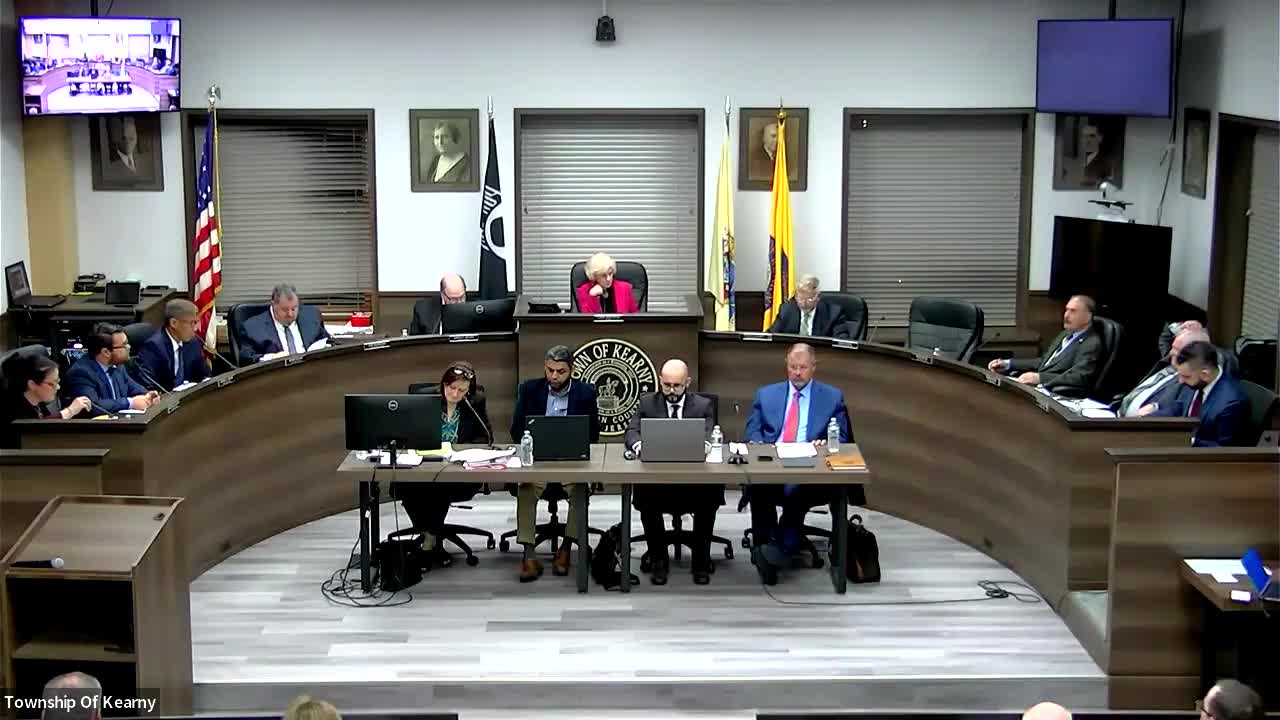
Council introduces permit-parking ordinance for Sanford-area pilot after months of resident complaints
Summary
The council introduced ordinance 25-O-12 to create permit parking on Sanford Avenue, Bradley, Anne and Ogden; proponents called it a pilot and opponents and residents asked for clearer rules on guaranteed spaces, enforcement and lottery slots.
The Town of Kearny introduced ordinance 25-O-12 on Tuesday, directing the police department to accept residential parking permit applications for specified streets and establishing a pilot permit system for overnight parking hours.
The ordinance adds section 7-32 to the town code to require residential permits on designated streets between 7 p.m. and 7 a.m., with an initial rollout date of April 15. The streets listed in the draft are Anne Street (both sides, entire length), Ogden Avenue (east side from Harrison Avenue south to the end), Bradley Street (both sides between Schuyler and Sanford Avenue) and Sanford Avenue (both sides, entire length), excluding 21 spaces north of Harrison Avenue that previously were used for overnight parking. The text sets a $10 annual fee for Kearny residents and a $50 annual fee for nonresident employees of businesses on the listed streets; commercial vehicles are not eligible for permits.
Council members described the measure as a pilot intended to test whether permitting and targeted enforcement reduce spillover parking from nonresidents and commuters. Councilman Zapata said the plan is "to see if something like this can work" and suggested council will evaluate the results before expanding the program. Councilwoman DeCastro said applications will be handled by the police department and that the administration will post details on the town website when the program opens.
Public comment was robust. Residents who supported the ordinance said out-of-town parking and vehicles left overnight by commuters have made neighborhood parking scarce; others urged a 24-hour restriction rather than the proposed 7 p.m. to 7 a.m. window. Several speakers raised concerns about logistics: how reserved municipal spaces would interact with street permits, whether reserved "lottery" spaces (21 municipal spaces adjacent to Sanford Avenue) should remain guaranteed for lottery winners or be available to permit holders when unused, and how the police would enforce the mix of reserved and general permit spots overnight.
Pablo Martinez, a Sanford resident and organizer on the issue, supported the pilot but asked the council to consider expanding enforcement hours and called for sustained police action in his neighborhood. Maria Margarita, another Sanford resident, urged care for long-time neighbors and said many households now have multiple cars, stressing local usage patterns.
Mayor and staff responses: Town officials and the police chief said they would work with the parking committee, the town's public works department for signage, and the police for enforcement. The town clerk noted additional municipal parking options (Mandy lot, senior center spaces and Hudson Park) and said the Sanford overnight parking lottery deadline (for those municipal spaces) was March 14 and the lottery would be held March 23 by Zoom.
Council action: Council voted to introduce ordinance 25-O-12; roll-call introduction recorded: Echol — yes; DeCastro — yes; Facido — yes; Zapata — yes; Diodaropoulos — yes; Solano — yes; S. Steves — yes; Rodriguez — yes; Mayor Doyle — yes. The ordinance was introduced by the governing body as a whole; second reading and final adoption will return to a future meeting and the administration said it will post application details online before April 15.
Ending: Council members described the measure as a pilot to be re-evaluated; residents in Sanford and adjacent streets asked for clear signage, a public schedule for permit issuance, and monthly enforcement reports as the program starts.