Get Full Government Meeting Transcripts, Videos, & Alerts Forever!
Get email alerts on the Water Utility Rates topic
No spam. Unsubscribe anytime.
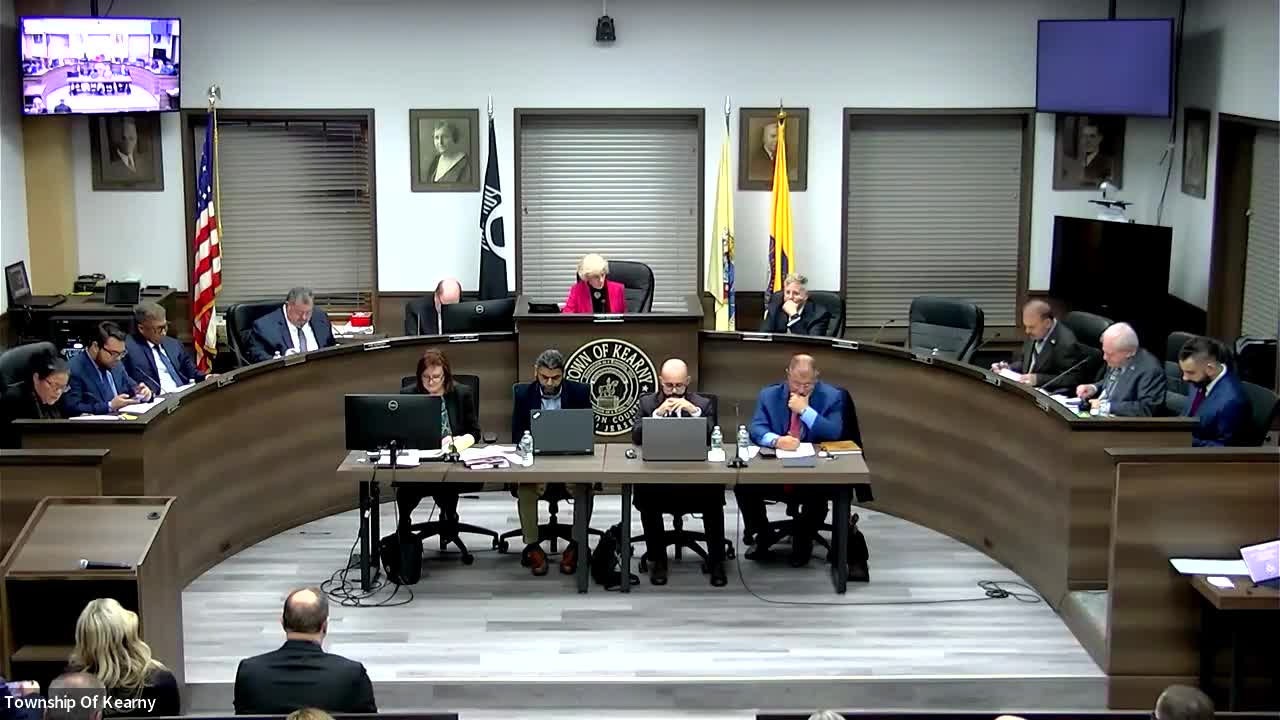
Kearny council adopts 25% first-year water rate hike after presentations on aging system and lead-line costs
Summary
After presentations from Veolia and NW Financial, the Town of Kearny adopted an ordinance that raises water rates by 25% in the first year with additional 6% increases in 2026 and 2027; council and residents pressed utility operator on main breaks, lead-service-line replacements, and widespread estimated bills.
The Kearny Town Council on Tuesday adopted ordinance 25-O-10, approving a 25% increase in water rates in the first year and additional 6% increases in each of the next two years, after presentations from Veolia (the town's water operator) and NW Financial on the system's capital shortfall.
Council action followed a summary of maintenance and capital pressures by Veolia and a financial overview by Michael (Mike) Hanley of NW Financial. The presentations described rising repair costs tied to main breaks and the state-mandated replacement of lead service lines.
Why it matters: The town's water operation is approaching a larger, multi-year capital program. Veolia said 2024 produced an unusually high number of main breaks and expensive gatehouse work. NW Financial said the utility needs tens of millions of dollars of capital over the next several years and that the town has been subsidizing the utility from the municipal budget rather than running it as a self-liquidating enterprise.
Jason Kiernan, vice president at Veolia, and John Libitz, Veolia project leader and the system's licensed operator, told the council the town's distribution system contains roughly 80 miles of water main and more than 700 hydrants and that pipe age and soil conditions have driven failures. Veolia reported about 26 main breaks in 2024, well above the five-year average of roughly 11 to 19, and said rehabilitation work at the South Kearny gatehouse last year contributed to a maintenance spike.
"You could see over the last five years it's pretty consistent except for the last two years," John Libitz said during the presentation, summarizing activity and cost drivers. Veolia showed photos from the 2024 repair work and said the gatehouse rehabilitation cost about $285,000; a full new gatehouse with full piping had been quoted at about $1.4 million.
On lead service lines, Veolia said replacement costs in the county run roughly $8,000 to $11,000 per service. An estimated two-thirds of Kearny's roughly 8,000 services — about 5,000 — may be lead, the presenters said; at $10,000 a service that would imply an unfunded liability on the order of $50 million to meet the state's 10-year replacement requirement that began in 2021.
Mike Hanley of NW Financial said the town has been subsidizing the utility from the municipal budget "almost $3,000,000 annually" and recommended beginning to restore utility-derived revenue. "The ordinance you have before you is the first step in that process," Hanley said, describing a plan that begins with the 25% rate increase followed by 6% increases in 2026 and 2027.
Residents in public comment urged the council to fix longstanding metering and billing problems before or alongside any rate increases. Melanie Ryan and other speakers said many households are receiving estimated bills, sometimes for months or longer, and asked for a clear inventory of how many meters are unread and a timeline for replacements. Several residents described high estimated bills and difficulty getting customer-service resolution.
Council and staff responses and next steps: Council members pressed Veolia and the finance consultant on how much of current repair spending is lead-line replacement (Veolia estimated roughly $700,000 to $800,000 of the recent annual repair work was for lead service-line replacements). Veolia said it is updating the system's hydraulic model to identify locations for pressure-reducing valves that could reduce night-time pressure spikes and thus breaks. The town said it is pursuing low-interest financing through the New Jersey Infrastructure Bank for discrete street-by-street projects and has an application pending for projects that have a defined start and end.
Vote and implementation: Councilman Zapata moved to adopt the ordinance; a second was recorded (mover/second not specified in the transcript). The governing body voted unanimously on the final adoption roll call: Echol — yes; DeCastro — yes; Facido — yes; Zapata — yes; Diodaropoulos — yes; Solano — yes; S. Steves — yes; Rodriguez — yes; Mayor Doyle — yes. The ordinance passed.
Council members and staff said they will ask Veolia for a report listing accounts currently billed on estimates, and for a schedule to replace or repair meters and MTU radio read devices. Several council members said their priority is both to begin stabilizing the utility's finances and to accelerate work to fix meter and meter-reading problems residents raised during public comment.
Ending: The council approved the ordinance as the first step toward funding the utility's capital needs and reducing municipal subsidies; residents and several council members said they will monitor meter-read and billing remediation closely as the town implements the rate increases and pursues state or low-interest financing for pipe and service-line work.