Get Full Government Meeting Transcripts, Videos, & Alerts Forever!
Get email alerts on the Rural Economic Development topic
No spam. Unsubscribe anytime.
Northern Michigan Chamber Alliance urges state support for regionally driven rural development
Summary
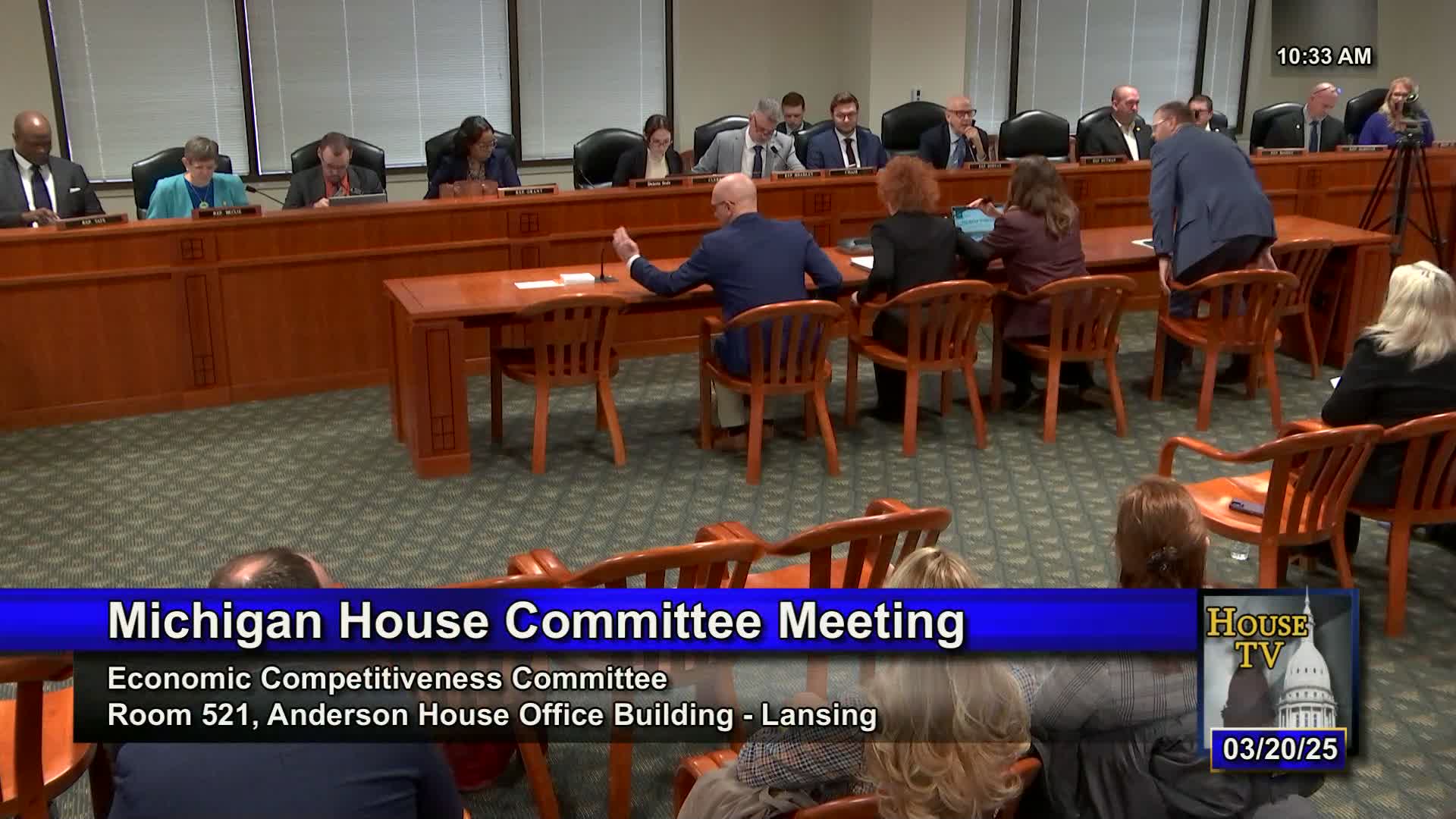
Chamber leaders from Northern Lower Michigan and the Upper Peninsula told the House Committee on Economic Competiveness that targeted, smaller-scale public‑private investments — housing, childcare, broadband, and place‑based grants — produce outsized returns for rural communities and should be preserved or expanded in state budgets.
Good morning. And thank you, Chairman Hoadley, for this opportunity and invitation to be here today. Good morning, members of the committee. We're really honored to have this opportunity and to represent Northern Lower Michigan as well as the UP. Our purpose of being here today is really just to highlight what rural economic development means to us in our communities, Haley, Northern Michigan Chamber Alliance spokesperson, told the committee.
The alliance asked lawmakers to protect and expand state programs that its members say have leveraged modest public dollars into housing, business growth and local partnerships across the Upper Peninsula and northern Lower Michigan.
Why it matters: Alliance leaders argued small, targeted investments can create sustained local impact in places that lack the infrastructure and workforce density of urban areas. ‘‘The founding, thriving foundation of any community is 100% tied to its people,’’ Nikki Devitt, president and CEO of the Petoskey Regional Chamber and chair of the Northern Michigan Chamber Alliance, told the committee.
Leaders described three broad themes for state policy: regionally driven economic competitiveness, workforce and talent development, and ‘‘real prosperity’’ that includes housing, healthcare access and childcare as part of economic strategy. Christopher Germain, CEO of Lake Superior Community Partnership, said rural areas lean heavily on public‑private partnerships and often measure success by smaller job gains: "You won't typically see a thousand job creation announcements ... but I can tell you 50 jobs makes a world of difference in rural communities."
Examples and programs discussed
- Marquette redevelopment: Speakers described a public‑private effort to clear a former hospital site adjacent to Northern Michigan University. The alliance said roughly $20,000,000 in public funding helped demolish the old Marquette General Hospital site to enable future housing development on more than 20 acres.
- Negaunee downtown investment: About $885,000 in public funding was cited for a downtown re‑investment project that alliance members said catalyzed new businesses and commercial activity outside Marquette.
- Build UP / InvestUP: The alliance said the UP program seeded with approximately $15,000,000 in state investment has supported more than 200 housing units and local program development, including interest‑rate buy‑downs and career‑tech partnerships.
- MEDC incentives and small job projects: Presenters said projects such as an Able Medical expansion in Marquette produced roughly 40–50 new jobs supported by a reported $500,000 Michigan Economic Development Corporation business development incentive; another project cited 50 jobs with a similar incentive level. (Speakers gave these figures as examples; exact contract and award documents were not provided in committee testimony.)
- Revitalization and Placemaking (RAP) grants and Office of Rural Prosperity (ORP): Alliance members credited the RAP grants and ORP grants with enabling downtown housing conversions, streetscaping and placemaking projects in Petoskey, Elk Rapids, Charlevoix and other communities. The alliance reported $32,000,000 in RAP funding directed to projects in northern Lower Michigan and the UP to date.
Additional needs: Speakers urged more investments in broadband, water and sewer infrastructure, air service and year‑round housing to support workforce retention. Childcare capacity was repeatedly cited as a constraint: one presenter said long licensing waits and limited administrative capacity had driven potential childcare providers away. Representative Altman asked speakers to identify licensing and administrative barriers; speakers named both regulatory requirements and the lack of licensing staff as obstacles.
Tourism and year‑round economies: Presenters emphasized tourism is significant but not sufficient as a standalone economic base. The alliance cited statewide visitor spending data and argued that rural places need diversified, year‑round employment and housing to retain workers and families.
What presenters asked: Alliance members urged lawmakers to preserve and tailor major state tools — including SOAR site‑readiness funds, ORP allocations, RAP grants and targeted MEDC incentives — so rural communities can continue to use smaller, locally appropriate investments for housing, infrastructure and business support.
Ending: Committee members asked a few follow‑up questions on childcare licensing and short‑term rentals; presenters offered examples of local responses and said they would follow up with project lists. The presenters thanked the committee for the opportunity and asked lawmakers to consider regional allocations as the legislature evaluates budgets.