Get Full Government Meeting Transcripts, Videos, & Alerts Forever!
Get email alerts on the Economic Development topic
No spam. Unsubscribe anytime.
MEDC outlines 'Make It in Michigan' strategy focused on people, places and projects
Summary
The Michigan Economic Development Corporation told the House Committee on Economic Competitiveness that its 'Make It in Michigan' strategy centers on workforce development, placemaking and project attraction, citing program metrics, regional teams and examples of recent awards.
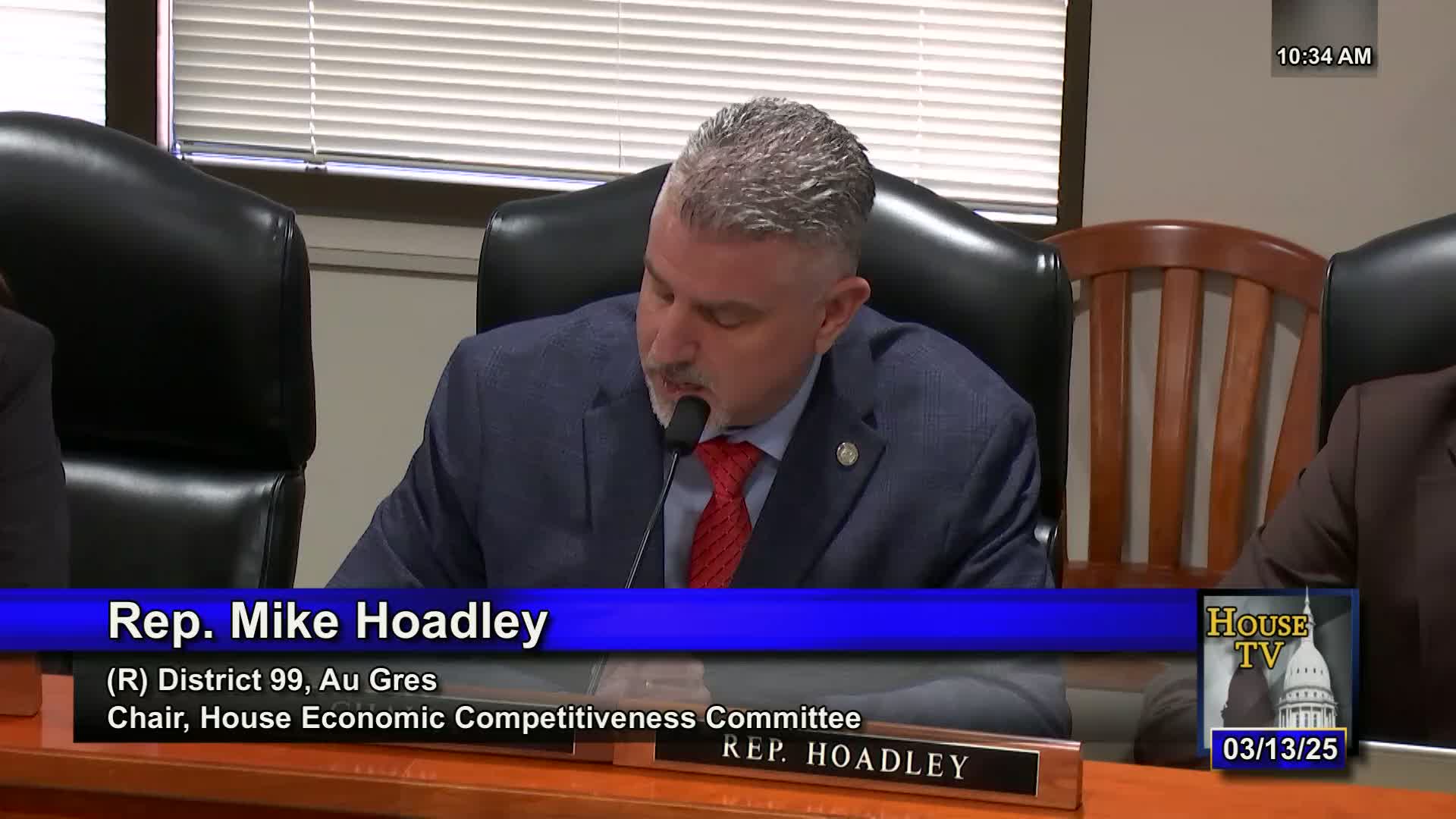
LANSING — The House Committee on Economic Competitiveness heard testimony from the Michigan Economic Development Corporation on its Make It in Michigan economic development strategy, Director Quentin Messer told the committee. Messer said the strategy “focused on attracting and developing people, cultivating and revitalizing places, and then competing for and winning projects.”
The presentation, given by MEDC Director Quentin Messer and Hillary Doe, the agency’s chief growth officer and chief marketing officer, outlined three pillars — people, places and projects — and highlighted statewide programs intended to connect talent with jobs, revitalize commercial districts and attract manufacturing and technology investment.
MEDC staff told lawmakers the agency works through 10 regional prosperity teams and supports partner organizations statewide, supplying technical assistance via small business development centers, 20 smart zones, the Michigan Manufacturing Technology Center and Apex Accelerators. Messer described the strategy as developed with both the executive and legislative branches and said the agency uses continuous strategic assessment and market feedback to shape programs.
On the people pillar, the agency described workforce pipelines and recruitment efforts, including the Michiganders Scholars Program and an AI-driven career portal tied to the UCAN and Michigan talent attraction campaign. Hillary Doe said the people goal is “to build a state where our workers feel connected to and are able to participate in the shared prosperity and economic growth.” MEDC reported that the talent campaign produced about 27,000 people who indicated interest in living and working in Michigan during roughly 18 months of activity.
On places, MEDC highlighted Michigan Main Streets and other placemaking tools. The agency said Michigan Main Streets projects announced in fiscal 2024 are projected to leverage about $3,900,000,000 in placemaking investment and reactivate approximately 6,400,000 square feet of public space. MEDC also said wrap investments leveraged roughly $500,000,000 in private investment in FY22 and nearly $950,000,000 in FY24.
Messer cited programs intended to make communities “redevelopment ready,” including the Redevelopment Ready Communities initiative, the community revitalization program (a budget line the agency described as roughly $100,000,000 annually for business attraction and revitalization), Build Michigan community public spaces, and brownfield tools. He used the example of Ordok Brewery, a mixed-use project that MEDC said attracted $7,800,000 in private investment and received a $3,900,000 revitalization award and additional local match and brownfield support to remediate blight and add housing and public space.
Under the projects pillar, MEDC described the Michigan Business Development Program, early-stage funding, match-on-main small business grants, small business lending, manufacturing-technology assistance for automation and AI, the strategic site readiness program and a critical industries focus meant to position the state for federal industrial funding. Messer noted Michigan added about 46,000 jobs in MEDC’s targeted focus industries between 2021 and 2024 and that the state ranks among the top states in absolute job numbers in those industries.
Committee members asked how legislators can better serve as ambassadors for MEDC programs. Messer suggested inviting MEDC staff to district events, joining company visits and using the agency’s website, www.michiganbusiness.org, to route businesses to programs. Hillary Doe said MEDC’s external affairs team can provide a point of contact to help legislators and their staff navigate available programs.
Messer closed by saying MEDC will return for follow-up briefings and that the agency seeks ongoing legislative input on refining tools and priorities.
MEDC provided contact information at the end of the presentation and distributed written materials to committee members for follow-up.