Get Full Government Meeting Transcripts, Videos, & Alerts Forever!
Get email alerts on the Public Safety Hotspot Policing topic
No spam. Unsubscribe anytime.
Yuma Police report reduced gun‑violence calls at targeted hot spot after year‑long program
Summary
Yuma Police presented first‑year results of a hot spot policing program, reporting that gun‑violence calls and reports taken in the targeted Arthur Tonglen hot spot remained flat while citywide gun‑violence cases rose. The department plans a second phase to bring social services and nonprofit partners into the area.
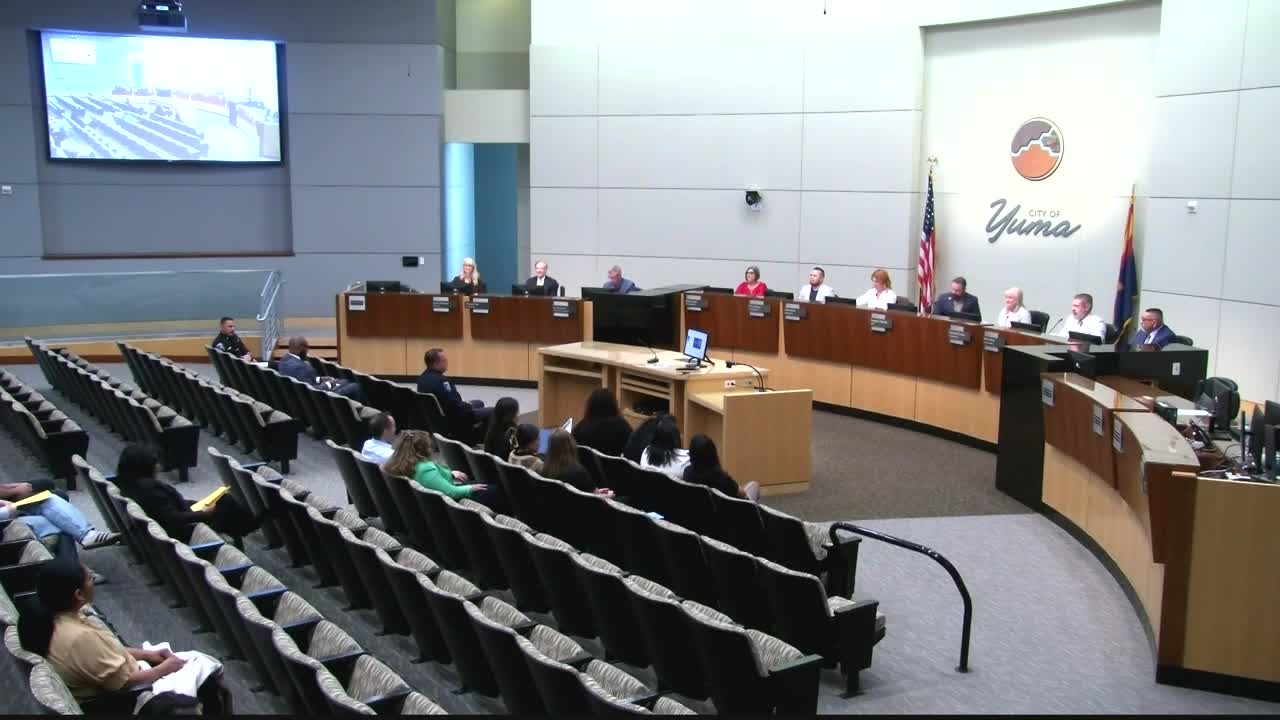
Chief Garrity, Yuma Police Department, and Lieutenant Robbie Wright presented the police department’s first‑year results for a hot spot policing program to the Yuma City Council on March 19.
The department said it defined “gun violence” internally as calls for service where a firearm was used and there was victimization or physical evidence. Lieutenant Robbie Wright told the council the intelligence unit mapped 107 gun‑violence cases in 2023 and identified two recurring hot spots — Carver Park and the Arthur Tonglen area — and that the department concentrated resources on the hotter Arthur Tonglen hot spot in 2024.
Wright said the department deployed a mix of tactics — 15 minutes of high‑visibility patrol at random intervals every two hours (about three hours of focused patrols per 24‑hour period), community engagement by officers on foot and bike, and both overt and covert cameras and license‑plate readers on public property — to deter crime and gather evidence. “We use the intelligence unit to find the high concentration of fish,” Wright said, explaining the hot spot concept.
The data the department presented show 107 gun‑violence cases citywide in 2023, 10 of which were within the Arthur Tonglen hot spot (a hot‑spot rate of 9.35 percent). In 2024 the city had 144 gun‑violence cases, 10 of which were in the hot spot (a 6.94 percent rate), a 2.41 percentage‑point reduction in the hot‑spot share, the department said. Wright also said calls for service within the hot spot fell 14.29 percent and reports taken in the hot spot fell about 49.9 percent from 2023 to 2024.
Wright attributed those changes to the hot spot patrols and said the program led officers to make more targeted arrests and provided evidence in cases that otherwise might have lacked it. He said the department limited its case selection to incidents with physical evidence of a firearm (for example casings, bullet damage or a firearm at the scene) and that those internal counts do not change how incidents are reported to national databases such as NIBRS.
Council members asked detailed questions about definitions and methods. Council member Martinez asked whether the department’s broader definition of gun violence would affect comparability with state and federal reporting. Chief Garrity and Wright said the department’s definition is for internal targeting; when they report to the FBI under NIBRS the department follows those standard definitions. “While the FBI may not say a BB is a gun crime, to us, that is,” Garrity said, adding that the department reports to NIBRS using the national definitions.
Council members also asked about displacement of crime and whether policing in one area moved activity to another neighborhood. Wright said data show occasional “warm” spots appearing elsewhere — most recently near Kennedy Park — but that the department’s analysis does not indicate crime was simply displaced from Arthur Tonglen. Wright said the program’s second phase will seek to bring city departments, churches, and nonprofit partners into the hot spot to address community needs and sustain improvements after the police reduce concentrated patrols.
Wright said the hot spot program has operated for about 14 months, involves many patrol officers across beats rather than only a few officers, and is carried out during regular patrol hours rather than as overtime. He also described camera and license‑plate reader deployments at intersections inside the public right‑of‑way and said they do not view private property.
Council members thanked the presenters and voiced support for continuing to the next hot spot after Phase 2 work begins.
The presentation and council questions concluded with the department saying it will continue the hot spot policing while developing the community‑support phase that will include neighborhood services, churches and mental‑health providers.