Get Full Government Meeting Transcripts, Videos, & Alerts Forever!
Get email alerts on the Budget Temporary Appropriation topic
No spam. Unsubscribe anytime.
Council approves AprilMay emergency temporary appropriation amid questions over 5.6% introductory tax figure
Summary
Paterson City Council adopted a temporary appropriation covering AprilMay 2025 to maintain city operations while its introduced budget is reworked. Council debate centered on an earlier 5.6% introductory tax plug tied to anticipated $33 million in transitional state aid.
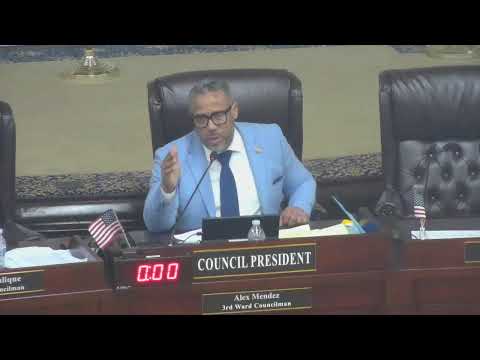
The Paterson City Council voted to adopt an emergency temporary appropriation to fund city operations through May 2025, after extended discussion about the introduced budget and the assumptions behind a possible tax increase.
The resolution (Administration resolution 25:222) authorizes temporary appropriations for April and May 2025. The measure passed on a roll call vote (7 in favor, 2 opposed). Councilmembers said the item is routine in municipalities that have not adopted a full budget by the end of the first quarter, but many used the debate to press the administration for detail on the broader budget assumptions.
Council members repeatedly raised a 5.6% tax increase figure that had been included in the introduced budget. Administration staff told the council that the 5.6% number reflected an introductory budget scenario that assumed up to $33 million in state transitional aid; without final state certification of that aid the city must rely on temporary appropriations to keep services running.
Council members asked for written clarification from the CFO explaining (1) why an AprilMay temporary appropriation was needed instead of relying on existing funds, (2) the precise dollar amounts involved in the temporary appropriation, and (3) whether previously-allocated capital or one-time items (including a $1,000,000 allocation for cameras) remain on track.
Several council members urged enforcement measures and revenue strategies rather than immediate reliance on property tax increases: stricter enforcement of commercial parking rules, better use of existing permit and ticketing penalties, and full use of enterprise-zone or code-enforcement revenue streams came up in debate.
The appropriation passed; councilmembers asked the CFO and administration to provide written detail on the temporary appropriation amounts and a timeline for re-introducing the municipal budget.
Ending: The measure ensures the city will remain funded while council and administration negotiate the introduced budget; councilmembers signaled they expect more documents and a plan before approving any property tax increases.