Get Full Government Meeting Transcripts, Videos, & Alerts Forever!
Get email alerts on the Entertainment License topic
No spam. Unsubscribe anytime.
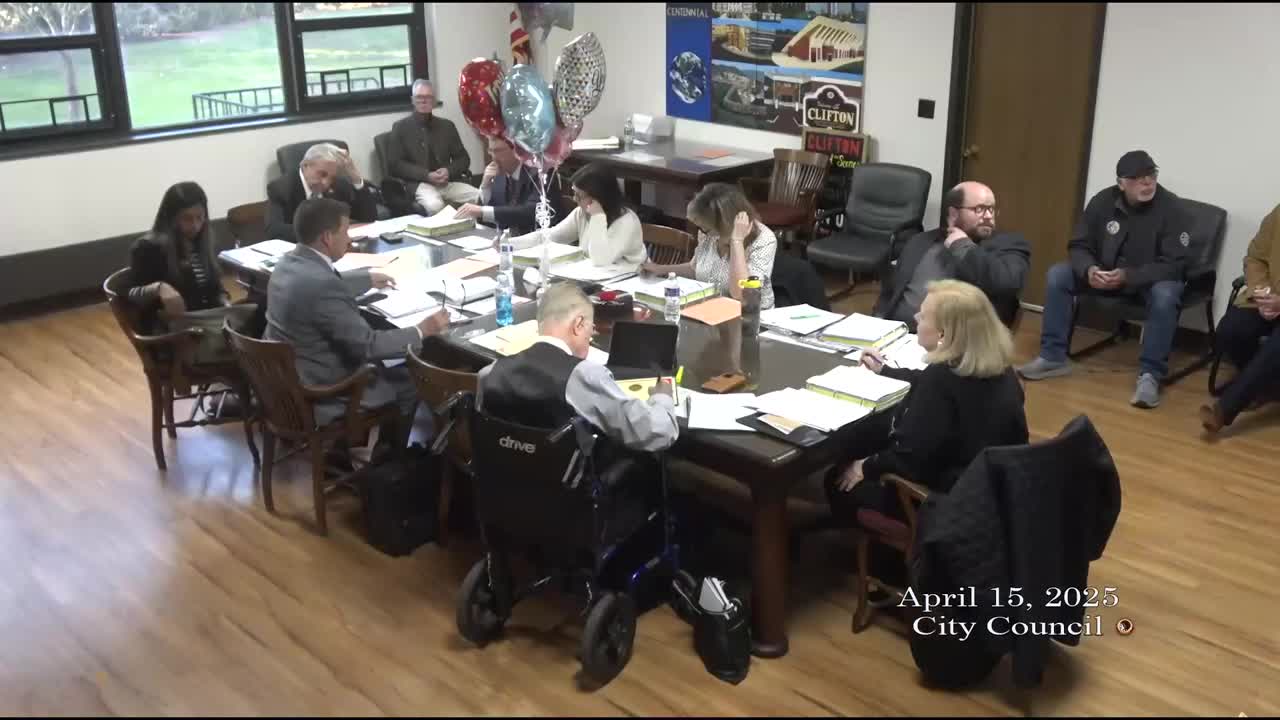
Clifton council denies entertainment license for La Habana 59 after hours, noise and parking concerns
Summary
The City of Clifton denied a request for an entertainment license for La Habana 59 after residents and council members raised persistent concerns about noise, late hours, parking overflow and zoning precedent tied to a prior nightclub case.
The Clifton Municipal Council voted to deny an application for an entertainment license for La Habana 59, a proposed Cuban restaurant and live-music venue, after more than two hours of testimony from the applicant, his attorney and more than a dozen neighbors and business owners.
The motion before the council sought to deny the entertainment license application for the property at the former Chengdu/Shenzhou restaurant. Supporters of the application said the business would operate as a family restaurant with limited live entertainment; neighbors said the proposal would function as a nightclub and resurrect the problems long associated with a closed nearby venue known as Pub 46.
Why it matters: Council members and public speakers described repeated, long-running problems in the neighborhood—noise late at night, people loitering and urinating, spilled trash and vehicles parked in residential streets. Several speakers said those problems persisted for years while Pub 46 operated, and they argued the La Habana proposal shared the same features that produced those problems: live music until late hours, dancing and service that shifts to primarily alcohol after 11:30 p.m.
The applicant, Pedro Ordonez, said he plans a Cuban restaurant with music three nights a week, a small dance floor and a kitchen that would close roughly at 11:30 p.m. He told the council he intends to use decibel meters and to direct performers to keep volumes low. Ordonez told the council he expects food-to-beverage revenue around 55/45, estimated seating between 148 and 156 (applicant also stated an interior configuration that would seat about 40 in certain calculations) and said he contracts valet service for busy nights.
Opponents included multiple residents who live within a few dozen feet of the restaurant’s rear fence, owners of neighboring businesses and an attorney representing a neighboring property owner. They cited direct experience with Pub 46-era impacts—trash, threats, late-night altercations, property damage and repeated calls to police—and said the La Habana plan would invite similar outcomes. “This is another nightmare waiting to happen,” one long-time neighbor told the council.
Legal context: An attorney representing neighbors cited an Appellate Division decision involving Pub 46 that treated a superficially similar operation as a nightclub, not a restaurant, and warned that issuing an entertainment license could circumvent land-use rules controlled by the Planning/Zoning boards. Council legal staff confirmed the municipal zoning code does not define “nightclub” and that community tolerance for live entertainment can trigger land‑use questions that are more appropriately addressed by the Board of Adjustment.
Council response and decision: Councilors pressed the applicant on specifics—sound insulation plans, the size and amplification of performing groups (the applicant proposed a maximum of three musicians on peak nights), parking counts and the plan to keep a kitchen door closed during music. Several council members said the applicant’s plans were incomplete; others said the neighborhood’s injury from prior venues weighed heavily. After debate the council voted on a motion to deny the entertainment license application; the motion to deny carried. Council members also directed staff to draft an ordinance change to require neighbor notification for new and renewal entertainment licenses and to tighten the renewal process so residents receive notice and an opportunity to be heard.
What the council heard in detail: Residents who said they lived within roughly 15–50 feet of the building’s rear door described repeated episodes of loud bass, people leaving at 1–3 a.m., urine odors near fences and property damage. The applicant described programming as a solo singer and small ensembles on limited nights; he said music would be stopped before closing and that he would use sound meters and insulation where feasible. Council members questioned the applicant’s timeline for hiring sound engineers and finalizing interior soundproofing.
Next steps: The council ordered staff to propose an ordinance to require neighborhood notification for both new and renewal entertainment licenses (council direction referenced a 200-foot notice practice used for zoning variances) and to publish clearer rules for how renewals are handled in areas with quality-of-life complaints. The denial of the license is subject to whatever legal remedies the applicant or neighbors pursue.
Ending: The item drew the largest public turnout of the evening and at times turned emotional as residents described years of hardship. The council’s denial leaves the applicant able to pursue other routes—including a zoning-board application—if he chooses, but it also prompted the council to promise changes to notification rules so residents receive earlier notice of similar proposals.