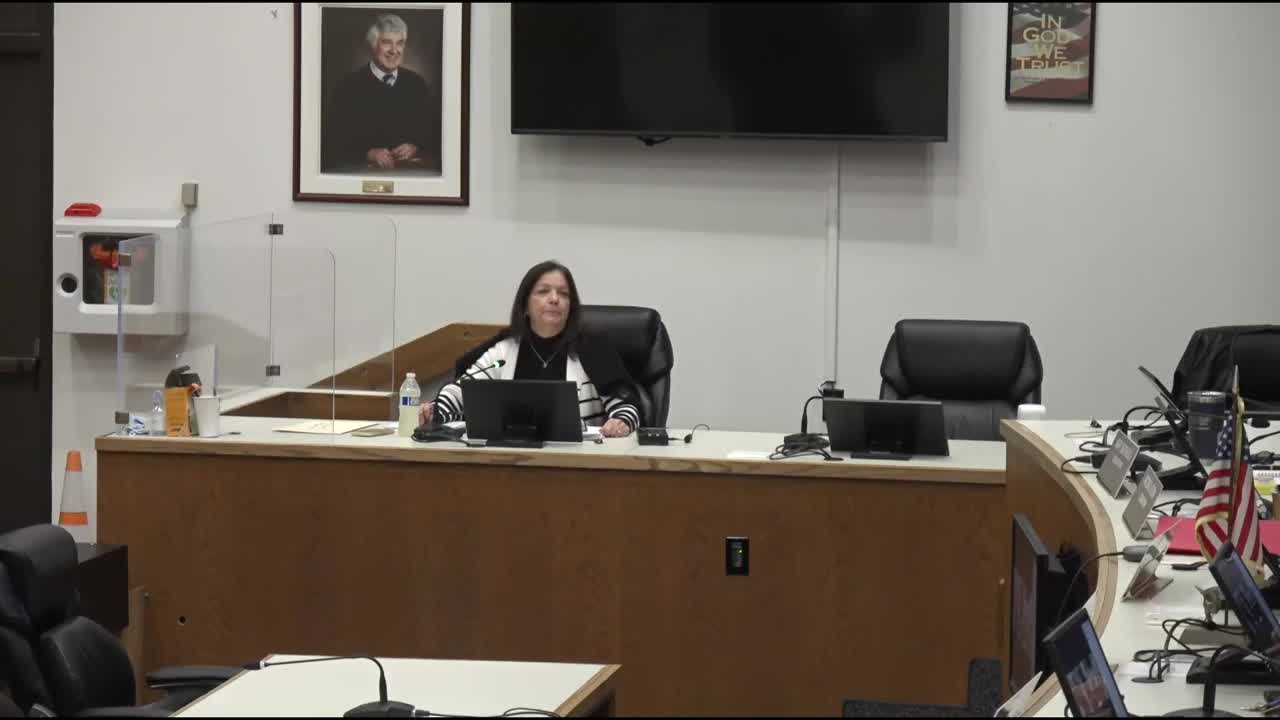
Clifton council opens 2025 budget review; members flag $8 million shortfall and $1.07 million in delinquent sewer charges
Loading...
Summary
The Clifton Municipal Council met under a special-meeting notice published Feb. 10, 2025, to begin review of the 2025 municipal budget, focusing on a roughly $8 million draft gap, reliance on one-time ARPA and grant revenues, and $1,072,391.52 in delinquent sewer charges.
The Clifton Municipal Council met under a special-meeting notice published Feb. 10, 2025, to begin review of the city—s 2025 municipal budget, focusing early on the sewer utility, fund balance and revenue assumptions.
Council members and staff told colleagues the current fund faces an estimated shortfall of roughly $8,000,000 in the draft 2025 budget and that the city is relying less on one-time federal American Rescue Plan (ARPA) payouts and other grants than in recent years. Council members pressed administration for more detailed, year-by-year fund-balance and revenue breakdowns and for earlier distribution of budget documents before future meetings.
Sewer utility: delinquent accounts, rate pressure and transfers Officials reported $1,072,391.52 in unpaid sewer charges from 2024, and said delinquent notices have been or are being mailed. Council members were told unpaid sewer charges generally enter the tax-sale process about a year after nonpayment; if a lien is sold at tax sale a lienholder pays the city and the revenue is realized then. Staff said collection rates run higher for property taxes overall (about 98%) than for sewer accounts (about 91%).
Council members and staff also discussed a large 2025 increase in the sewer budget tied to higher billing from the Passaic Valley Sewage Commission and other cost pressures. To balance the utility for the draft budget, staff said they moved $200,000 from the current fund to cover a sewer deficit and relied on sewer fund balance to absorb the remainder; council members were told using the draft figures would exhaust the sewer fund balance (staff described a roughly $1.06 million use of fund-balance to make the utility work under the current draft). Several council members objected to taking further action on sewer rates until an updated sewer study — which the council just approved a $7,500 update for — is completed.
Current fund, ARPA and recurring costs Council members discussed that the city ended 2024 with about $14,000,000 in current-fund balance and that the draft budget would use roughly half of that (about $7,000,000) to close the 2025 gap. Staff reminded members that the prior availability of ARPA and other grant receipts materially supported the city—s fund balance in recent years; staff said the city previously received roughly $33 million in ARPA-related funds and that about half of that was set aside for capital. Council members and staff noted that ARPA spending that helped balance earlier budgets is no longer available for recurring expenses.
Members asked for clearer, line-by-line explanations of where prior-year surpluses and one-time grant proceeds were used and for a multi-year fund-balance history by fund. Council members also pressed for concrete cost-cutting proposals from administration and asked that budget documents be distributed earlier (they requested materials the Friday before meetings) and posted online for public review.
Revenue assumptions and specific line items Administration described a 2.5% illustrative increase in the levy used in the draft revenue estimate (moving the revenue figure from about $89.7 million in 2024 to roughly $92.2 million in the draft). Staff reported an estimated $8,000,000 overall gap on the draft revenue/expenditure balance if no additional savings or revenue changes are adopted. Council members pointed to specific drivers, including a $1 million pension increase and a $700,000 rise in the city—s garbage contract as contributors to rising expenditures.
Council members raised several other revenue and trust-account items for follow-up: the police extra-duty trust (reported year-end balance $806,000 with $605,000 in administrative and vehicle fees that the city retains), an opioid settlement balance of roughly $514,000 limited to qualifying public-health purposes, and questions about how payments in lieu of taxes (PILOTs) are shown in the revenue schedule (staff explained the draft uses a net approach that subtracts county shares from PILOT receipts rather than showing a gross line and a separate county expense). Members asked staff to provide itemized spreadsheets for pilots, trust accounts and a multi-year reconciliation of each fund.
Insurance, capital and grants Staff noted higher projected insurance and liability costs and said changes in the market have introduced both higher premiums and a new —corridor— exposure in addition to per-claim deductibles; the city is budgeting to cover the corridor/deductible exposure in a trust account. Council members also reviewed that large grant awards in prior years (including state funding for parks) boosted 2023'024 revenues and that current-year grant projections are lower so far. Members asked staff to identify known grants that can be expected in 2025 and to quantify the city—s exposure to federal and state grant funding.
Staffing, overtime and programmatic questions Council members examined salary and benefit line items for multiple departments. Discussion included police and fire overtime variances from 2024 to the draft 2025 budget, increases in part-time or temporary lines in several departments (including health), and whether some positions in the draft are fully funded for a full year even if vacancies persist. Members asked for a breakdown of outside legal expenses by firm/attorney and for more detail on the allocation of special-events overtime across departments so that the $200,000 special-events appropriation can be reconciled with actual charges in police, fire and public works.
Code enforcement and illegal dwellings Several council members urged the city to pursue stronger enforcement against illegal dwelling units and raised possible program responses including a non-owner-occupied inspection program, public outreach about relocation assistance available under state rules, and increased use of quality-of-life officers. Staff said there are enforcement pathways — including administrative warrants when cause exists — but that investigations and prosecutions can be time-consuming and that fines and penalties are limited under current procedures. Council members asked staff to return with a concrete proposal and cost estimate for additional enforcement or inspection authority.
Next steps Council members asked that staff: provide detailed, redlined budget worksheets and the underlying spreadsheets (including Excel files) ahead of the next meeting; produce year-by-year fund-balance history for the current and sewer funds; itemize trust-account balances and the composition of police extra-duty escrow; and bring cost-saving options for consideration. A follow-up budget meeting was scheduled in two weeks; council members requested documents be distributed at least by the preceding Friday so members can review them in advance.
Adjournment The meeting concluded after the budget discussion with a motion to adjourn and a second. The council adjourned the special meeting.