
Horry County Schools outlines $2025–26 budget priorities, seeks funds for teacher pay, AI tools and dual enrollment
Get AI-powered insights, summaries, and transcripts
Sign Up Free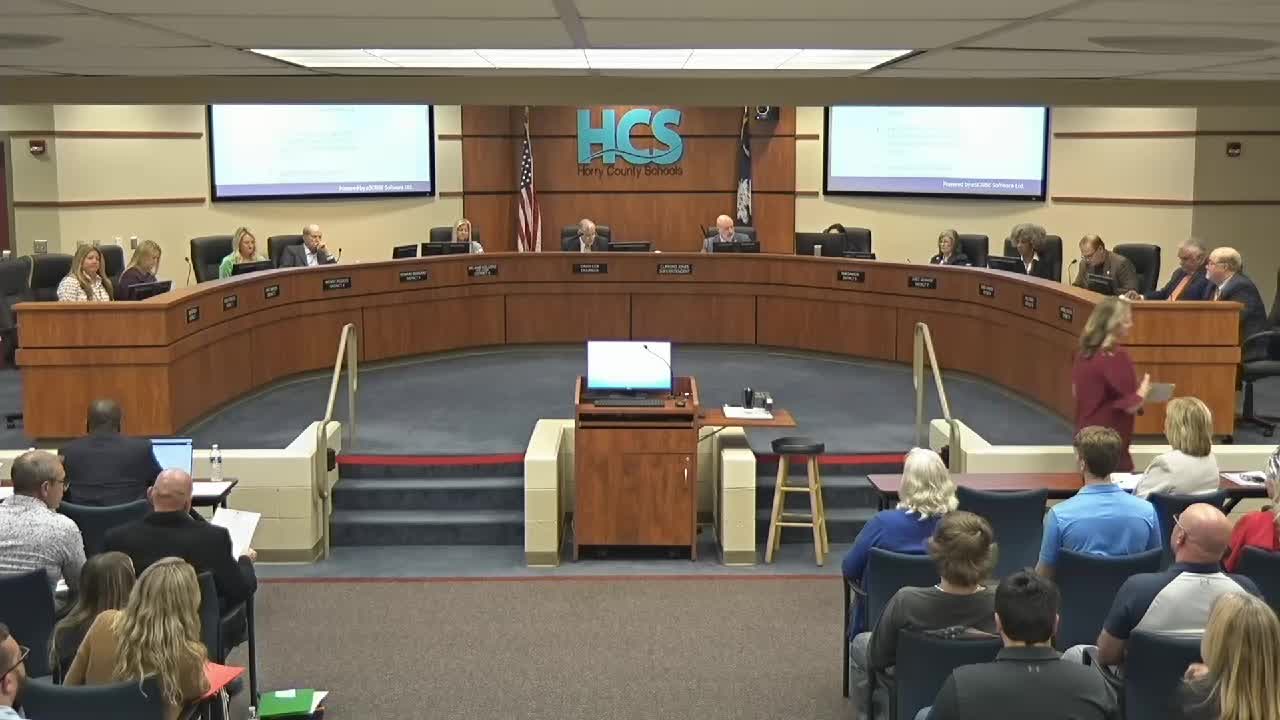
Summary
Superintendent Jones and chief officers presented Markup 1 of the 2025–26 budget March 24, emphasizing a target $51,500 starting teacher salary, assumed 2% COLA plus step increases, two new elementary schools, and one‑time requests for AI tools, dual‑enrollment shortfall coverage and expanded literacy supports.
Superintendent Jones and district chiefs presented the district’s Markup 1 budget proposals on March 24, laying out assumptions, central‑office request lines and several one‑time program asks ahead of a final superintendent’s recommendation in May.
The presentation focused on steadying pay and expanding classroom resources as the district opens two new elementary schools next year. Superintendent Jones said staff were using conservative planning assumptions — including an assumed step increase and a 2% cost‑of‑living adjustment for budgeting — and pledged the budget would “reflect what we need to do for our students here in Horry County Schools.”
Why it matters: The presentation set the baseline for compensation, staffing and program decisions that affect schools’ classroom budgets, special‑education services, transportation and capital support. The board will take additional votes in April and May before adopting a final budget.
Key numbers and assumptions
- The district is budgeting with the assumption of roughly $37 million in new revenue tied to the state; that figure is part of the planning assumptions staff are using but is subject to state action.
- For planning purposes staff are assuming a step increase for eligible employees plus a 2% COLA. The district signaled an aim to target a starting teacher salary of $51,500 next year.
- The timeline: district office (Markup 1) in March, school allocations and compensation (Markup 2) in April, final recommendation in May and adoption in June.
Major chief‑officer highlights
- Superintendent’s office: the superintendent requested two district safety vehicles as one‑time purchases for rapid response (not marked police vehicles) and reported reductions of several nonpersonnel packages totaling roughly $113,150. Nonpersonnel totals for the office were presented near $9.7 million, with total personnel costs for nine staff at about $1.46 million (including the step and COLA assumption). (Presentation: Superintendent Jones.)
- Fiscal services (Mr. Gardner): fiscal services presented personnel of 37.5 district employees, reported two long‑standing vacancies and a proposed nonpersonnel total that includes large district‑wide fixed operating costs. Gardner said staff reviewed 26 budget packages and cut $1.65 million but that opening two new schools will add roughly $2.65 million in costs. He requested an additional $1.3 million for substitute teachers based on prior year run rates and said a workers’ compensation premium rebate would reduce next year’s projection (an insurance trust rebate was discussed in the meeting; the amount referenced in the discussion was roughly $319,500). (Presentation: Mr. Gardner.)
- Learning Services (Lee James): Learning Services presented a nonpersonnel request near $19.3 million at the district level with 93 district positions (no requested additional FTEs). James said the department trimmed roughly $900,000 from the prior year by reviewing and reducing underused materials. One‑time requests included up to $200,000 for an AI tool to help teachers plan and differentiate instruction, $400,000 to cover a projected dual‑enrollment shortfall, $233,000 for a second year of LETRS (literacy) professional development and substitutes to allow teacher participation, and $100,000 to contract with Coastal Carolina University’s PEARL Center to evaluate district programs. (Presentation: Lee James.)
- Student Services (Velma Allen): Allen said her proposed nonpersonnel budget is roughly $10.27 million, and that about 92.5% of those dollars flow back to schools. Her one‑time request was to evaluate the Care Solace mental‑health care coordination contract (previously paid with ESSER funds) rather than automatically renew it out of the general fund.
- Support Services (Ben Prince): Support Services presented personnel and nonpersonnel numbers tied to custodial, maintenance, transportation and food‑service operations and noted large cost increases tied to opening Pine Island and Tin Oaks elementary schools. One‑time asks included funding for an added bus monitor per attendance office (presented as a one‑time $450,000 allocation to staff monitors districtwide while data collection is established) and modular classroom lease extensions at three schools (a one‑year extension total just under $500,000). Prince said routing and hiring improvements have allowed some reductions in transportation lines.
Items the board flagged for follow‑up
- Substitutes: chief officers asked for an additional $1.3 million for substitute costs based on actual 2023–24 spend; board members asked for clarification on where unfilled positions and coverage costs are recorded and suggested modeling a realistic fill rate scenario in the April markup.
- Dual enrollment: Lee James described the $400,000 request as a one‑time ask while the district updates MOUs with higher‑education partners; board members pushed to confirm recurring costs vs. one‑time adjustments.
- Artificial intelligence: James said the AI tool procurement would go through an RFP and would be piloted to support teachers; the board requested details on ongoing licensing costs and safeguards.
- Staffing and vacancies: Human Resources reported several clerical and technology vacancies and ongoing recruiting difficulty for certain IT positions; the district said it will return with proposed salary adjustments for hard‑to‑fill roles in later markups.
What the board did not vote on
Markup 1 was a discussion presentation; the board did not vote on the 2025–26 budget at the March 24 meeting. Final recommendations are scheduled for May, with adoption after subsequent hearings.
Speakers quoted in the presentation
- “Doing what's right for students in Horry County Schools is not dependent upon what's going on in Columbia or Washington, D.C. Our budget will reflect what we need to do for our students here in Horry County Schools. That's my commitment to this board,” Superintendent Jones said during his opening remarks.
- “We went through about 26 packages and we were able to reduce $1,650,000,” Mr. Gardner said while summarizing cuts in fiscal services.
Ending
Board members praised the line‑by‑line reviews and asked staff to return in April with compensation and school allocation details. The superintendent reiterated the May timeline for a final recommendation and asked the board to hold questions until the April markup for salary/compensation specifics.