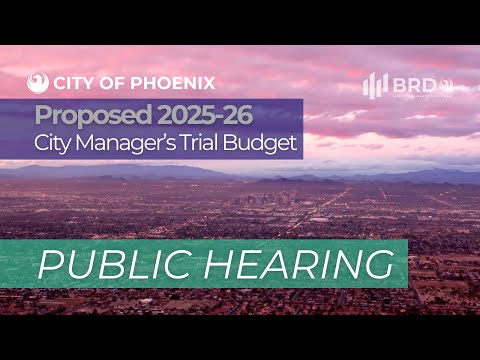
Phoenix holds District 4 budget hearing as veterans, firefighters and library advocates press council on funding
Get AI-powered insights, summaries, and transcripts
SubscribeSummary
PHOENIX — Residents and advocacy groups at a District 4 budget hearing urged Phoenix leaders to preserve and expand services in the proposed fiscal year 2025–26 budget, focusing public comments on veterans’ service officers, fire-department staffing, library materials, bike lanes and homelessness services.
The hearing reviewed the city manager’s proposed FY2025–26 “trial” budget and outlined the timeline for adoption: the proposal will be presented to the Phoenix City Council on May 6, voted on May 21 and legally adopted in June, with the city’s property tax ordinance scheduled for early July. City staff noted the proposal assumes previously approved actions, including a March 18 City Council vote that raised the city’s transaction privilege tax rate from 2.3% to 2.8%, effective July 1, 2025.
Why it matters: The budget hearing gathered stakeholders who said small-to-midsize changes in the budget will have immediate effects on emergency response times, homelessness services and access to library materials for low-income residents. Several speakers asked the council to reverse proposed cuts or add new targeted funding to avoid service disruptions.
Veterans and veterans’ groups pressed for funding to expand local claims and benefits assistance. “So we need about 8 to 10 more service officers just in Greater Phoenix area,” said Thomas Kendra, a veteran and speaker at the hearing, who described long-term health effects from toxic exposures and the need for additional service officers to help veterans file claims. Joe Sephora, representing VFW Post 720, asked the city for $350,000 to develop a service officer program through the VFW, saying the funds would help veterans access benefits and reduce homelessness. A representative of Disabled American Veterans Chapter 1 asked the council for $400,000 to support chapter services and a permanent meeting space for veterans seeking in-person assistance.
Firefighters and public-safety backers spoke in favor of the budget’s proposed public-safety investments. Ben Lucas, representing United Phoenix Firefighters, said the budget would bring staffing and capital investments the department needs and warned of current strains on response capacity: “It ultimately took the first truck to get to my parents’ house in 19 minutes,” Lucas said, recounting a delayed response that he tied to high call volumes and limited apparatus availability. The budget presentation cited plans to fund two new fire stations and additional apparatus using excise-tax proceeds.
Speakers also opposed proposed cuts to library materials. Carolyn Cruz, a Friends of the Phoenix Library board member, said the group opposes a proposed $250,000 reduction to library materials budgets and warned cuts would increase wait times and reduce access for low-income residents. Several other speakers echoed that position and asked the council to reinstate the $250,000 allocation.
Active-transportation advocates urged continued investment in protected bike lanes and pedestrian safety. John Walker of Phoenix Spokespeople and other residents credited protected lanes on Third Street and in the Willow neighborhood with increasing neighborhood activity and safety, and they urged expansion of similar infrastructure, including connections to the Rio Salado and South Phoenix.
Homelessness and shelter funding drew multiple appeals. The proposed budget includes a revised estimate of $4.5 million in general fund resources for the Office of Homeless Solutions for FY2025–26 to replace ending federal pandemic-era funding, according to the budget summary read at the hearing. Several speakers described gaps in outreach and shelter services and asked the council to maintain or increase funding for shelters, summer resource centers and navigation services.
Infrastructure and utilities also appeared in the budget overview. The proposal includes a $5,600,000 non‑general fund addition to the Water Services Department budget to support reopening the Cane Creek Water Reclamation Plant and expand wastewater and purification capacity.
City Council context and timeline noted by staff at the hearing included an emphasis on balancing the budget “as required by state law,” the March 18 action on the transaction privilege tax, and use of multiple strategies to offset revenue losses from state actions, including reprioritizing the general fund, using excise tax proceeds for capital projects and setting aside reserves.
Councilmember Laura Pastore, who chaired the hearing, thanked speakers and reiterated the council’s stated priorities, including public safety, maintenance and bike-lane investments. “I do believe in protective bike lanes,” Pastore said. She also said the city will continue to advocate for more fire stations while recognizing that staffing and maintenance must accompany new facilities.
The hearing allowed residents to place written comments on the record and to speak in person. The city encouraged residents to review budget materials at phoenix.gov/budget and to attend the May 6 council presentation and the May 21 budget vote.
Votes at a glance: The hearing itself did not include formal votes. The proposal as presented incorporates the City Council’s March 18, 2025, vote to raise the transaction privilege tax rate from 2.3% to 2.8%, effective July 1, 2025.