Citizen Portal

Phoenix council approves $4.9 million 2025 heat‑response plan, leases 20 West Jackson for 24/7 respite center

3164837 · March 25, 2025

Get AI-powered insights, summaries, and transcripts

Subscribe
AI-Generated Content: All content on this page was generated by AI to highlight key points from the meeting. For complete details and context, we recommend watching the full video. so we can fix them.

Summary

The Phoenix City Council voted 8–0 on March 25 to approve a $4.9 million heat‑response plan that consolidates overnight services at a leased warehouse at 20 West Jackson, extends late library hours at three branches and funds contracts for operator and security services ahead of the May 1 start of the heat season.

PHOENIX — The Phoenix City Council on March 25 approved a $4.9 million 2025 heat response plan that consolidates overnight heat‑relief services into a leased 24/7 respite center at 20 West Jackson, extends evening hours at three library cooling locations and authorizes related contracts and an intergovernmental agreement with Maricopa County. The vote on the plan and related contracts was 8–0.

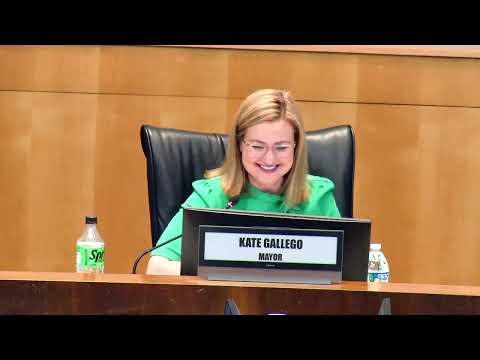
City officials said the plan builds on 2024 efforts that coincided with the first decline in heat‑related deaths in more than a decade and a 20% reduction in heat‑related 911 calls. Mayor Kate Gallego called extreme heat “an evolving public health emergency that requires every level of government to step up to save lives” and said the plan is designed to expand and refine heat relief ahead of seasonal temperature spikes.

The plan consolidates two overnight locations used in 2024 — the Burton Barr Central Library 24/7 respite and the Senior Opportunities West overnight site — into a single leased facility at 20 West Jackson. Deputy City Manager Gina Montes and heat‑office staff said the 20,000‑square‑foot warehouse can accommodate the combined population served at the two sites last year; staff estimated operational capacity “upwards of 100 individuals at any given time.” Rent and utilities for the lease were reported as roughly $40,000 per month; city staff said the proposed summer budget for the program is approximately $4,900,000, funded by City ARPA dollars, opioid settlement funds and funding from the Maricopa County Department of Public Health.

The City will contract with Community Bridges, Inc. (CBI) to operate the 24/7 respite center. The memorandum presented to council cited a proposed CBI contract amount of $2,900,000 to cover operations during the summer period; an additional up to $700,000 was identified for police overtime to provide exterior security at the site (city staff said CBI would reimburse for that service). City staff described an operational model of two 12‑hour shifts with a minimum of nine CBI staff per shift, plus Office of Homeless Solutions staff during daytime hours.

Fire, emergency‑medical and public‑health presenters reviewed 2024 outcomes used to shape the 2025 plan. Dr. Nick Stob, chief medical officer for the Maricopa County Public Health Department, summarized county surveillance data and told the council his office saw a preliminary decline in confirmed heat‑related deaths (602 preliminary in 2024 versus 645 in 2023) and described demographic patterns: roughly 80% of heat‑related deaths were male; most deaths occurred in people aged 35–64; about three‑quarters occurred outdoors; and about half of deaths were among people experiencing homelessness. He also said substance use was involved in more than half of 2024 heat‑related deaths and that “almost 90 percent of those deaths involving substance use involve stimulants.”

Phoenix Fire Department Executive Assistant Chief Tim Christ highlighted operational innovations and outcomes from last year, including cold‑water immersion treatment for critical hyperthermia cases (used 311 times May–October 2024) and a reported 20% drop in heat‑related 911 patient calls compared with 2023. Dr. David Hondula, director of the Office of Heat Response and Mitigation, described last year’s network of heat relief sites (including two 24/7/overnight locations and three extended‑hours library sites) that together logged roughly 35,000 visits from an estimated 5,000 unique individuals; staff reported 962 placements into shelter, housing, treatment or family‑reunification programs as a result of engagement at heat relief sites.

For 2025 the city plans to: (1) lease 20 West Jackson for short‑term use as the consolidated 24/7 respite and navigation center beginning May 1; (2) keep three library locations fully open with services and programs until 10 p.m.; (3) continue partnerships with Terros Health and ASU nursing for onsite medical care; (4) distribute water through a regional logistics partnership with Maricopa County; and (5) continue grants to community partners for localized heat relief. Staff said the operational season is May 1 through Sept. 30 with an option to extend month‑to‑month if heat persists into October.

Council members pressed staff on several topics during roughly two hours of Q&A: community outreach and engagement with neighbors and local businesses near 20 West Jackson; how the city selected CBI (staff said CBI was chosen from the city’s Qualified Vendor List based on prior performance in 2024 rather than a new competitive solicitation); anticipated staffing and security plans; whether the large leased warehouse could be partitioned or zoned to limit conditioned space and conserve energy; and the degree of oversight and auditing planned for contractor performance. Office of Homeless Solutions Director Rachel Milne said the city will conduct daily on‑site OHS monitoring during the season, and staff told council the city intends to perform fiscal and programmatic audits of CBI contracts.

Public testimony included praise for the city’s heat‑relief model from nursing faculty and faith‑based partners who said the program provides critical services and training opportunities; other public commenters and some council members urged stronger enforcement of the city’s cooling standards for rental properties and suggested additional community outreach and data collection to better target services. Council members asked for weekly heat response reports to be provided to the council and posted at phoenix.gov/heat; staff confirmed those reports will include heat‑related calls for service, site visits by location and service referrals.

Votes at a glance: Item 1 — Approval of the City of Phoenix 2025 Heat Response Plan (motion by Councilman Carlos Galindo Rivera; second not recorded on the public transcript) — outcome: approved, 8–0. Items 2–5 — authorizations including (a) lease of 20 West Jackson, (b) intergovernmental agreement with Maricopa County, (c) contract with Community Bridges, Inc. to operate the site, and (d) contract with CBI or other vendor for security services (motion by Councilman Carlos Galindo Rivera; second not recorded on the public transcript) — outcome: approved, 8–0.

Council and staff said operations are scheduled to begin May 1. Staff asked the council for authorization to execute the lease and contracts and to proceed with the operational model described to the council, and council members tied final oversight to the weekly reporting and the planned fiscal and programmatic monitoring of the contracts. That reporting will be publicly available on phoenix.gov/heat. Ending