Get Full Government Meeting Transcripts, Videos, & Alerts Forever!
Get email alerts on the Broadband Networks topic
No spam. Unsubscribe anytime.
Phoenix council adopts Chapter 5D to license fiber in city right-of-way with new contractor disclosures
Summary
The council voted unanimously to add Chapter 5D to city code authorizing licensed fiber-to-home providers to operate in Phoenix right-of-way, adopting new fee options, a microtrenching pilot and mandatory preconstruction contractor disclosures that could allow the city to revoke licenses for repeated noncompliance.
Phoenix — The Phoenix City Council on March 26 adopted a new city code chapter titled “Network Infrastructure Services” (Chapter 5D) to create a licensing framework for fiber-optic internet providers installing equipment in the city right-of-way.
The ordinance, identified as G-7,343, passed unanimously. City staff said the code is intended to allow additional internet service providers to build fiber-to-home networks while protecting Phoenix’s streets and requiring clearer contractor oversight.
City leaders said the measure matters because residents could gain more high-speed options and the city will have stronger enforcement tools if construction harms infrastructure or public safety. “If this proposed amendment goes forward, then the residents could have a choice for other internet service providers,” Deputy City Manager Alan Stevenson said during the presentation.
Staff presentation and key provisions
Deputy City Manager Alan Stevenson introduced the item and said the code mirrors existing licensing language for utilities and cable TV in the right-of-way and establishes rules specific to fiber. City Engineer Eric Froeburg explained the fee options staff proposed: either a 3% fee on direct gross revenue for vertically integrated providers, or 6% for firms that build wholesale fiber but do not themselves retail service. Staff also proposed an annual minimum fee of $6 per home passed until the percentage fee exceeds that amount.
The draft code also addresses construction practices. Staff said Phoenix will continue to prohibit microtrenching citywide for now but will allow a pilot program expected to begin in May. “One of them has taken us up on it and that pilot will start in May,” Froeburg said. The ordinance preserves the city’s pavement-restoration standards and requires contractors to comply with OSHA/ADOSH and other city safety rules.
Public safety and contractor transparency
Council members and labor representatives pressed staff for stronger oversight after recent high-profile problems with fiber deployments in neighboring jurisdictions. Jeremiah, president of Communication Workers of America Local 7050, told the council that Las Vegas had issued a notice of default to a fiber firm for “significant and unreasonable disruption” and urged Phoenix to require detailed workforce plans and contractor lists.
“We are encouraging the city of Phoenix to commit to a strong oversight process of these fiber developments,” Jeremiah said. Fernando Grama, another CWA member and a former technician, said requiring vendors to identify prime contractors and subcontractors at preconstruction meetings would improve accountability.
Council substitute motion and enforcement language
Councilwoman Laura Pastor offered a substitute motion adding specific administrative and contract requirements. Her motion directed staff to (1) require each contractor listed on the preconstruction meeting form to provide its Arizona registrar of contractors or business license number; (2) add language to future license agreements requiring licensees to abide by the city’s updated utility inspection and preconstruction procedures and to submit the completed preconstruction meeting form; and (3) reserve the city’s right to revoke a license or individual permits for noncompliance with license terms, construction permits, city code or policy (citing city code 31-80). She also asked staff to add a field on the form for the percentage of employees who reside in Arizona and the firm’s business cell number. “The city reserves the right to revoke a license agreement or individual permits for fiber to the home projects for noncompliance,” Pastor said as part of the motion.
Support from smaller and new providers
Multiple prospective providers and smaller operators spoke in favor of the code, saying it would allow competition with incumbent providers. Kelly Ann Shaw of BAM Broadband said the chapter “allows us to build and compete against the current monopoly.” Novose Fiber Chief Build Officer Andrew Novoselski and representatives from Zoom Technology and Novose also told the council they support the ordinance and will comply with inspection and public-right-of-way requirements.
Council and staff intent
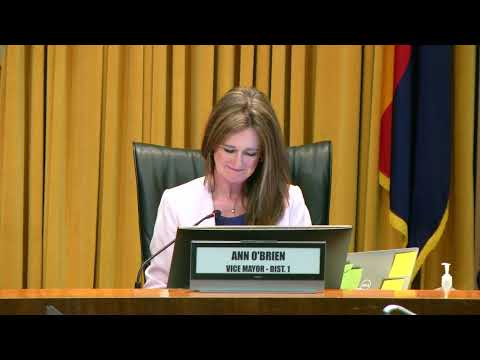
Council members repeatedly stressed two aims: expand broadband options and protect city streets. Vice Mayor O’Brien and others noted the council’s recent $200 million pavement investment and said the ordinance balances new deployments with pavement protection. Staff said the code also includes provisions to support new subdivisions — fees would be suspended for new developments until 51% of homes in a subdivision are sold, to avoid penalizing early build-out.
Outcome and next steps
Councilwoman Pastor’s substitute motion was adopted and the ordinance passed on a unanimous roll call. Staff said they will implement the administrative updates called for in Pastor’s motion and continue stakeholder engagement, including the microtrenching pilot and further work with unions and industry on inspection processes and contractor training.
The council directed staff to return with the updated forms and license agreement language and to make preconstruction notifications more visible to neighborhoods so residents know who is working in their streets and how to contact responsible parties.
Ending
Supporters and labor groups praised the added transparency measures as a practical response to problems in other cities, while industry players said the licensing path creates an opportunity to expand competitive fiber service in Phoenix. The ordinance creates a new regulatory framework Phoenix officials say they will use to balance infrastructure expansion with protections for residents and city streets.