Get Full Government Meeting Transcripts, Videos, & Alerts Forever!
Get email alerts on the Hb1930 Reimbursement topic
No spam. Unsubscribe anytime.
House committee advances HB 1930 to set minimum hospital reimbursement levels amid insurer, employer and hospital disagreement
Summary
The House Insurance & Commerce Committee voted to advance HB 1930, a bill that would set minimum commercial reimbursement rates for health-care providers in Arkansas with a phased approach starting at a 45% threshold. Insurers and business groups warned it could raise premiums; hospitals said higher reimbursements are needed to avoid closures.
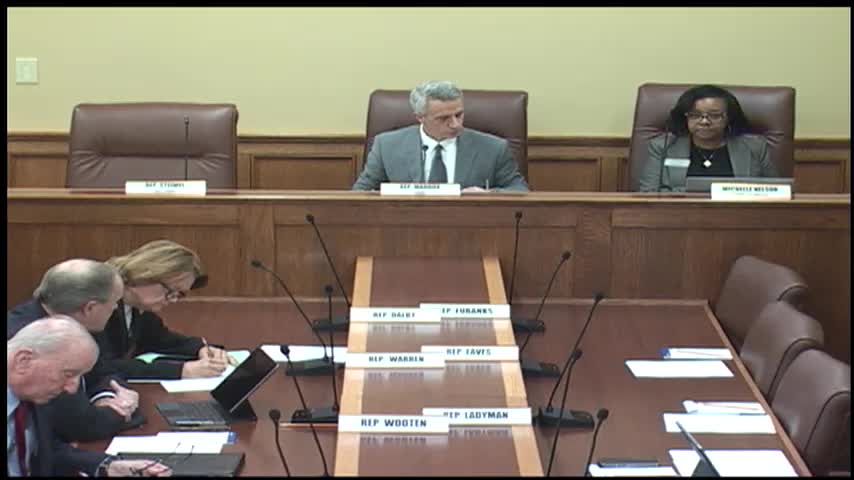
The House Insurance & Commerce Committee advanced HB 1930 after several hours of testimony from insurers, employers, and hospital executives over how the bill would set minimum reimbursement levels for health-care providers.
Insurer testimony: Representatives of major insurers urged caution. "Last year, we had 125 small businesses drop coverage," said David Mans, Arkansas Blue Cross, explaining why his company was testifying. Mans told the committee Blue Cross analyzed the bill's language and, under one interpretation, estimated significant premium increases for some groups. He said his actuaries would need more time to model the bill as amended to 45% before projecting premium impacts. Alicia Barkmeier also appeared with Arkansas Blue Cross during questioning.
Randy Zook, president of the Arkansas State Chamber of Commerce, told the committee HB 1930 "proposes mandating minimum reimbursement levels for health care providers in Arkansas" and warned the measure could shift costs to private employers and employees. Zook repeated an insurer-provided estimate that private employers and employees could see a 20–30% increase in premiums under earlier drafts and testified that such increases could lead smaller firms to drop coverage. "This is real money," he said, illustrating potential impacts using a $1,000-per-employee annual estimate provided to the chamber by an insurer.
Insurer and market analysis: Jack Hopkins of QualChoice described his firm’s method: merging the Grama report averages for neighboring states with QualChoice encounter data to estimate claims-cost impacts; QualChoice estimated roughly a 30% medical unit-cost increase for its plan under the original draft. Hopkins cautioned that comparisons must account for market differences among adjacent states.
Hospital testimony: CEOs from hospitals across Arkansas urged the committee to advance the bill to shore up struggling facilities. Matt Troop, CEO of Conway Regional, said Arkansas is one of the lowest-paid states for hospitals and that many hospitals face financial distress; he described a recent termination of a major payer contract that temporarily left patients without in-network options. Brian Thomas, CEO of Jefferson Regional in Pine Bluff, said the hospital posted a roughly 10% operating margin loss last year (about $20 million) and that cash on hand had fallen from roughly 300 days to about 160 days; he said long-term survival depends on higher commercial reimbursement. Angie Longing, president of CHI St. Vincent Morrilton, told the panel her hospital lost $2 million two years ago and more than $4 million last year as salaries and benefits rose 36% over five years while revenue declined.
Committee discussion and amendments: Committee members asked multiple technical questions about how the bill calculates the "average commercial rate" and how the 45% initial threshold in the amendment would affect premium and revenue impacts. Representative Johnson and insurer witnesses disagreed on the bill's interpretation; witnesses said the amended ramp (45%, then 55%, 65%, 75% in later years) could produce minimal revenue for some large payers in early years and larger impacts later.
Procedural actions: Representative Eubanks moved to expunge a prior voice vote related to an earlier amendment; the committee approved that motion. The committee then adopted a technical amendment clarifying the higher-education exemption. After debate and sponsor remarks emphasizing that the bill is a phased "first step" rather than a comprehensive solution, the committee voted to approve HB 1930 as amended by voice vote.
Why it matters: Committee passage moves a controversial reimbursement measure toward a House floor vote. Supporters — chiefly hospital leaders — say commercial reimbursement increases are needed to keep rural and community hospitals open; opponents — insurers and business groups — warn the bill could raise premiums for employers and employees, gravely affecting small businesses and self-funded plans.
Ending: The committee advanced HB 1930 as amended; the transcript excerpt includes testimony and committee voice votes but does not contain a roll-call tally. Additional legislative action and formal fiscal analyses will determine whether the bill’s phased thresholds materially affect premiums or hospital finances.