Get Full Government Meeting Transcripts, Videos, & Alerts Forever!
Get email alerts on the Energy Wind Siting topic
No spam. Unsubscribe anytime.
Arkansas committee adopts amendments but defeats wide-ranging wind energy regulations
Summary
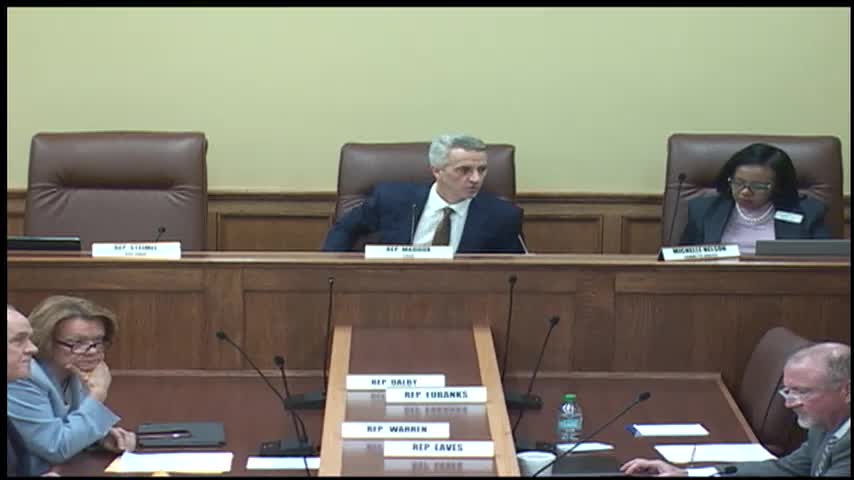
Representative Eubanks and other lawmakers debated Senate Bill 437, a comprehensive package of regulations for commercial wind energy projects in Arkansas, before the House Insurance & Commerce Committee on a late‑day hearing.
Representative Eubanks and other lawmakers debated Senate Bill 437, a comprehensive package of regulations for commercial wind energy projects in Arkansas, before the House Insurance & Commerce Committee on a late‑day hearing. The committee adopted a negotiated amendment and heard multiple witnesses on both sides before voting the bill down.
The vote followed extended public testimony about safety, land use and the economic effects of large‑scale wind projects. Proponents argued the measure fills a regulatory gap; opponents said the combined requirements would amount to a de facto moratorium on new projects outside existing developments.
The bill’s sponsor and members said the state currently has little or no siting regulation for wind projects and that SB 437 would establish statewide standards. “Right now, there is no regulation. They can put them anywhere they want to, as tall as they want to,” a sponsor told the committee during discussion of the amended language. The amendment removed a prior elevation threshold (300 feet) that had divided the state for siting rules and instead applied the bill’s requirements statewide.
Witnesses for the bill and for developers said the measure simply creates predictable rules. Robert Morey of Swift Current Energy said his firm had worked with lawmakers and stakeholders and that his in‑development projects are exempted from the new rules. “We have worked very closely with him. We are okay with this language,” he told the committee.
Opponents included timber company and agricultural aviation representatives who said the bill’s combined requirements—setbacks, hydrological study zones, visibility ("view shed") analyses, minimum setbacks from nonparticipating landowners, and other environmental and cultural protections—would make most wind development infeasible in much of Arkansas. Jackson Braswell of Weyerhaeuser warned that the bill would remove a potential revenue stream for landowners and local communities: “The legislation as drafted today would likely remove this potential revenue stream from not only us, but the communities that we live and operate in.”
Agricultural aviators pressed safety concerns. Cole Hartley, president of the Arkansas Agricultural Aviation Association, told the committee that turbines clustered throughout farmland would sharply increase risk for crop‑dusting pilots who operate at or below typical turbine heights. “If our farmland’s dotted with wind turbines, it’s not really a matter of if, but when there will be an ag aviation accident because of them,” Hartley said.
Technical provisions drew specific questions. Julie Morton, who explained several technical elements of the amended bill, said a view‑shed analysis would assess “what the physical view is going to be” from parks, historic sites and conservation lands; she said the Public Service Commission would evaluate analyses submitted by developers. Morton also described a four‑mile hydrogeological assessment requirement in some terrain, citing U.S. Geological Survey data showing that construction can affect groundwater and private wells at a distance in certain areas.
The assembled rules also included a 2,500‑foot setback from nonparticipating landowners’ property lines and optional opt‑out language for landowners who agreed to a smaller buffer. Supporters framed those protections as new rights for relatives and nonparticipating neighbors; opponents said the safeguards, combined with other restrictions, would leave little developable land.
Developers and industry groups said the bill’s cumulative effect mirrors laws in other states that have halted projects. Simon Mahan of the Southern Renewable Energy Association showed a map the committee that he said illustrated areas where the proposed restrictions would bar development and argued the package resembled a Tennessee law he described as effectively banning wind projects.
Committee action: The panel first adopted an amendment that clarified “underdevelopment,” added an effective start date for prior activity, and removed the 300‑foot elevation line that had split the state. Representative Eubanks also successfully moved to expunge an earlier amendment vote from that morning. After testimony and debate, Representative Eubanks moved to pass the bill as amended. The motion failed; the chair announced the bill had failed after members vocalized their votes at the end of the hearing.
Why it matters: The debate reflects a larger policy tension between private landowner property rights and local agricultural safety, plus state‑level interest in balancing renewable energy development against environmental, cultural and public‑safety concerns. Industry representatives said the package would sharply constrain future projects in Arkansas; opponents said the bill would protect communities and nonparticipating landowners from unregulated siting.
What’s next: Committee members noted the amendment must return to the Senate because the committee modified the version the Senate had adopted. Because the motion to pass failed in committee, the bill will not move from this committee at this time.