Get Full Government Meeting Transcripts, Videos, & Alerts Forever!
Get email alerts on the Transmission Compact topic
No spam. Unsubscribe anytime.
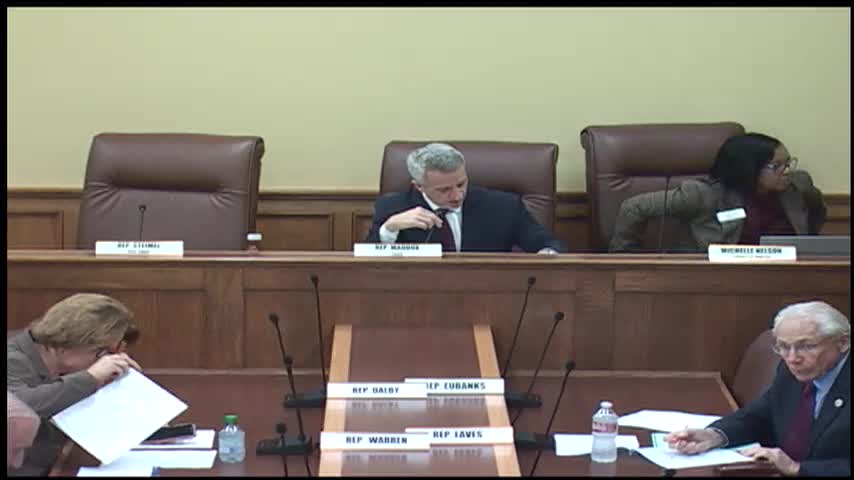
Committee debates multistate transmission compact; sponsor withdraws bill for study
Summary
Representative Zach Graemeck presented legislation to create a multi‑state transmission council aimed at lowering the cost and speeding construction of high‑voltage transmission lines, but withdrew the bill for further study after extensive questions about authority, cost, and overlap with regional planners.
Representative Zach Graemeck presented legislation to authorize an interstate compact to coordinate siting, permitting and long‑range planning for high‑voltage transmission lines in the Mid‑South region. The bill would create a multi‑state transmission council charged with preparing annual reports and recommending changes to state rules and laws intended to lower the cost and shorten timelines for constructing new transmission capacity.
The sponsor said the compact is intended to “lower the cost of the construction, new high voltage transmission infrastructure, and facilitate the expansion of transmission capacity through cost effective transmission planning and siting and construction,” and stressed the proposal would not itself build projects or displace regional transmission organizations (RTOs). He also said the compact requires additional states to join before it would have practical effect and described the bill as a “first step” to enable regional conversation about permitting and siting.
Supporters at the table included Mike Adair of American Powerplay, who described his organization as an advocacy group and said the compact would be “purely a vehicle for communication, formal communication between the states to reach recommendations for a desired end of reducing red tape to building.” Micah Derry, also with the advocacy group, urged faster planning to address what he described as a national energy shortfall.
Opponents, including John Bethel of Entergy Arkansas, said the compact as drafted overlapped with work already done by regional transmission organizations and planners such as the Midcontinent Independent System Operator (MISO) and the Southwest Power Pool (SPP). Bethel told the committee that both organizations have regional committees and offices “in Little Rock that are accessible” and questioned whether a new compact would add value.
Committee members focused on three recurring concerns: whether the compact would create new regulatory obligations for member states; the meaning of mandatory or “shall” language in the compact’s principles; and potential costs and administrative burdens. Representative Dolby and others pointed to draft language in article 5 that says member states “shall allow and shall streamline regulatory review,” and asked whether that phrasing would limit a state’s ability to opt out or preserve its regulatory authority.
The sponsor and supporters repeatedly said the compact would not displace state regulatory authorities or the Public Service Commission (PSC). Graemeck referenced article 4 language that “shall not be construed to displace any regulatory responsibilities of the existing relevant electric rate regulatory authority” and noted state legislatures would retain authority to accept or reject any recommendations coming from the compact. Mike Adair said the compact includes a principle requiring open competitive bids for construction and that existing transmission rights‑of‑way could be used or upgraded to reduce the need for new corridors.
Several legislators requested more time to vet the bill’s language, financial impacts and interactions with MISO/SPP. Representative Gramlich, Representative Wooten, Representative Lademan and Representative Dolby asked for clarification on severability, membership, who would staff the council, and whether the compact could bind a state to financial commitments. The sponsor said any financial commitments would depend on later actions by member states and emphasized that the compact’s committee would only make recommendations.
After extended questioning and public comments from Entergy, the sponsor announced he would withdraw the bill from consideration and file it as an interim study (ISP) for further work. "After speaking with counsel, I think what we're gonna do is we're gonna pull this bill, and we're gonna, submit it as an ISP and come back to this in the future," he told the committee.
What happened next: the sponsor removed the bill for further drafting and study. No vote on adoption of the compact was taken.
Why it matters: supporters framed the proposal as a state‑led, regional approach to cut permitting delays and control costs as the region plans for new generation and load growth; opponents warned it might duplicate existing RTO planning and could contain mandatory language with unclear effects on state law and spending.
Speakers quoted in this article are drawn from the committee hearing transcript and include Representative Zach Graemeck (bill sponsor), Mike Adair (American Powerplay), Micah Derry (American Powerplay) and John Bethel (Entergy Arkansas). The bill was withdrawn and will be returned as an interim study for further review.
Ending note: The committee did not vote on the compact. Sponsors and critics said they want additional time to refine language on authority, cost sharing and the legal relationship between the compact and state constitutions.