Get Full Government Meeting Transcripts, Videos, & Alerts Forever!
Get email alerts on the Street Lighting Policy topic
No spam. Unsubscribe anytime.
House committee advances bills to update Arkansas street-lighting rules, set color and fixture standards
Summary
Rep. Meeks’ bills, which clear older language and set new fixture and color-temperature standards for utility-installed street lighting, passed the House Insurance and Commerce Committee after discussion about costs, health effects and local control.
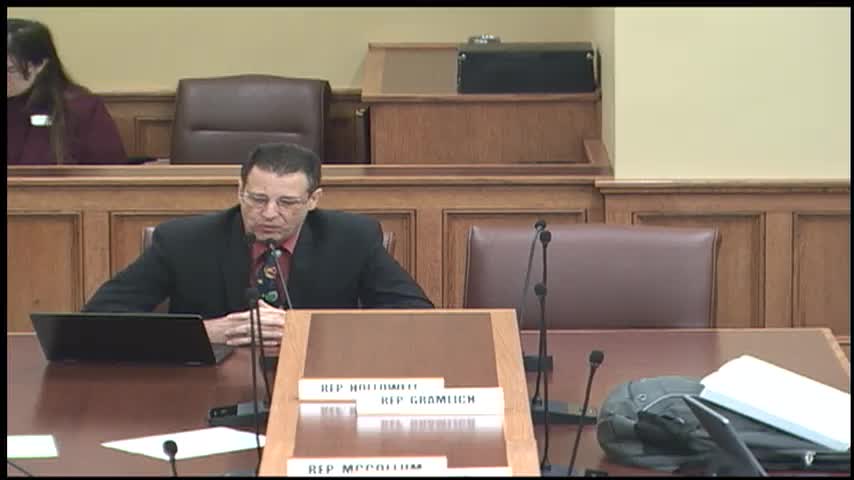
The House Insurance and Commerce Committee on Tuesday voted to pass legislation from Rep. Jayme Meeks to modernize Arkansas’ Shielded Outdoor Lighting Act and to repeal obsolete 1990s language.
Meeks told the committee the bills remove municipalities and co-ops from the state law, apply the rules to Entergy Arkansas when it installs brand-new street-light systems, require fully shielded fixtures and set color-temperature limits: 4,000 Kelvin for main thoroughfares and 3,000 Kelvin in residential areas. “We’re not saying that we’re going to rip out all the lights,” Meeks said. “This is when you install brand‑new equipment.”
The measure also would require illumination be designed to meet guidance from the Illumination Engineering Society and add exemptions for historic districts, sports facilities, monuments, correctional and mental‑health facilities and other locally sensitive uses. It would allow Entergy to install compliant fixtures and recover costs through its rate schedule before the next rate case so the company can offer those fixtures to local governments without waiting for a formal rate‑case cycle.
Entergy’s John Bethel, director of public affairs, told the committee that the company will identify compliant fixtures and file rates with the Public Service Commission; Bethel said the company does not yet have a single dollar figure for the incremental cost of those fixtures but noted they typically have higher upfront costs and lower lifetime energy and maintenance costs than older technology. “Those fixtures are more expensive, but over the long run they’re cheaper because they’re more energy efficient and have less maintenance,” he said.
Rep. Meeks cited public‑health literature in broad terms, saying studies have linked nighttime blue‑rich light to sleep disruption and to higher risks in hormone‑driven cancers and that lowering color temperature in neighborhoods can reduce that effect. He said the bill’s intent is to “provide plenty of light for safety and security, but it’s a much healthier light for our citizens as they’re trying to sleep.” Committee members pressed on cost and whether retrofitting existing systems would be required; Meeks and Bethel said the bills apply to new installations, not an immediate replacement of all existing fixtures.
Supporters argued the bills preserve local control because cities could adopt ordinances to exempt specific projects that need a different approach. Critics on the committee raised questions about potential placement and overall costs to municipalities and businesses; Bethel said the industry is moving toward LED fixtures regardless of the bills, and customers already face fixture upgrades as older technologies are phased out.
The committee adopted an amendment adding a Senate sponsor and then approved both measures on voice votes. Rep. Richardson moved the “do pass” motion for the primary modernization bill; the committee passed both bills as amended.
The bills now move to the full House for further consideration.