Get Full Government Meeting Transcripts, Videos, & Alerts Forever!
Get email alerts on the Student Behavior Mental Health topic
No spam. Unsubscribe anytime.
Committee advances pilot for mental‑health crisis teams to serve students whose behavior risks harm
Summary
The committee approved Senate Bill 451 to pilot multi‑agency mental‑health crisis response teams for students exhibiting violence or severe behavioral threats; sponsors said the pilot will be limited to 500 students and carry an estimated state fiscal impact in the millions, split between education and Medicaid funding.
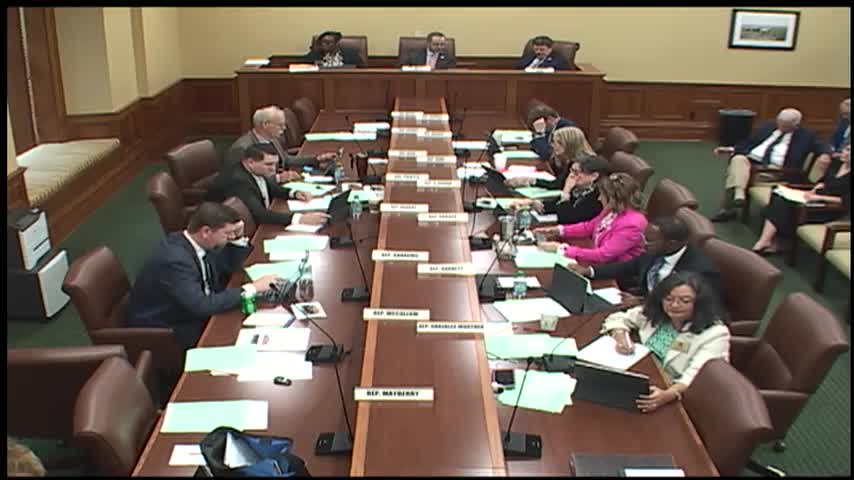
The Arkansas House Education Committee voted to advance Senate Bill 451, a pilot program that would create mental‑health crisis response teams to evaluate and provide short‑term intensive services for students who “demonstrate behavior that is substantially likely to cause injury,” sponsors and agency officials said.
Representative Scott Richardson, who presented the bill to the committee, described it as a targeted, costly but necessary intervention. “This bill provides that the Department of Education, along with the Department of Health, work together, to create mental health crisis response teams,” Richardson said. He told members the pilot would be limited to 500 students and estimated the initial annual cost at about $4 million, and that the program is intended to bring students back into less‑restrictive school settings as quickly as possible.
Department of Education staff and Department of Human Services officials briefed the committee on the mechanics and fiscal implications. Courtney Salas Ford of the Department of Education said the ALE (alternative learning environment) funding that pays per‑student educational costs would follow students into any new program, and that ADE’s fiscal note reflects a worst‑case projection for ALE reimbursement. Greg Rogers (Department of Education) and DHS Secretary Christie Putnam explained how Medicaid and other payors could cover clinical services: “It is a $4,000,000 Medicaid state share cost,” Secretary Putnam told the committee, while noting a range depending on service length and mix of payors.
DHS’s Melissa Weatherton described operational options and the prior programs that inform the pilot. The department said some service concepts come from earlier day‑treatment models and from in‑home family‑centered treatment pilots; the new effort would attempt to blend what worked into a stepped model so students can receive intensive services, then step down to reintegration into standard school classrooms.
On funding, witnesses and sponsors said the pilot will affect ADE’s ALE appropriation and require coordination between ADE and DHS. The committee received a fiscal breakdown in which ADE’s potential exposure was modeled as up to roughly $12 million moved within the existing ALE pool (the note used a worst‑case scenario), while DHS estimated a Medicaid state‑share cost in the neighborhood of $4 million with an upper range as high as $8 million depending on the length of placement (three versus six months in models discussed).
Supporters described classroom safety and learning disruption as the rationale. Richardson said the pilot is intended to provide services earlier and reduce the need for longer residential placements later. Multiple committee members urged careful attention to student privacy, to anti‑targeting measures and to ensuring teachers and students are not stigmatized by placement in an intensive program.
The committee approved the bill by voice vote after extended discussion. Sponsors and agency staff said the pilot will require additional implementation work and interagency rule‑making or guidance if the bill advances.
What’s next: The bill moves to the House floor. Committee members asked ADE and DHS to continue refining fiscal estimates and to provide implementation detail before the bill advances further.
Speakers quoted or referenced: Representative Scott Richardson (House District 13), Courtney Salas Ford (Arkansas Department of Education), Greg Rogers (Arkansas Department of Education), Christie Putnam (Secretary, Arkansas DHS), Melissa Weatherton (DHS).