Get Full Government Meeting Transcripts, Videos, & Alerts Forever!
Get email alerts on the Public Safety topic
No spam. Unsubscribe anytime.
Goodyear police recommend phased build of city real‑time crime center; council asks for budget details
Summary
Police Chief Brian Nissitt told the Goodyear City Council on March 17 that the police department has completed a strategic‑plan task to study creation of a Real Time Crime Center and recommended moving forward with a two‑phase implementation beginning in the FY 2026 budget process.
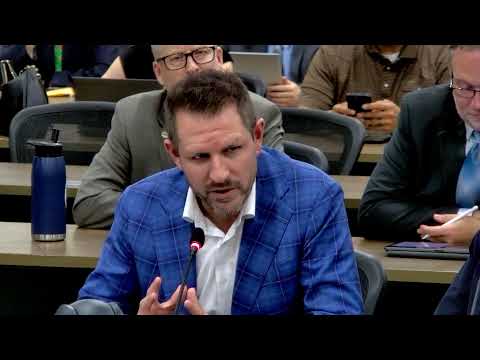
Police Chief Brian Nissitt told the Goodyear City Council on March 17 that the police department has completed a strategic‑plan task to study creation of a Real Time Crime Center and recommended moving forward with a two‑phase implementation beginning in the FY 2026 budget process. "For me, the most important question to ask when discussing any project is the why," Nissitt said, describing how the center would centralize camera feeds, records data and analytical tools to give officers timely operational intelligence.
The nut graf: Chief Nissitt said a stand‑alone Goodyear RTCC would improve response safety and case solvability and allow collaboration with fire and emergency management. He recommended a Phase 1 build inside the city’s Emergency Operations Center and asked council to support including Phase 1 in the upcoming budget so staff can plan costs and procurement.
Nissitt cited national evaluations showing RTCCs can improve clearance rates and reduce response times, and described site visits to departments that operate similar centers. He proposed two phases: Phase 1 would buy a platform and hardware, integrate the city’s CAD (computer aided dispatch) and RMS (records management system), integrate city cameras and the Flock analytics system, and staff an initial team of one officer, one tactical dispatcher, one crime analyst and a systems engineer. Phase 2 would add hardware for community/private camera integration, implement a drone‑first‑responder program and add two tactical dispatchers, one crime analyst and one civilian supervisor.
Council members pressed for technical and policy details. On data retention, the chief initially said camera footage had been held for periods such as 72 and 180 days depending on use, but the council clarified that the city’s traffic camera retention follows the Arizona State Library schedules and the traffic camera policy adopted by the city: general traffic camera footage is retained 14 days unless pulled for an investigation, after which different retention schedules apply. Director Faizyan of IT described segregated networks and role‑based access to reduce exposure; she said chief’s staff would determine which PD personnel could access RTCC systems.
Nissitt described current Flock analytics activity: roughly 11,000 inter‑agency NCIC hits in the past year and about 1,200 vehicles entered by Goodyear detectives, which yielded 12 arrests — a solvability rate he characterized as "a little less than 1 percent." He said an RTCC could allow staff to locate vehicles on cameras in real time and vector officers to effect arrests rather than relying on manual circulation after a notification.
On drones, the chief gave specifications discussed with vendors: some systems use single drones with about a 45‑minute flight time and battery swaps; others use a hive model with roughly 20‑minute flights and rotating units. He said vendors report speeds near 45 mph and zoom/resolution capability that can read license plates at significant distances, which would let crews get eyes on scene before patrol arrives.
Costs and timing: staff estimated Phase 1 operating costs at about $1.4 million annually and a one‑time CIP request "a little over $500,000" for initial hardware and integration; staff said Phase 1 implementation might take roughly 18 months and Phase 2 an additional 18 months. The council asked for a Gantt chart and clearer phased cost breakdowns prior to final budget votes. No formal budget appropriation or ordinance was adopted at the meeting.
Privacy, community outreach and regional options were recurring topics. Council members asked whether the city had explored a regional RTCC with neighboring police agencies and whether cameras would be limited to major signalized intersections; Nissitt said he had discussed regional options with nearby chiefs but recommended a standalone Goodyear center due to prioritization and proximity considerations. He also said the department plans community education and a "virtual block watch" to offer opt‑in participation by businesses and residents. Several council members said site visits to existing centers (Glendale and others) had shaped their support.
What happened next: staff requested council consensus to include a Phase 1 RTCC package in the manager’s recommended FY 2026 budget; council did not take a formal vote at the work session but directed staff to return budget and scope details. Council members asked for explicit Phase 2 costs and grant‑search updates before approval of final appropriations.
Ending: Council members generally voiced support for pursuing Phase 1 but repeatedly requested more specific budget figures, a project timeline and community outreach plans before committing funds. Staff said they would provide cost breakdowns, a Gantt schedule and details on CAD/RMS integration options during the upcoming budget cycle.
"The possibilities of collaboration are literally endless with this type of technology at our fingertips," Nissitt said during his presentation.