Get Full Government Meeting Transcripts, Videos, & Alerts Forever!
Get email alerts on the Rocky Glades Quarry topic
No spam. Unsubscribe anytime.
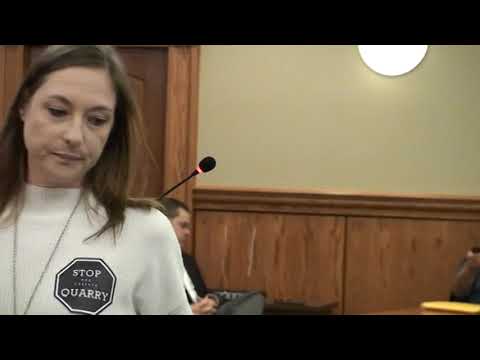
Casita residents tell ADEM proposed Rocky Glades quarry threatens wells, air, roads and wildlife
Summary
At a public hearing before the Alabama Department of Environmental Management, residents from Casita and nearby areas urged the agency to deny the Rocky Glades quarry permit, citing risks to groundwater and private wells, air quality and health, endangered species, and local roads — and flagging inconsistencies in the draft permit documents.
Residents and community leaders told the Alabama Department of Environmental Management at a public hearing that the proposed Rocky Glades granite quarry could lower groundwater, contaminate streams, worsen air quality and damage local roads, and urged ADEM to reject or tighten the draft permit.
Speakers described a fractured-rock aquifer that supplies dozens of private wells near the site and said blasting or quarrying could “hit a fracture” and reduce well yields or make wells unusable. Rebecca Massey, a resident who said she lives less than a mile from the proposed site, said of quarry dust: “That dust affects everyone within miles.”
The concerns were not limited to private wells. Patricia Robertson Smith and other residents pointed to inconsistencies in the quarry application and the ADEM draft permit, including different statements of hours of operation and which pollutants would be subject to emission testing. “Which is correct? The Rocky Glades application or the ADEM preconstruction analysis?” Smith asked, noting one document lists 10 hours per day and another allows, quote, “other hours may include operation 24 hours a day, 7 days a week.”
Speakers gave numerical and technical details they said supported their objections. Commenters said there are roughly 50–55 private wells within a two-mile radius of the site and described well depths varying from about 30 feet to as much as 500–600 feet, depending on where drillers intersect water-bearing fractures. One speaker summarized local water delivery rates cited at a community well meeting: “wells in the immediate 1 mile radius provide an excess of 20,000 gallons per day” for cattle and “household wells provide approximately 3,000 gallons per month.” Several speakers warned that surface waters named during testimony — including Double Branch and nearby creeks that flow to Lake Harding and Saugahatchee Lake — could receive quarry runoff.
Multiple commenters raised public-health and environmental threats tied to dust and blasting. Carla Robertson Williamson, who described herself as immunocompromised after a kidney transplant, said blasting and removal of topsoil would release silica dust along with fungal spores and other contaminants and warned of harm to people and livestock. Cameron Douglas Williamson, a retired senior master sergeant in the Alabama Air National Guard, described chronic lung disease he attributes to environmental exposures and said he feared similar harms for his children living near the proposed site.
Community organizations and services expressed particular concern. Dina Little, founder and executive director of Storybook Farm, told ADEM that the nonprofit serves thousands of vulnerable children and that “unavoidable dust pollution” passing by the farm would be dangerous for children with compromised immune and respiratory systems. Little also said she had been told the permit application mentions contributions to Storybook Farm and local schools; she said Storybook Farm would not accept money tied to the quarry.
Speakers also flagged permit-document errors and enforcement questions. Patricia Robertson Smith cited the draft permit’s Pollution Abatement/Preconstruction Analysis and the SPCC (spill prevention, control and countermeasure) plan and said contact information in the application appears incorrect — listing a fire department in Widowie roughly 40 miles away and a sheriff’s office phone number for a local water contact. Smith and others asked how ADEM would measure compliance with dust-control promises such as wetting trucks before departure, and why volatile organic compounds would not be required to be tested when visible emissions testing is specified in appendix materials.
Local infrastructure impacts were a recurring theme. Russell Bland called County Road 389 a narrow, aging tar-and-gravel road with sinking culverts and said heavy truck traffic required for quarry operations would “destroy” the road and could isolate parts of the community if culverts fail. Bland asked that the Chambers County Commission be given time to study road impacts with the Alabama Department of Transportation and the Alabama Department of Public Safety.
Several speakers referenced species and habitat concerns. Commenters said state and federal biologists have identified protected species and that a US Fish and Wildlife biologist had noted Georgia rockcress appears on maps for the Casita area but is not listed in the permit. One speaker told ADEM that four threatened or endangered species were identified in the permit and that additional state-protected species occur within five miles downstream of the site, citing work by the Alabama Department of Conservation and Natural Resources.
No formal vote or agency decision occurred at the hearing. The department’s hearing officer reminded attendees that the public comment period would remain open until 5:00 p.m. on Friday, 05/09/2025, and that ADEM would consider oral and written arguments before making a determination and preparing responses to relevant comments.
The public comment record as described by speakers includes allegations of potential groundwater depletion or contamination, untested or under-tested airborne pollutants, errors or gaps in contact and permit documents, and possible harm to vulnerable groups and local infrastructure. ADEM did not make a decision at the close of the hearing; the agency’s staff will review written and oral comments and notify the public of its determination.