Get Full Government Meeting Transcripts, Videos, & Alerts Forever!
Get email alerts on the Convention Center Modernization topic
No spam. Unsubscribe anytime.
Mesa staff present study to modernize Convention Center, amphitheater and adjacent hotel; consultants propose outdoor event patio, larger lobby and enhanced rig
Summary
Andrea Moore, director of Parks, Recreation and Community Facilities, told the Mesa City Council that consultants had completed a draft facility improvement study for the Mesa Convention Center and Mesa Amphitheatre and that a 190‑page report was available on the council agenda.
Andrea Moore, director of Parks, Recreation and Community Facilities, told the Mesa City Council that consultants had completed a draft facility improvement study for the Mesa Convention Center and Mesa Amphitheatre and that a 190‑page report was available on the council agenda.
The study, presented by Tyler Oton of Convention Sports & Leisure, recommends targeted, phased investments to improve the city’s ability to attract higher‑value, multi‑day conventions and more commercially competitive concerts. "This is an older building," Oton said, noting the center’s origins in the 1970s–80s and several size and amenity constraints.
Why it matters: consultants and local hotel ownership told the council the center and the amphitheater are drawing more interest than a few years ago, but Mesa is losing potential business to newer or higher‑amenity venues in the Valley. The study estimates about $79.8 million in additional direct spending over 20 years from new, net‑new events and about $133 million in total economic output; the consultants and hotel owner said those gains would primarily benefit downtown businesses and hotel room nights.
Key findings and recommended capital moves
- Market context and demand: Oton said the study team interviewed more than 65 event planners, promoters and conference organizers and reviewed dozens of peer facilities. He told council that pre‑pandemic Mesa hosted about 15 high‑impact conferences in 2019 and 26 in 2024 — a 70% increase driven in part by coordinated sales efforts between the city, the hotel and Visit Mesa.
- Physical constraints: the consultants identified the hotel’s 274 rooms and the convention center’s ballroom sizing as a constraint. The convention center’s main hall can be used for trade shows (about 15,000 sq ft) while the hotel ballroom is about 9,700 sq ft, which planners said is small for many food‑function needs at high‑impact conferences.
- Convention center upgrades: recommended scenarios range from lower‑cost “surgical” upgrades to larger investments. A leading, lower‑cost recommendation is a 7,000–8,000 sq ft expanded lobby/atrium tied to the hotel entrance to provide natural light, better circulation and a launch point for downtown wayfinding. The study also highlights outdoor event space — a three‑season patio with retractable doors, high‑end lighting and integrated AV — as attractive to newer generations of meeting planners who prefer flexible, experiential settings.
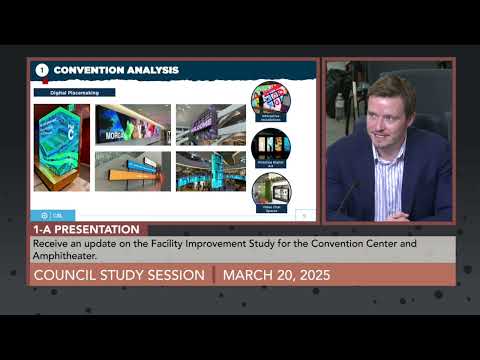
- Immersive technology and placemaking: the report proposes digital placemaking (LED panels, projection mapping) to create programmed experiences and to better connect the convention district to downtown (the report repeatedly cites a need to strengthen the route to the MIX/ASU area and downtown pedestrian connections).
- Amphitheatre improvements: for the Mesa Amphitheatre the consultants recommended improved backstage hospitality and artist green room space, upgraded rigging capacity to handle modern production loads, additional fan shading, enhanced VIP offerings and better ADA access. The study said these are generally lower‑cost than the larger convention center scenarios but are important to retain touring shows.
Hotel partnership and private investment
Randy McGrane, owner/manager of the Delta Hotel, described the property as interdependent with the public facilities and said the hotel has invested about $15 million since purchase in 2018. McGrane said he is negotiating with Marriott about a brand upgrade and intends further hotel investments in food and beverage and breakout space that would complement the public improvements. "We are embedded in the middle of essentially a civic center and a convention center," McGrane said.
Council reaction and next steps
Council members pressed staff and the consultant for financing and phasing details. Several members asked for clearer cost estimates and funding options; staff said a follow‑up finance analysis would be prepared. Mayor and staff characterized the presentation as a planning study and asked finance staff to return with a funding and phasing plan. Council did not vote on capital authorization during the meeting.
What was not decided
No formal appropriation, bond authorization or specific project financing was approved at the meeting. Council members repeatedly requested additional cost breakdowns and potential funding paths including use of bed tax, public‑private partnerships and phased capital approaches.
Ending
City staff left the council with a clear next task: return with a financing/phasing plan and cost estimates tied to the scenarios presented. The consultants emphasized the market opportunity to attract more high‑value conventions and upgraded concert bookings if the city pairs fiscal commitment with the hotel and private programming partners.