Get Full Government Meeting Transcripts, Videos, & Alerts Forever!
Get email alerts on the Utilities Utility Billing topic
No spam. Unsubscribe anytime.
Council updates utility billing rules: wholesale rate used for leak relief, new abnormal-event relief and deadline for storm-related adjustments
Summary
City amended code to use the Tampa Bay wholesale water rate for leak and event adjustments, added up-to-10,000-gallon relief for abnormal events and created a 60-day emergency window for relief following a declared emergency; staff said they have cleared a backlog of delayed bills and are updating application forms.
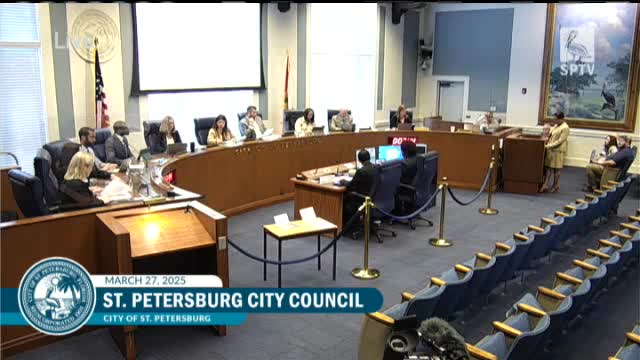
The St. Petersburg City Council unanimously adopted an ordinance amending Chapter 27 of the city code to change how the city calculates relief for unusually high water bills and to add new categories of relief for accidents, vandalism and storm-related events.
Under the ordinance, when staff grant a leak or event adjustment the city will calculate commodity charges using the Tampa Bay wholesale water rate ($2.64 per 1,000 gallons) instead of the city’s lowest residential block rate (previously $3.79). The ordinance also authorizes water-and-sewer relief for up to 10,000 gallons for qualifying abnormal events and creates a 60-day window of relief for billing periods that fall within or immediately after a declared state or local emergency.
Candace Winter, Billing and Collections director, told the council that staff have updated the city’s adjustment applications and applied the newer rules retroactively where appropriate. "As of yesterday, we are all caught up and there are no more delayed bills," Winter said, reporting that the billing backlog that affected some customers has been cleared.
Council discussion focused on how the revised rules will be applied administratively, how the city will detect mechanical meter errors, and whether customers will be proactively contacted when staff identify eligible relief. Claude Tankersley, public works administrator, and utility staff told the council the city replaces meters that are defective and that digital meter reads can be pulled to identify high-read events. David, a member of the billing-review team, said staff had already applied adjustments to many recent applicants: "For the March meeting we had 42 people on the agenda and right off the bat we were able to apply adjustments for 21 of them." He said UBRC (the utility billing review committee) meetings will continue and that the revised application may allow the department to approve more adjustments without referring every case to UBRC.
The ordinance follows earlier council resolutions adopted in February that created and clarified several adjustment policies, including the definition of the adjustment period for storm-surge or flooding events and a correction to a typographical error in a separate mechanical-meter procedure. Staff said the updated leak-adjustment application and the revised UBRC forms are available online and that customers who qualify for reductions have been notified directly.
During public comment earlier in the meeting several residents and local advocates had pressed council for more answers about billing anomalies and refunds; multiple speakers urged stronger oversight of billing systems and faster communication with affected residents. Council members repeatedly urged staff to ensure clear outreach to customers and to continue refining the review process.
Council voted 9-0 to adopt the ordinance and to approve companion resolutions updating the department’s policies and procedures.
What’s next: staff said it will continue direct outreach to qualifying customers, publish FAQs and outreach materials, and bring routine UBRC agendas as needed. Customers who want to dispute bills should use the updated bill review and adjustment form on the city website; many routine cases will be handled administratively and routed to UBRC only when required.