Get Full Government Meeting Transcripts, Videos, & Alerts Forever!
Get email alerts on the Trails Crossing Master Plan topic
No spam. Unsubscribe anytime.
St. Petersburg council approves master plan work for Trails Crossing park under I‑275, 7‑1
Summary
City council voted 7‑1 to authorize contracts and a funding agreement to produce a master plan for Trails Crossing, a project to activate underused land beneath I‑275 and better connect the Pinellas Trail with adjacent districts. The vote follows questions about parking impacts for existing businesses, particularly Vertical Ventures.
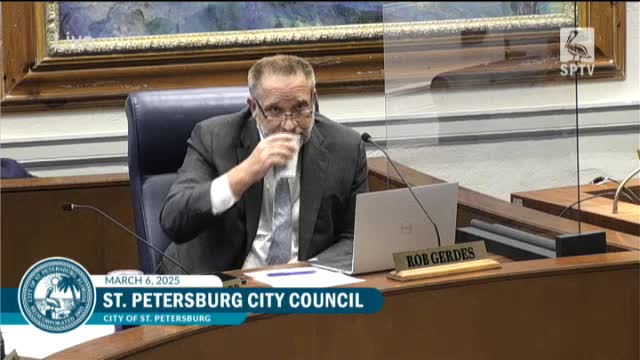
St. Petersburg city council on March 5 approved a resolution allowing the city to execute agreements to create a master plan for Trails Crossing, a proposed cultural park and trail connection under I‑275, passing the item 7‑1 with Councilmember Vic Sanders voting no.
The master plan will guide design, phased implementation, and long‑term maintenance for the four‑block stretch roughly between First Avenue North and Third Avenue South under I‑275. "Trails Crossing is a community‑initiated request for a concept that transforms and improves underutilized land under I‑275 to connect the Pinellas Trail with adjacent districts," Cheryl Stacks, the city’s transportation manager, said during the presentation to council.
The plan will be produced by a consultant after the city completed a solicitation for architecture and engineering services; Land Design Inc. was identified as the most qualified firm and will deliver data collection, community engagement, design workshops, and a draft and final master plan. As presented, the city and the nonprofit Friends of Trails Crossing will each contribute up to $150,000 toward the contract and related administration costs; the city’s share is already appropriated, and the Friends’ funding would be phased under the attached funding agreement.
Supporters, including John Barquette, a business and property owner and co‑founder of Friends of Trails Crossing, told council the project could knit together the Grand Central District, the historic gas plant area, the Warehouse Arts District, Palmetto Park and Kenwood while activating a long‑neglected corridor. "This is more than a park," Barquette said. "It's a cultural landmark in the making." He urged council to move forward with the master‑planning work.
Council discussion focused on implementation details and potential effects on nearby businesses that rely on existing surface parking. Several council members said they supported the project but pressed staff for assurances about how to preserve parking for Vertical Ventures, a climbing gym that leases nearby lots and whose customers depend on those spaces. Stacks and other staff explained the master plan will include a maintenance, operations and governance strategy and that stakeholder outreach will be part of the consultant’s scope.
Administration staff noted some current parking arrangements are governed by existing use agreements and lease terms. Staff said portions of the JDMU surface lots currently contribute to approximately 7,000 surface parking spaces used by the Rays and Hines developments and that those arrangements are expected to continue for the next several years; any significant construction or reconfiguration would be phased to accommodate those uses. Staff also said the Vertical Ventures lease had been extended short term and that the administration was open to negotiating additional extensions while the master plan work proceeds.
Councilmember Mike Harding said he was "fully supportive of the project" while reiterating the need to protect existing businesses. Councilmember Gina Driscoll described the project as a long‑sought opportunity to reclaim underused urban space and stressed the master plan should align with federal and local grants and complete‑streets approaches. Councilmember Vic Sanders cast the lone no vote, citing concerns that the city had not secured firm commitments to protect businesses that rely on the parking.
The approved resolution authorizes execution of the AE contract, the funding agreement with Friends of Trails Crossing, and related documents needed to initiate the master‑planning work. With the consultant under contract, staff said they will begin the community engagement process and produce short‑, medium‑ and long‑term phasing recommendations and a governance plan spelling out maintenance responsibilities.
The master plan will also consider zoning and land‑use recommendations, utilities and stormwater resilience, parking and circulation needs, and strategies to fund implementation. Staff said the consultant will research funding models used in comparable projects — including public‑private partnerships — and will recommend avenues for private and public financing in later project phases.
Councilmembers and staff emphasized the project will be implemented in phases and that the master plan will be subject to public review before any construction. The master plan resolution passed 7‑1; staff will return with further milestones as the consultant completes community engagement and deliverables.