Get Full Government Meeting Transcripts, Videos, & Alerts Forever!
Get email alerts on the Public Health topic
No spam. Unsubscribe anytime.
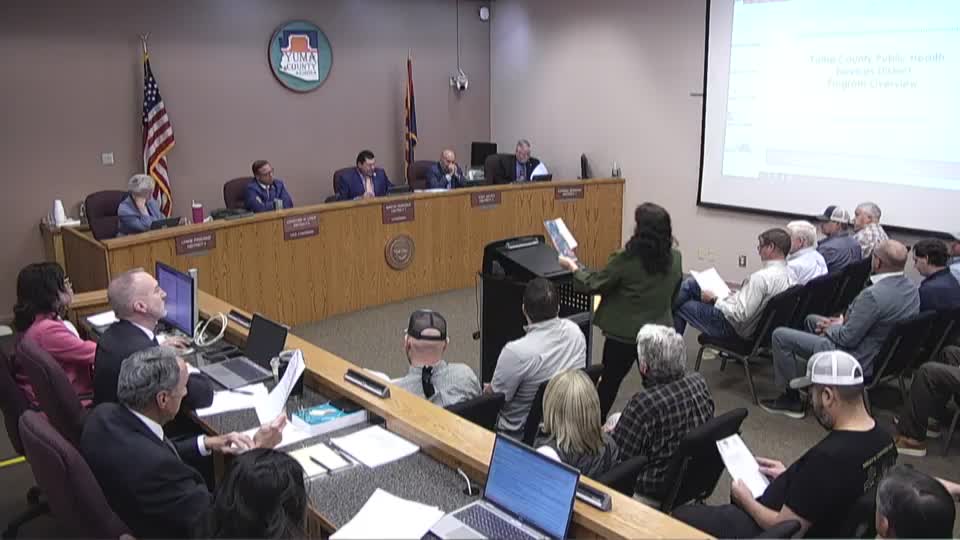
Yuma County public health director outlines services and warns of federal grant risk
Summary
Director Diane Gomez gave the Board an overview of the Public Health Services District’s programs — from WIC and immunizations to vector control and maternal-child health — and said about half the department’s budget depends on federal and state grants that could be cut, creating a planning and cash-flow risk for county services.
Diane Gomez, director of the Yuma County Public Health Services District, described a broad set of county-run programs on Monday and told the Board the department relies substantially on federal and state grant funding.
Gomez told supervisors the department runs routine services such as WIC nutrition and vaccination clinics, birth- and death-certificate services, environmental health inspections and mosquito control as well as programs for maternal-child health, youth wellness, opioid and suicide fatality review teams, and emergency preparedness exercises. "People are used to our WIC program or the vaccination, but it's a pretty busy department," she said.
The director framed the department’s budget risk. "About 52% of our operations is funded through the district funding, and the other half is roughly a combination of federal and state grants. So about 40% is federal grants," Gomez said, noting that many outreach and community programs, including WIC and maternal-child services, are grant-supported.
Why it matters: Gomez said federal pass-through grant structures create a cash-flow vulnerability because the county or its subcontractors perform work and later request reimbursement. She described a recent episode when a grant office issued then rescinded guidance on work, creating fear for partners about paying staff and vendors in the interim.
Board members asked how deep cuts would affect local services. Gomez said reductions would force either program shrinkage, fee increases for county services that are currently subsidized by grants, or both. "If those go away, either programming will have to shrink back or some of these fees ... will have to go up or both," she said.
Gomez emphasized cooperative work with nonprofits, academic partners (including University of Arizona and University of California research partnerships) and municipalities to maintain services such as community immunization clinics, cooling centers for heat resiliency and outreach to farmworkers. She also outlined the department’s role in animal control, including rabies control and licensing now handled in-house.
Staffing and statutory duties: Gomez said the district must carry out statutorily mandated services and that some programs exist specifically to satisfy those requirements while others are supplemental community services. She referenced fatality-review teams for child, opioid and suicide deaths and said the health department participates in binational public-health coordination with counterparts across the border.
What comes next: Gomez said staff will continue to seek federal grants and pursue academic partnerships to support programming, and that the board’s awareness and public discussion of funding dynamics is important to local planning. She answered supervisors’ questions about specific programs and said the department was preparing contingency plans but that uncertainty makes long-term planning difficult.
For now, Gomez characterized operations as "business as usual" while the department watches federal developments and pursues alternate funding and partnerships.