Get Full Government Meeting Transcripts, Videos, & Alerts Forever!
Get email alerts on the Stadium Repairs topic
No spam. Unsubscribe anytime.
St. Petersburg approves $22.5M roof replacement for Tropicana Field amid legal and community concerns
Summary
City Council voted 7–1 to approve a guaranteed maximum price and related funding to replace Tropicana Field's upper roof, moving forward with a roughly 10‑month fabrication and installation schedule after extensive technical review with Major League Baseball and the Rays.
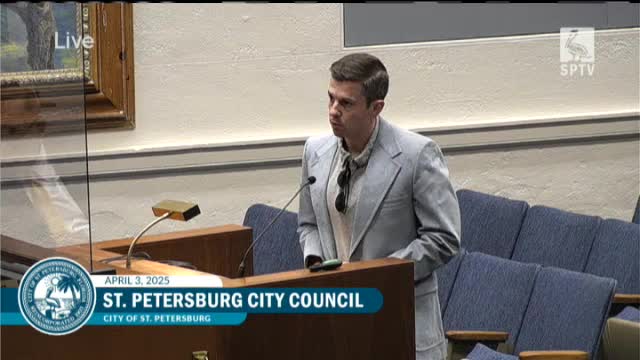
St. Petersburg City Council on April [date not specified] approved two resolutions to fund and authorize a guaranteed maximum price (GMP) for replacement of the top roof at Tropicana Field, the city-owned stadium long used by the Tampa Bay Rays. The council approved the funding resolution (F3A) and the GMP amendment/assignment (F3B) by roll call, with seven votes in favor and one opposed (Councilmember Richie Floyd voted no). The votes were 7–1 for each resolution.
Council members and staff said the work is necessary under the city’s existing use agreement with the Rays and Major League Baseball and that the replacement must meet current Florida Building Code wind and safety standards before the stadium can host regular-season games. Raul Quintana, director of City Engineering and Capital Improvements, told council staff and MLB consultants had tested acoustical and lighting performance for the replacement membrane and that both MLB and the Rays provided written approval of the selected white PTFE roof material.
The resolution package included a GMP in the neighborhood of $22 million for the roof work and related contract conditions; staff identified a project total estimate that remains in a broader range previously presented to council. Quintana described the GMP cost breakdown in staff remarks: roughly $19.3 million for the core construction work, subcontract fabrication and installation of the membrane (fabricated in Europe and assembled in China), plus contractor general conditions, bonds, insurance and contingencies that bring the contract sum to approximately $22.5 million. Council documents and staff remarks also referenced a supplemental appropriation and interfund transfers totaling about $23,000,000 to cover initial payments and related expenses; exact line‑item accounting for later packages remains subject to subsequent council approvals.
Quintana and Beth Herndine, managing director in City Development Administration, outlined a construction schedule staff described as roughly 10 months for fabrication and installation. Fabrication and assembly will begin after council authorization; staff said bundles of membrane will be air‑freighted to the U.S. in multiple deliveries, with the first bundle expected to arrive in August and installation work continuing through November with a final waterproofing target in December. Installation steps described to council include perimeter rigging and temporary netting, staged unfurling of prefabricated membrane bundles, progressive tensioning and cable systems, and final waterproofing. City staff and the construction manager said the contractor will bear responsibility for on‑site construction work and for performance during the work; once complete, the roof and warranties will be the city's asset.
Council debate focused on three recurring concerns: (1) whether the city had alternatives to performing the work given an acrimonious relationship with the Rays and uncertainty over the franchise’s future use; (2) tariff and supply risks for material manufactured abroad (staff said the GMP includes a $100,000 tariff allowance in the contractor scope but that staff will seek additional detail from subcontractors); and (3) acoustics and lighting without the original liner (staff and consultants told council they expect different acoustic qualities but said the stadium's audio and lighting systems can be adjusted to produce acceptable game‑day conditions). Several council members asked for further breakdowns of subcontractor costs and for prompt follow‑up on the tariff exposure after recent changes in U.S. tariff policy.
A member of the public speaking by Zoom, Ron Diner, urged council to withhold approval pending a new negotiation to end the use agreement with the Rays; he argued the city should use insurance funds to pursue redevelopment. Council and administration responded that prior settlement discussions had focused on a new stadium and that administration judged a settlement that avoided FEMA and insurance reimbursement to be financially unfavorable to the city. Legal counsel reminded council that the existing use agreement creates obligations the city must satisfy unless a negotiated settlement is reached.
Council member comments ranged from pragmatic support — to avoid litigation and meet contract obligations — to insistence that staff return quickly with tighter cost breakdowns for the subsequent work packages, which staff said they would do. Staff said subsequent bid packages will follow and that the next expected package for council review is the vertical metal panels (interior/exterior), targeted for May, with additional packages for architectural finishes, playing turf and netting, sports lighting and audio‑visual/low‑voltage to follow.
Votes at the council meeting recorded on the floor show the two Tropicana items passed by roll call: F3A (funding appropriation/initial release) passed 7–1 (Driscoll; Fick Sanders; Gabbard; Gerdes; Givens; Hanowitz; Harding — yes; Floyd — no). F3B (assignment/first amendment and GMP approval) passed 7–1 with the same vote split.
Why it matters: the vote obligates the city to repair the stadium roof under its current legal commitments and moves the largest single repair package into procurement and construction. The work is time‑sensitive for the stadium schedule, introduces international fabrication and tariff risk, and will be followed by additional expensive packages for lighting, audio‑visual systems and interior repairs — all items councilors asked to see with greater cost specificity before future votes.
The council directed staff to return with more detailed subcontractor cost breakdowns, tariff exposure analysis and the next bid packages in the weeks ahead.
Ending: With the two resolutions approved, city leaders said crews will begin pre‑installation steps this summer and that staff will return to council with subsequent packages and further financial details. Councilmember Richie Floyd cast the lone no vote on both items; several council members reiterated a preference to continue exploring settlement options if the Rays or MLB present acceptable terms in the future.