
Fulton County Schools report 87,054 students for 2024–25, project modest decline over five years
Get AI-powered insights, summaries, and transcripts
Subscribe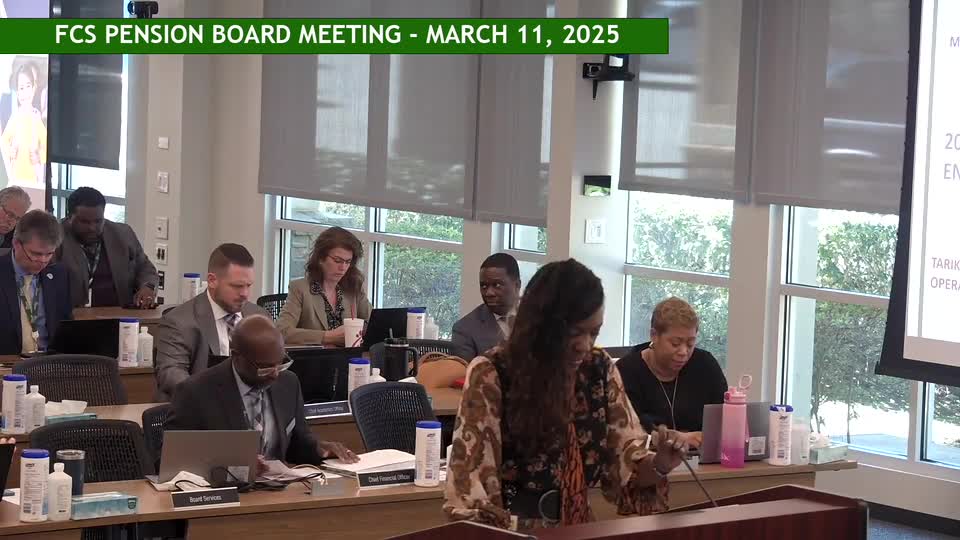
Summary
District officials told the school board the district enrolled 87,054 students for 2024–25, a decline of 818 from the prior year, and presented a five‑year forecast that projects continued but slowing declines tied to larger graduating classes, smaller kindergarten cohorts and regional housing trends.
Fulton County Schools’ executive director of operational planning, Tarika Peaks, told the school board on March 11 that the district enrolled 87,054 students for the 2024–25 school year, a decline of 818 students from the previous year.
Peaks said the most significant driver of the decline is cohort dynamics: this year the district counted about 7,000 12th‑graders and roughly 5,000 kindergartners, so larger exiting classes exceed smaller incoming kindergarten cohorts. The district’s three planning regions and the Fulton Academy of Virtual Excellence (FAVE) all showed regional variation: South Region enrollment was roughly 32,348 (up 4 students), Sandy Springs declined by 207 to about 8,700 students, and the North Region fell by about 538 to nearly 46,000 students. FAVE declined by 77 to 387 students.
The projections rely on a modified cohort model that progresses students forward grade‑to‑grade and applies three sets of factors: birth factors to estimate incoming kindergarten cohorts; grade‑level mobility to capture resales, private‑school returns and general in‑/out migration; and residential development forecasts to model students coming from new housing. Peaks said the district uses municipal rezoning filings, third‑party quarterly sales data and a district database of “student yields” by housing type and attendance boundary to estimate how many students new home closings will generate.
Using those inputs, Peaks presented a five‑year forecast that anticipates a districtwide decline of roughly 1,023 students in 2025–26 (to 86,031) and more than 3,300 fewer students over the next five years. She said the rate of decline slowed compared with last year (this year’s first‑month count was down 818 vs. last year’s 1,851 decline), a trend the presentation attributed in part to cohort growth and to active residential development in the South Region (the district reported tracking more than 59,000 active, pending and approved housing units systemwide and expects nearly 16,000 new homes in the South Region over the next ten years).
Board members asked for methodological detail. Ms. Dove (board member) asked how the district calculates home inventory and converts new homes into projected student counts; Ms. Huff (staff member) said new‑home counts come from rezoning approvals and municipal planning filings, sales are tracked by a third‑party vendor, and the district applies historical student‑yield rates (by housing type and school attendance boundary) and an absorption schedule to lag projected units into the year students are expected to appear. Ms. Warren (Vice President) and other board members asked how the model accounts for resales and nontraditional housing; staff said resales are captured via grade‑level mobility factors, and new rental‑style large single‑family homes are being tracked though staff has not yet changed yield rates for those newer product types.
Board members also asked about private and charter school reporting. Peaks noted private school counts are self‑reported and only include schools that respond to the district survey. Doctor Looney (superintendent) added that private schools are legally required to report but the district cannot compel full compliance; the district reports what it receives.
Why this matters: the projection informs capital planning and potential rezoning. Board members raised capacity concerns in rapidly developing areas — for example, Ms. Warren noted growth near Hall Road/Union City that could push Renaissance Elementary and Renaissance Middle toward or above state capacity by the end of the decade. Peaks said the capital plan and future rezoning remain options if materialized growth requires them.
The presentation concluded with staff direction to continue coordinating with municipal planning departments, monitor birth and mobility data, and update yields annually. No formal board action was taken on the enrollment presentation itself.