Get Full Government Meeting Transcripts, Videos, & Alerts Forever!
Get email alerts on the Agenda Management topic
No spam. Unsubscribe anytime.
Clerk's office explains agenda-setting, reconvened meetings and limits on regular meeting frequency
Summary
Borough clerk detailed how agenda items are scheduled, chairs' role in setting agendas, how reconvened meetings work and the code limit of quarterly regular meetings unless changed by ordinance or by mayor/assembly action.
The Fairbanks North Star Borough clerk's office reviewed how boards and commissions arrange agendas, add items and handle unfinished business.
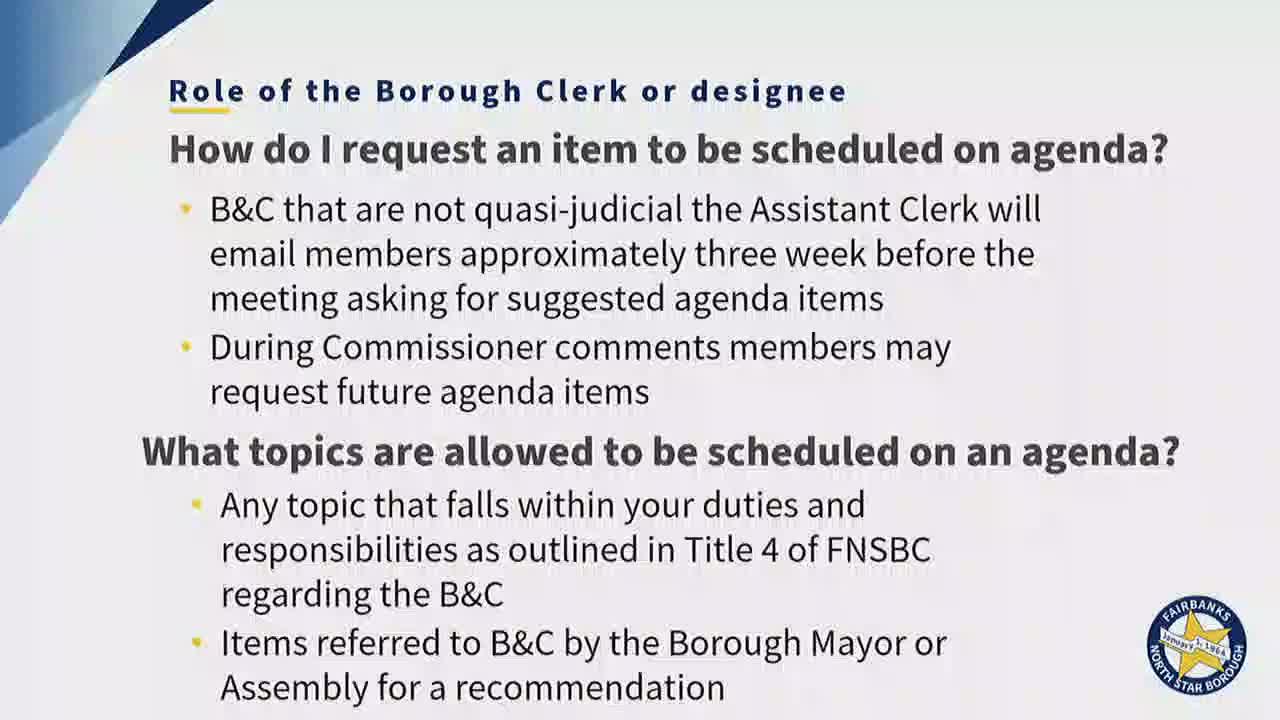
April Tricke said assistant clerks email members about suggested agenda items roughly three weeks before a meeting so clerks and chairs can finalize the agenda and provide adequate public notice. She reminded commissioners that chairs decide whether an item is within the board's duties and can be put on the agenda. "It's ultimately the person who makes a decision whether it goes on the agenda," Tricke said.
Tricke described reconvened (continuation) meetings as a standard option when a regularly noticed meeting cannot finish its agenda. A reconvened meeting continues the original publicly noticed agenda and does not require a new five‑day notice if it is a direct continuation; clerks may still publish notice when practicable. "A reconvene meeting is a continuation of an already public noticed meeting," she said.
On meeting frequency, Tricke said borough code limits most boards to quarterly regular meetings unless law requires more frequent meetings or the assembly or mayor requests additional sessions. Commissioners who want a permanent change in frequency must request a code amendment from an assembly member; for short-term needs the mayor's office can request a special meeting by memo to clerks.
Tricke encouraged commissioners to work with clerks early when they need additional meetings or have complex agenda items so staff can manage public notice and scheduling.